


Primary treatment of pelvic organ prolapse: pessary use versus prolapse surgery
- PMID: 28600758
- PMCID: PMC5754400
- DOI: 10.1007/s00192-017-3372-x
Primary treatment of pelvic organ prolapse: pessary use versus prolapse surgery
Abstract
Introduction and hypothesis: The objective of this study was to compare the functional outcomes after pessary treatment and after prolapse surgery as primary treatments for pelvic organ prolapse (POP).
Methods: This was a prospective cohort study performed in a Dutch teaching hospital in women with symptomatic POP of stage II or higher requiring treatment. Patients were treated according to their preference with a pessary or prolapse surgery. The primary endpoint was disease-specific quality of life at 12 months follow-up according to the prolapse domain of the Urogenital Distress Inventory (UDI) questionnaire. Secondary outcomes included adverse events and additional interventions. To show a difference of ten points in the primary outcome, we needed to randomize 80 women (power 80%, α 0.05, taking 10% attrition into account).
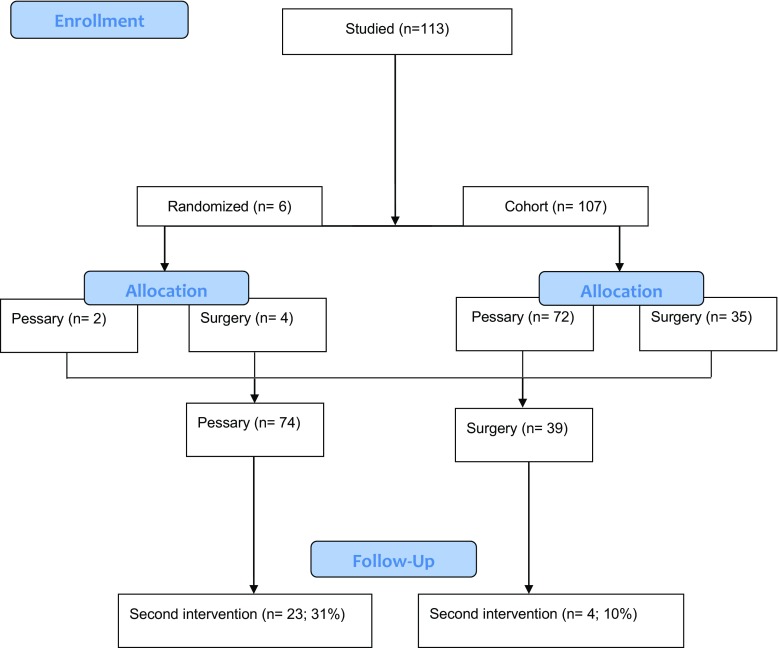
Results: We included 113 women (74 in the pessary group, 39 in the surgery group). After 12 months, the median prolapse domain score was 0 (10th to 90th percentile 0-33) in the pessary group and 0 (10th to 90th percentile 0-0) in the surgery group (p < 0.01). Differences in other domain scores were not statistically significant. In the pessary group, 28% (21/74) of the women had a surgical intervention versus 3% (1/39) reoperations in the surgery group (p = 0.01).
Conclusions: In women with POP of stage II or higher undergoing surgery, prolapse symptoms were less severe than in those who were treated with a pessary, but 72% of women who were treated with a pessary did not opt for surgery.
Trial registration number: Dutch trial register NTR2856.
Keywords: Pelvic organ prolapse; Pessary; Prolapse surgery.
Conflict of interest statement
Conflicts of interest
None.
Ethical approval
The study was approved by the ethics committee of the Máxima Medical Centre.
References
-
- Slieker-ten Hove MC, Pool-Goudzwaard AL, Eijkemans MJ, Steegers-Theunissen RP, Burger CW, Vierhout ME. The prevalence of pelvic organ prolapse symptoms and signs and their relation with bladder and bowel disorders in a general female population. Int Urogynecol J Pelvic Floor Dysfunct. 2009;20:1037–1045. doi: 10.1007/s00192-009-0902-1. - DOI - PMC - PubMed
Publication types
MeSH terms
LinkOut - more resources
Full Text Sources
Other Literature Sources
Medical
