


Loose regulation of medical marijuana programs associated with higher rates of adult marijuana use but not cannabis use disorder
- PMID: 28600874
- PMCID: PMC5735415
- DOI: 10.1111/add.13904
Loose regulation of medical marijuana programs associated with higher rates of adult marijuana use but not cannabis use disorder
Abstract
Background and aims: Most US states have passed medical marijuana laws (MMLs), with great variation in program regulation impacting enrollment rates. We aimed to compare changes in rates of marijuana use, heavy use and cannabis use disorder across age groups while accounting for whether states enacted medicalized (highly regulated) or non-medical mml programs.
Design: Difference-in-differences estimates with time-varying state-level MML coded by program type (medicalized versus non-medical). Multi-level linear regression models adjusted for state-level random effects and covariates as well as historical trends in use.
Setting: Nation-wide cross-sectional survey data from the US National Survey of Drug Use and Health (NSDUH) restricted use data portal aggregated at the state level.
Participants: Participants comprised 2004-13 NSDUH respondents (n ~ 67 500/year); age groups 12-17, 18-25 and 26+ years. States had implemented eight medicalized and 15 non-medical MML programs.
Measurements: Primary outcome measures included (1) active (past-month) marijuana use; (2) heavy use (> 300 days/year); and (3) cannabis use disorder diagnosis, based on DSM-IV criteria. Covariates included program type, age group and state-level characteristics throughout the study period.
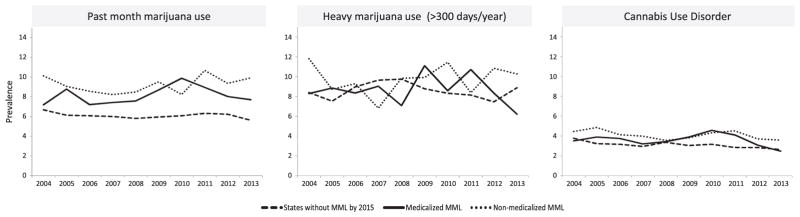
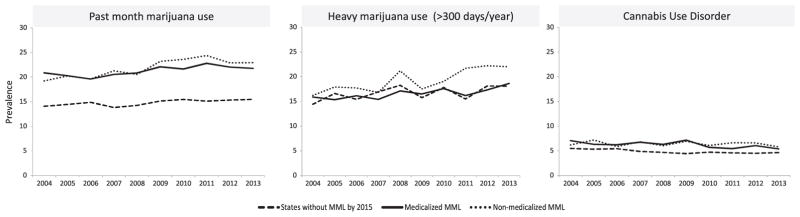
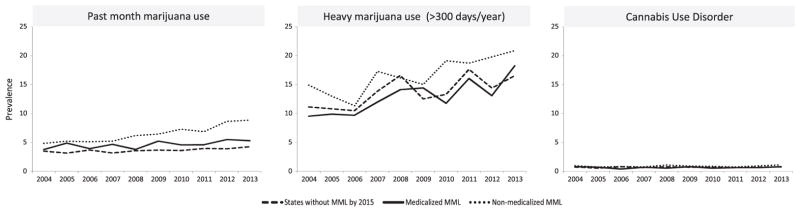
Findings: Adults 26+ years of age living in states with non-medical MML programs increased past-month marijuana use 1.46% (from 4.13 to 6.59%, P = 0.01), skewing towards greater heavy marijuana by 2.36% (from 14.94 to 17.30, P = 0.09) after MMLs were enacted. However, no associated increase in the prevalence of cannabis use disorder was found during the study period. Our findings do not show increases in prevalence of marijuana use among adults in states with medicalized MML programs. Additionally, there were no increases in adolescent or young adult marijuana outcomes following MML passage, irrespective of program type.
Conclusions: Non-medical marijuana laws enacted in US states are associated with increased marijuana use, but only among adults aged 26+ years. Researchers and policymakers should consider program regulation and subgroup characteristics (i.e. demographics) when assessing for population level outcomes. Researchers and policymakers should consider program regulation and subgroup characteristics (i.e. demographics) when assessing for population level outcomes.
Keywords: Adolescent drug use; cannabis use disorder; epidemiology; marijuana; medical marijuana laws; public health; state policy.
© 2017 Society for the Study of Addiction.
Conflict of interest statement
None.
Figures
References
-
- Williams AR. Medical and recreational marijuana policy: from prohibition to the rise of regulation. In: Compton M, editor. Marijuana and Mental Health. Arlington, VA: American Psychiatric Publishing Inc; 2016. pp. 39–70.
-
- Wen H, Hockenberry JM, Cummings JR. The effect of medical marijuana laws on adolescent and adult use of marijuana, alcohol, and other substances. J Health Econ. 2015;42:64–80. - PubMed
MeSH terms
Substances
Grants and funding
LinkOut - more resources
Full Text Sources
Other Literature Sources
Medical
Miscellaneous
