Glucose Self-monitoring in Non-Insulin-Treated Patients With Type 2 Diabetes in Primary Care Settings: A Randomized Trial
- PMID: 28600913
- PMCID: PMC5818811
- DOI: 10.1001/jamainternmed.2017.1233
Glucose Self-monitoring in Non-Insulin-Treated Patients With Type 2 Diabetes in Primary Care Settings: A Randomized Trial
Abstract
Importance: The value of self-monitoring of blood glucose (SMBG) levels in patients with non-insulin-treated type 2 diabetes has been debated.
Objective: To compare 3 approaches of SMBG for effects on hemoglobin A1c levels and health-related quality of life (HRQOL) among people with non-insulin-treated type 2 diabetes in primary care practice.
Design, setting, and participants: The Monitor Trial study was a pragmatic, open-label randomized trial conducted in 15 primary care practices in central North Carolina. Participants were randomized between January 2014 and July 2015. Eligible patients with type 2 non-insulin-treated diabetes were: older than 30 years, established with a primary care physician at a participating practice, had glycemic control (hemoglobin A1c) levels higher than 6.5% but lower than 9.5% within the 6 months preceding screening, as obtained from the electronic medical record, and willing to comply with the results of random assignment into a study group. Of the 1032 assessed for eligibility, 450 were randomized.
Interventions: No SMBG, once-daily SMBG, and once-daily SMBG with enhanced patient feedback including automatic tailored messages delivered via the meter.
Main outcomes and measures: Coprimary outcomes included hemoglobin A1c levels and HRQOL at 52 weeks.
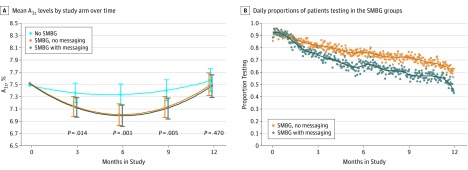
Results: A total of 450 patients were randomized and 418 (92.9%) completed the final visit. There were no significant differences in hemoglobin A1c levels across all 3 groups (P = .74; estimated adjusted mean hemoglobin A1c difference, SMBG with messaging vs no SMBG, -0.09%; 95% CI, -0.31% to 0.14%; SMBG vs no SMBG, -0.05%; 95% CI, -0.27% to 0.17%). There were also no significant differences found in HRQOL. There were no notable differences in key adverse events including hypoglycemia frequency, health care utilization, or insulin initiation.
Conclusions and relevance: In patients with non-insulin-treated type 2 diabetes, we observed no clinically or statistically significant differences at 1 year in glycemic control or HRQOL between patients who performed SMBG compared with those who did not perform SMBG. The addition of this type of tailored feedback provided through messaging via a meter did not provide any advantage in glycemic control.
Trial registration: clinicaltrials.gov Identifier: NCT02033499.
Conflict of interest statement
Figures

Comment in
-
The Need to Test Strategies Based on Common Sense.JAMA Intern Med. 2017 Jul 1;177(7):929. doi: 10.1001/jamainternmed.2017.1251. JAMA Intern Med. 2017. PMID: 28600912 No abstract available.
-
Der Effekt der Blutzuckerselbstmessung bei Typ-2-Diabetes scheint nicht so gross wie oft angenommen.Praxis (Bern 1994). 2017 Aug;106(16):893-894. doi: 10.1024/1661-8157/a002762. Praxis (Bern 1994). 2017. PMID: 28795627 German. No abstract available.
-
Routine Glucose Self-Monitoring Unnecessary for Non-Insulin-Treated Patients with Type 2 Diabetes.Am J Nurs. 2017 Sep;117(9):55-56. doi: 10.1097/01.NAJ.0000524549.73814.ca. Am J Nurs. 2017. PMID: 28837492 No abstract available.
-
Self-monitoring of blood glucose did not improve HbA1c or QoL at 1 year in non-insulin-treated type 2 diabetes.Ann Intern Med. 2017 Oct 17;167(8):JC46. doi: 10.7326/ACPJC-2017-167-8-046. Ann Intern Med. 2017. PMID: 29049765 No abstract available.
-
Concerns About Conclusions of Self-monitoring of Blood Glucose.JAMA Intern Med. 2017 Dec 1;177(12):1873-1874. doi: 10.1001/jamainternmed.2017.6142. JAMA Intern Med. 2017. PMID: 29204633 No abstract available.
-
Concerns About Conclusions of Self-monitoring of Blood Glucose-Reply.JAMA Intern Med. 2017 Dec 1;177(12):1874-1875. doi: 10.1001/jamainternmed.2017.6152. JAMA Intern Med. 2017. PMID: 29204640 No abstract available.
-
Commentary: Glucose Self-monitoring in Non-Insulin-Treated Patients With Type 2 Diabetes in Primary Care Settings: A Randomized Trial.Front Endocrinol (Lausanne). 2018 Jul 12;9:389. doi: 10.3389/fendo.2018.00389. eCollection 2018. Front Endocrinol (Lausanne). 2018. PMID: 30050503 Free PMC article. No abstract available.
References
-
- American Diabetes Association 5. Glycemic targets. Diabetes Care. 2016;39(suppl 1):S39-S46. - PubMed
-
- Allemann S, Houriet C, Diem P, Stettler C. Self-monitoring of blood glucose in non-insulin treated patients with type 2 diabetes: a systematic review and meta-analysis. Curr Med Res Opin. 2009;25(12):2903-2913. - PubMed
-
- Clar C, Barnard K, Cummins E, Royle P, Waugh N. Aberdeen Health Technology Assessment Group . Self-monitoring of blood glucose in type 2 diabetes: systematic review. Health Technol Assess. 2010;14(12):1-140. - PubMed
-
- Farmer AJ, Perera R, Ward A, et al. Meta-analysis of individual patient data in randomised trials of self monitoring of blood glucose in people with non-insulin treated type 2 diabetes. BMJ. 2012;344:e486-e486. - PubMed
-
- Malanda UL, Welschen LM, Riphagen II, Dekker JM, Nijpels G, Bot SD Self-monitoring of blood glucose in patients with type 2 diabetes mellitus who are not using insulin. Cochrane Database of Systematic Reviews. http://onlinelibrary.wiley.com.libproxy.lib.unc.edu/doi/10.1002/14651858.... Login required. Accessed April 9, 2017. - PMC - PubMed
Publication types
MeSH terms
Substances
Associated data
Grants and funding
LinkOut - more resources
Full Text Sources
Other Literature Sources
Medical