


Validity of humerus fracture classification in the Swedish fracture register
- PMID: 28601085
- PMCID: PMC5466790
- DOI: 10.1186/s12891-017-1612-3
Validity of humerus fracture classification in the Swedish fracture register
Abstract
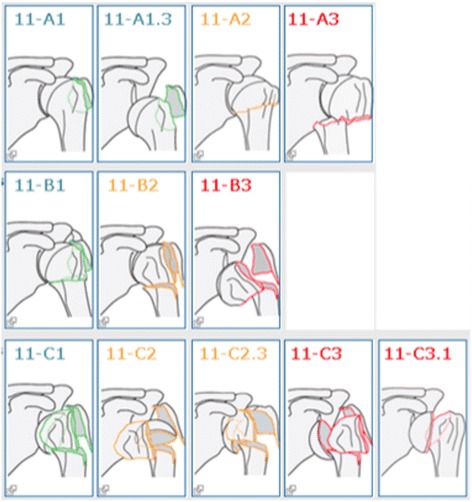
Background: The ability to correctly classify fractures is of importance for choosing the appropriate treatment and for providing appropriate data for research and quality registers. In the Swedish Fracture Register (SFR) fractures of all types are registered by the attending physician, often a junior doctor. For the majority of fractures, a modified AO/OTA classification is used. This study aimed to validate the accuracy of classification of humerus fractures in the SFR and also at providing insight into inherent classification uncertainties.
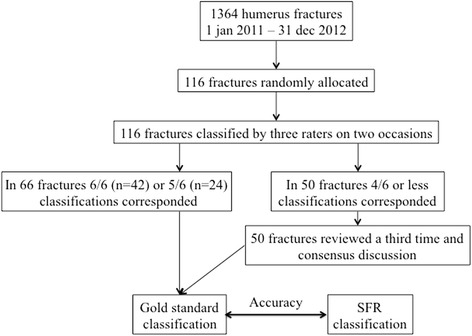
Methods: One hundred and sixteen humerus fractures (among them 90 proximal) were retrieved by computer randomisation from the SFR and reassessed independently at two occasions, 6 weeks apart, by three senior orthopaedic surgeons blinded to patient information and a consensus "gold standard" classification was established. This was compared with the classifications that had been entered into the register.
Results: The agreement between gold standard classification and original classification in the SFR was kappa = 0.57 for all humerus fractures. For proximal humerus fractures kappa-coefficient for intra-observer agreement was 0.593, 0.599 and 0.752 for the three observers respectively. Taking into account the similarities between certain fracture groups, a modified calculation of agreement was performed. With this modification the intra-observer agreement was 0.910-0.974 and inter-observer agreement was 0.912.
Conclusion: The classification of humerus fractures in the Swedish Fracture Register was just as accurate as in previous studies, i.e. moderate as defined by Landis and Koch. However, when we introduced a modified analysis, that takes into account the similarities between certain fractures, the accuracy was "near perfect".
Keywords: Accuracy; Agreement; Fracture classification; Fracture register; Humerus fracture; Validity.
Figures
References
-
- Müller M, Koch P, Nazarian S, Schatzker J. The comprehensive classification of fractures of long bones. Berlin, Heidelberg, New York: Springer-Verlag; 1990.
Publication types
MeSH terms
LinkOut - more resources
Full Text Sources
Other Literature Sources
Medical
