


The role of neighborhood economic context on physical activity among children: Evidence from the Geographic Research on Wellbeing (GROW) study
- PMID: 28601623
- PMCID: PMC10627422
- DOI: 10.1016/j.ypmed.2017.06.007
The role of neighborhood economic context on physical activity among children: Evidence from the Geographic Research on Wellbeing (GROW) study
Abstract
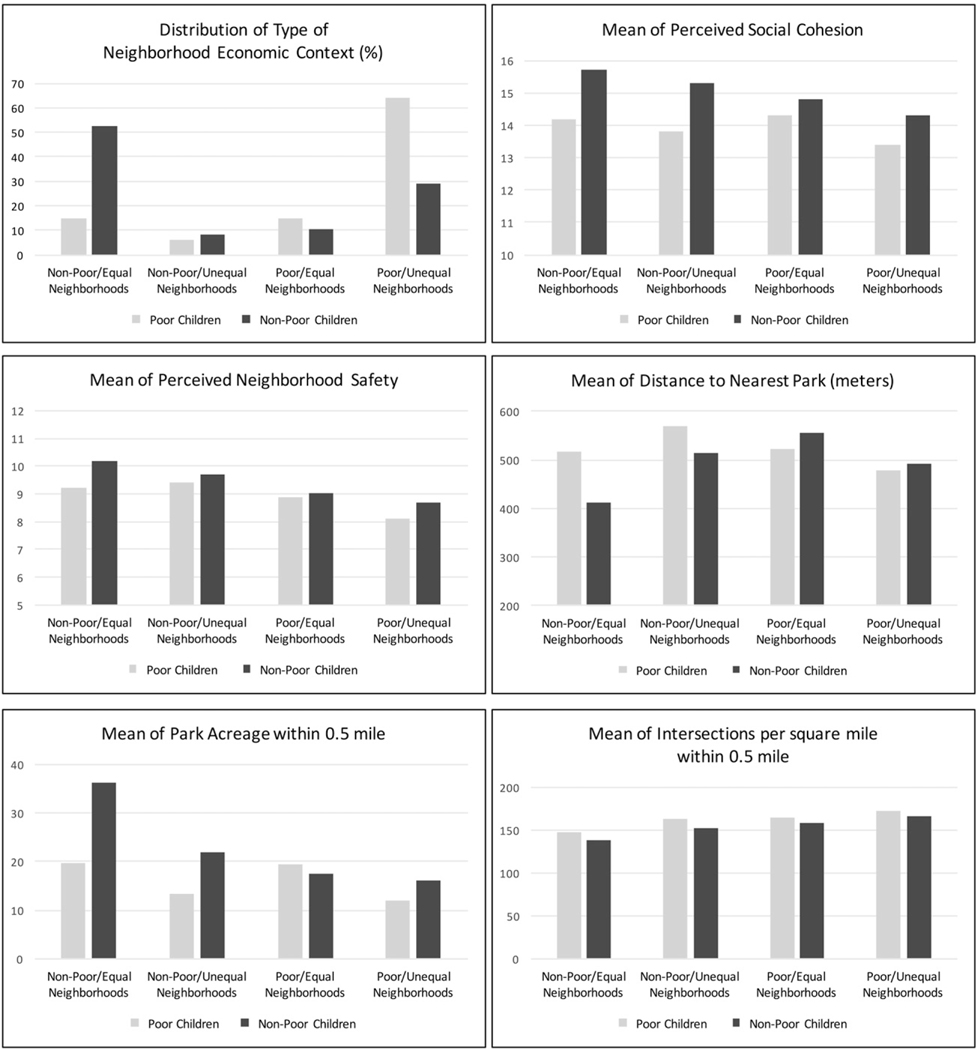
Less than half of young children in the U.S. meet physical activity recommendations. While neighborhood economic context has been shown to be associated with physical activity, it is unknown whether this association varies according to family economic context. This study thus investigates whether neighborhood economic context, measured by poverty concentration and income inequality, are associated with physical activity among poor and non-poor children using data from the Geographic Research on Wellbeing study, California, 2012-2013 (N=2670). Poor children who resided in (a) poor and equal neighborhoods or (b) non-poor and equal neighborhoods were more likely to engage in sufficient physical activity than were children residing in non-poor and unequal neighborhoods. Poor children in (a) non-poor and equal neighborhoods, (b) poor and equal neighborhoods, or (c) poor and unequal neighborhoods were less likely to report insufficient physical activity than those in non-poor and unequal neighborhoods. Neighborhood economic context was not associated with physical activity among non-poor children. Findings suggest that neighborhood economic context presents a social barrier to physical activity among poor children. Increasing physical activity among poor children in non-poor and unequal neighborhoods should be a high policy priority. Perceived social cohesion, perceived neighborhood safety, and park and walkability indicators did not mediate the associations between neighborhood economic context and physical activity. Further research needs to explore the mechanisms by which neighborhood economic context affects physical activity among children.
Keywords: Neighborhood economic context; Neighborhood income inequality; Neighborhood poverty; Physical activity.
Copyright © 2017 Elsevier Inc. All rights reserved.
Figures
References
-
- Aber JL, Bennett NG, Conley DC, Li J, 1997. The effects of poverty on child health and development. Annu. Rev. Public Health 18 (1), 463–483. - PubMed
-
- Alvarado SE, 2011. The Effect of Neighborhood Context on Obesity and Educational Achievement Among Youth. University of Wisconsin – Madison.
-
- Babey SH, Tan D, Wolstein J, Diamant AL, 2015. Neighborhood, family and individual characteristics related to adolescent park-based physical activity. Prev. Med. 76, 31–36. - PubMed
-
- Baron RM, Kenny DA, 1986. The moderator–mediator variable distinction in social psychological research: conceptual, strategic, and statistical considerations. J. Pers. Soc. Psychol. 51 (6), 1173–1182. - PubMed
MeSH terms
Grants and funding
LinkOut - more resources
Full Text Sources
Other Literature Sources
Medical
