


Trends in Environmental Tobacco Smoke (ETS) Exposure and Preterm Birth: Use of Smoking Bans and Direct ETS Exposure Assessments in Study Designs
- PMID: 28602080
- PMCID: PMC5536243
- DOI: 10.1021/acs.chemrestox.7b00054
Trends in Environmental Tobacco Smoke (ETS) Exposure and Preterm Birth: Use of Smoking Bans and Direct ETS Exposure Assessments in Study Designs
Abstract
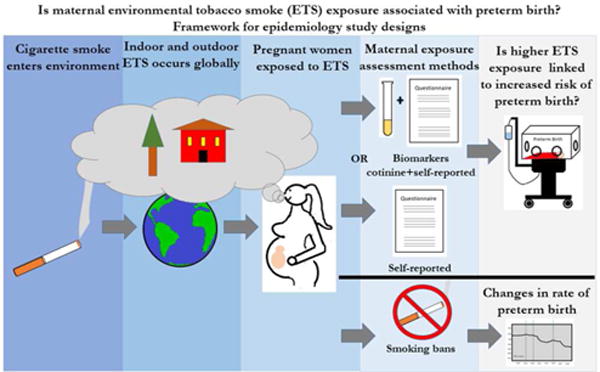
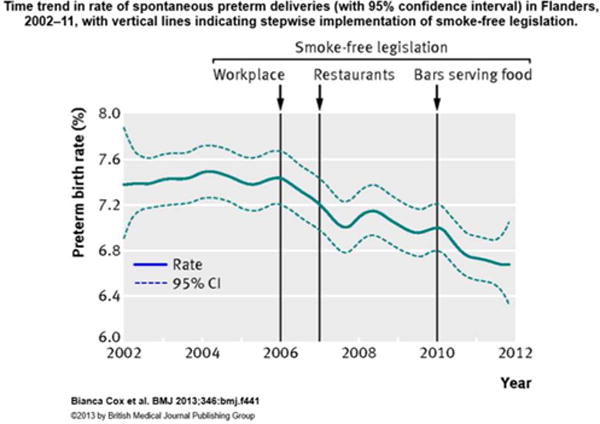
For decades, many studies have linked maternal smoking to an increased risk of preterm birth. As a result, the scientific community has long hypothesized that exposure to environmental tobacco smoke (ETS), commonly referred to as second-hand smoke, is also associated with an increased risk of preterm birth. Multiple studies have examined this proposed association through different strategies and approaches. Recently, a small number of epidemiology studies have examined preterm birth trends before and after the implementation of antismoking legislation in various jurisdictions. We found that these studies have largely revealed a significant trend of decreasing population-level preterm birth rates after the implementation of smoking bans. However, most of the studies reviewed did not distinguish the impact of maternal smoking from ETS in their analyses, making it difficult to specifically evaluate the effects of smoking bans on ETS exposure. Other studies have taken the approach of directly measuring maternal ETS exposure and associations with preterm birth within particular study populations. In contrast to smoking ban studies, the latter group of studies had more inconclusive results. The use of a variety of exposure assessment methods ranging from different self-reporting techniques to biomarker measurements posed a challenge to compare studies. We evaluate current scientific literature for evidence of an association between maternal ETS exposure and risk of preterm birth. We also discuss the strengths and weaknesses of the different approaches to study this association as well as methods used for ETS exposure assessment. We propose that more studies, specifically, evaluating rates of preterm birth among nonsmoking women before and after smoking bans, are needed as well as using better ETS exposure assessments methods in studies measuring maternal ETS exposure.
Conflict of interest statement
Notes
The authors declare no competing financial interest.
Figures
References
-
- Blencowe H, Cousens S, Oestergaard MZ, Chou D, Moller AB, Narwal R, Adler A, Vera Garcia C, Rohde S, Say L, Lawn JE. National, regional, and worldwide estimates of preterm birth rates in the year 2010 with time trends since 1990 for selected countries: a systematic analysis and implications. Lancet (London, England) 2012;379:2162–2172. - PubMed
-
- WHO. Preterm Birth Factsheet. World Health Organization; 2014.
-
- Behrman RE, Butler AS. Preterm Birth. National Academies Press; 2007. Committee on Understanding Premature, B., Assuring Healthy, O., Board on Health Sciences, P., and Medicine, I. o.
-
- Abel EL. Smoking during pregnancy: a review of effects on growth and development of offspring. Human biology. 1980;52:593–625. - PubMed
Publication types
MeSH terms
Grants and funding
LinkOut - more resources
Full Text Sources
Other Literature Sources
Research Materials
