Review
. 2017 Jul;13(3):427-444.
doi: 10.1016/j.hfc.2017.02.002.

Diagnosis and Management of Heart Failure in Older Adults

Affiliations
Review

Diagnosis and Management of Heart Failure in Older Adults

Gurusher Panjrath et al. Heart Fail Clin. 2017 Jul.

Abstract

Aging is characterized by heterogeneity, both in health and illness. Older adults with heart failure often have preserved ejection fraction and atypical and delayed clinical manifestations. After diagnosis of heart failure is established, a cause should be sought. The patient's comorbidities may provide clues. An elevated jugular venous pressure is the most reliable clinical sign of fluid volume overload and should be carefully evaluated. Left ventricular ejection fraction must be determined to assess prognosis and guide therapy. These 5 steps, namely, diagnosis, etiologic factor, fluid volume, ejection fraction, and therapy for heart failure may be memorized by mnemonic: DEFEAT-HF.

Keywords: Clinical manifestations; Diagnostic assessment; Etiologic factor; Heart failure; Older adults.


Figures

Fig. 1.
Fig. 1.
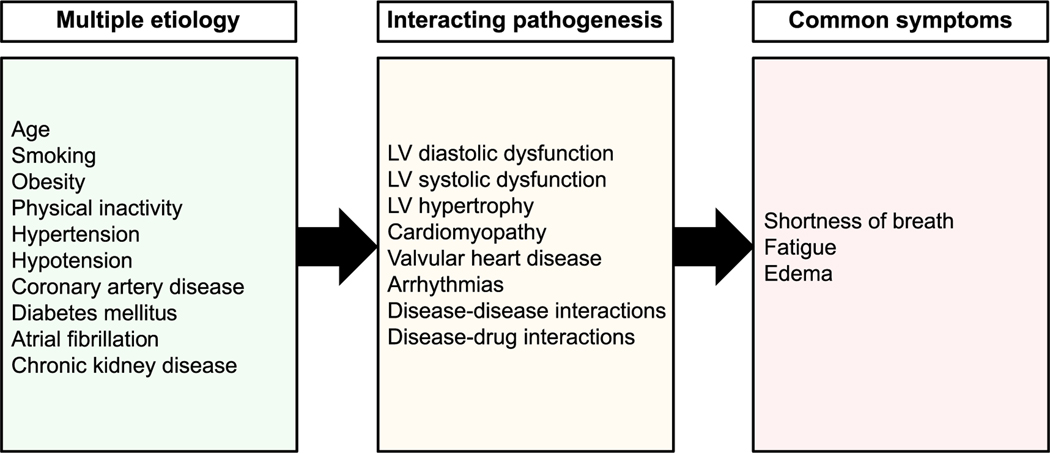
Geriatric syndrome model of heart failure in older adults. LV, left ventricular. (Adapted from Inouye SK, Studenski S, Tinetti ME, et al. Geriatric syndromes: clinical, research, and policy implications of a core geriatric concept. J Am Geriatr Soc 2007;55:781; with permission.)
Fig. 2.
Fig. 2.
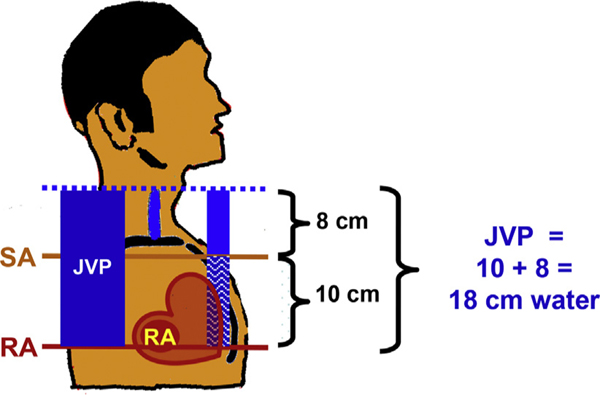
Estimation of jugular venous pressure (JVP) in centimeters (cm) of water. First, estimate the distance between the sternal angle (SA) and the top of the jugular venous pulsation (marked by the horizontal dotted blue line) in cm (8 cm in the example above). Then, estimate the distances between right atrium (RA) and SA (10 cm in the example above, but would vary depending on the body position as shown in Fig. 3). Finally, add these two numbers to get the estimated JVP (18 cm water in the example above). (Adapted from Ahmed A. Chronic heart failure in older adults. Med Clin N Am 2011;95:439–61; with permission.)
Fig. 3.
Fig. 3.
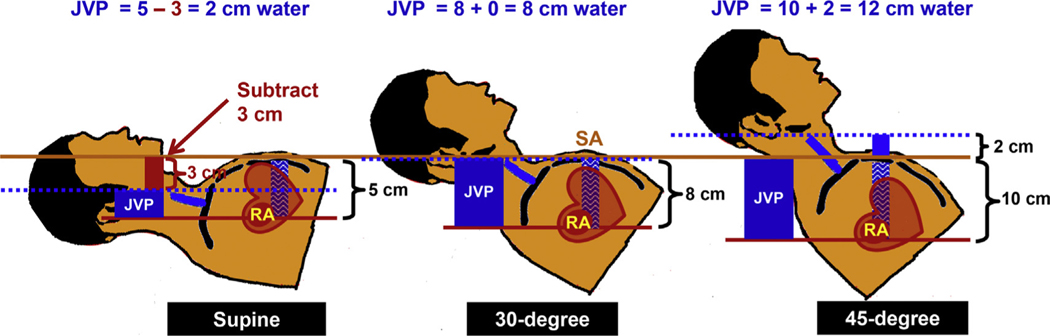
Estimation of jugular venous pressure (JVP, marked by the vertical blue bars) in centimeters (cm) of water. First, identify the top of the external jugular venous pulsation in the middle of the neck (the blue line in neck) by adjusting the patient’s position. Second, estimate the distance between the sternal angle (SA, marked by the dark brown line), and the top of venous pulsation (marked by the horizontal dotted blue lines). Third, estimate the distance from right atrium (RA, marked by the red line) to SA (note that this distance would vary with the body position). Finally, add these two numbers, the “SA to the top of the jugular venous pulsation distance” and the “RA to SA distance”, to obtain JVP in cm water. Please note that when JVP is low as it in the left panel, the top of jugular pulsation is only visible in the middle of the neck when the patient is in the supine position. Because in this position, the top of the jugular pulsation is below the SA, the JVP is estimated by subtracting the “SA to the top of the jugular venous pulsation distance” from the “RA to SA distance. (Adapted from Ahmed A. Chronic Heart Failure in Older Adults. Med Clin N Am 2011;95:439–61; with permission.)

References

    1. Inouye SK, Studenski S, Tinetti ME, et al. Geriatric syndromes: clinical, research, and policy implications of a core geriatric concept. J Am Geriatr Soc 2007;55:780–91. - PMC - PubMed
    1. Aronow WS. Epidemiology, pathophysiology, prognosis, and treatment of systolic and diastolic heart failure. Cardiol Rev 2006;14:108–24. - PubMed
    1. Aronow WS. Drug treatment of systolic and of diastolic heart failure in elderly persons. J Gerontol A Biol Sci Med Sci 2005;60:1597–605. - PubMed
    1. Ahmed A American College of Cardiology/American Heart Association chronic heart failure evaluation and management guidelines: Relevance to the geriatric practice. J Am Geriatr Soc 2003; 51:123–6. - PubMed
    1. Ahmed A, Allman RM, Aronow WS, et al. Diagnosis of heart failure in older adults: predictive value of dyspnea at rest. Arch Gerontol Geriatr 2004;38: 297–307. - PubMed