


Review
doi: 10.1016/j.ymben.2017.06.003.
Epub 2017 Jun 7.
Engineering biological systems using automated biofoundries
Affiliations
- PMID: 28602523
- PMCID: PMC5544601
- DOI: 10.1016/j.ymben.2017.06.003
Item in Clipboard
Review
Engineering biological systems using automated biofoundries
Metab Eng.
2017 Jul.
Abstract
Engineered biological systems such as genetic circuits and microbial cell factories have promised to solve many challenges in the modern society. However, the artisanal processes of research and development are slow, expensive, and inconsistent, representing a major obstacle in biotechnology and bioengineering. In recent years, biological foundries or biofoundries have been developed to automate design-build-test engineering cycles in an effort to accelerate these processes. This review summarizes the enabling technologies for such biofoundries as well as their early successes and remaining challenges.
Copyright © 2017 International Metabolic Engineering Society. Published by Elsevier Inc. All rights reserved.
Figures

A biofoundry platform is an integration of biology with software and hardware systems. The protocols, parts, and biological entities used as engineering tools should be optimized first to facilitate automated high-throughput manipulations. The software system orchestrates the automation processes and assists design as well as data processing. The hardware system conducts the build and test tasks. Through iterations of design-build-test, learning algorithms can potentially be integrated to help extend the understanding of the biosystems beyond human cognition.
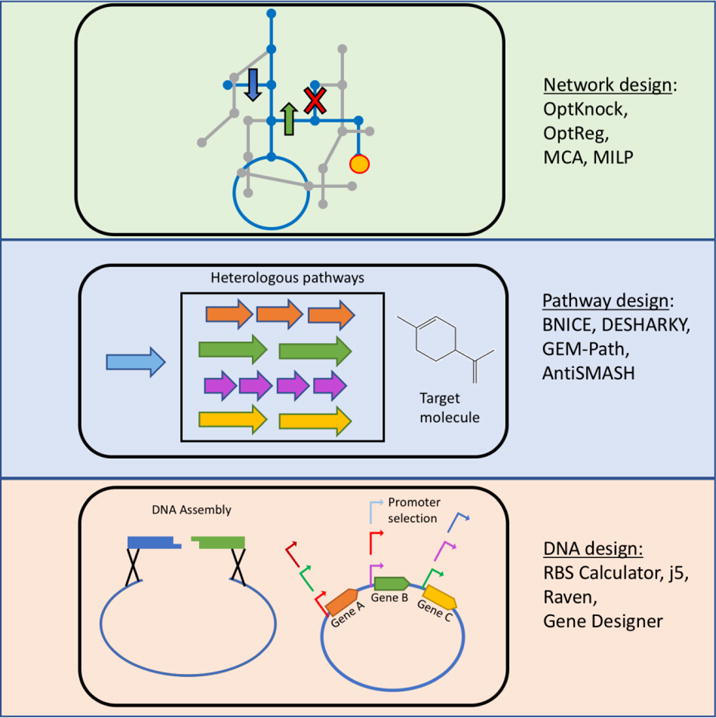
Design algorithms can be implemented at the scale of network design, pathway design and genetic construct design. At the level of network modifications, optimization algorithms such as OptKnock or OptReg (for stoichiometric models) and MCA or MILP (for kinetic models) are used to design engineering strategies for the metabolic network (Okuda et al., 2008). At the pathway level, algorithms such as BNICE are used to suggest native or heterologous pathways that can be used for synthesis of a target molecule. Having decided a specific network and/or pathway strategy, algorithms such as RBS Calculator suggest specific RBS designs for controlling expression whereas algorithms such as j5 and Raven aid in designing the method of construction of genetic elements from the user-defined parts.

DNA parts are mixed and ligated to form the final constructs based on the designs. The order of parts in each assembly is designated by the linkers flanking the parts. The DNA fragments can be inserted to donor plasmids as an intermediate step. Golden Gate assembly is used as an example.
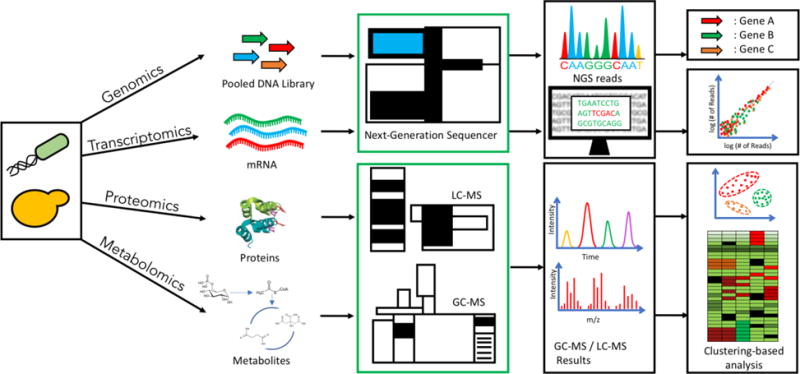
The strategies for testing a biosystem are implemented at various levels, depending on the engineering strategy being implemented. Genetic modifications to the host genome or assembly of DNA parts usually require sequencing methods such as Sanger or NGS for verification of the end product. If inquiry is focused on studying global changes on gene expression levels, influenced by either genetic or environmental modifications, then mRNA transcript levels are measured using methods such as microarray analysis and RNA-Seq. Modification strategies targeted at changing protein numbers in the biosystem are monitored using proteomics-based tools such as MALDI-TOF and LC-MS. However, if protein numbers are not solely indicative of the modified phenotype, the end-effect of the engineering strategy on the metabolic profiles is typically analyzed using LC-MS or GC-MS based metabolomics tools. Testing capabilities can also be performed for in a targeted manner for specific mRNA, protein or metabolite species.
References
-
- Appleton E, Tao JH, Haddock T, Densmore D. Interactive assembly algorithms for molecular cloning. Nat Methods. 2014;11:657–+. - PubMed
-
- Araki M, Cox RS, Makiguchi H, Ogawa T, Taniguchi T, Miyaoku K, Nakatsui M, Hara KY, Kondo A. M-path: A compass for navigating potential metabolic pathways. Bioinformatics. 2015;31:905–911. - PubMed
-
- Bao ZH, Xiao H, Lang J, Zhang L, Xiong X, Sun N, Si T, Zhao HM. Homology-Integrated CRISPR-Cas (HI-CRISPR) System for One-Step Multigene Disruption in Saccharomyces cerevisiae. ACS Synth Biol. 2015;4:585–594. - PubMed
Publication types
MeSH terms
Grants and funding
LinkOut - more resources
Full Text Sources
Other Literature Sources
