


Neurobiological correlates of impulsivity in healthy adults: Lower prefrontal gray matter volume and spontaneous eye-blink rate but greater resting-state functional connectivity in basal ganglia-thalamo-cortical circuitry
- PMID: 28602816
- PMCID: PMC5600835
- DOI: 10.1016/j.neuroimage.2017.06.015
Neurobiological correlates of impulsivity in healthy adults: Lower prefrontal gray matter volume and spontaneous eye-blink rate but greater resting-state functional connectivity in basal ganglia-thalamo-cortical circuitry
Erratum in
-
Corrigendum to "Neurobiological correlates of impulsivity in healthy adults: Lower prefrontal gray matter volume and spontaneous eye-blink rate but greater resting-state functional connectivity in basal ganglia-thalamo-cortical circuitry" [Neuroimage 157 (2017) 288-296].Neuroimage. 2018 Feb 15;167:505. doi: 10.1016/j.neuroimage.2017.10.042. Epub 2017 Nov 4. Neuroimage. 2018. PMID: 29108915 No abstract available.
Abstract
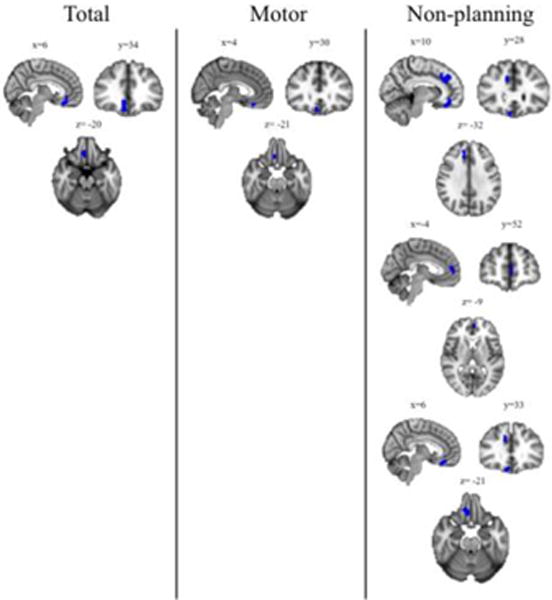
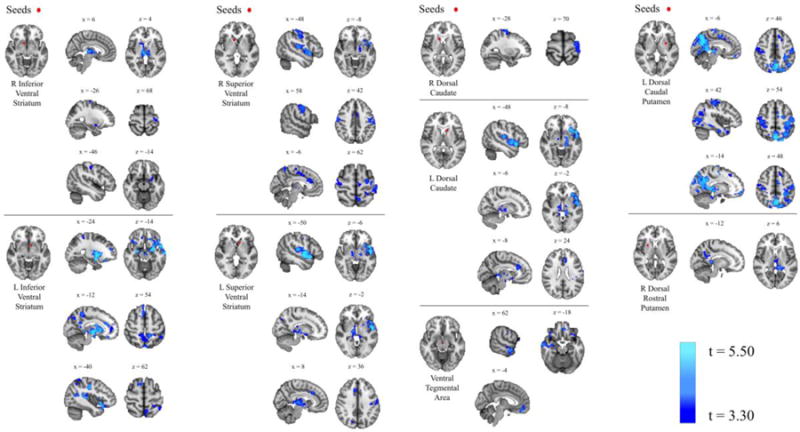
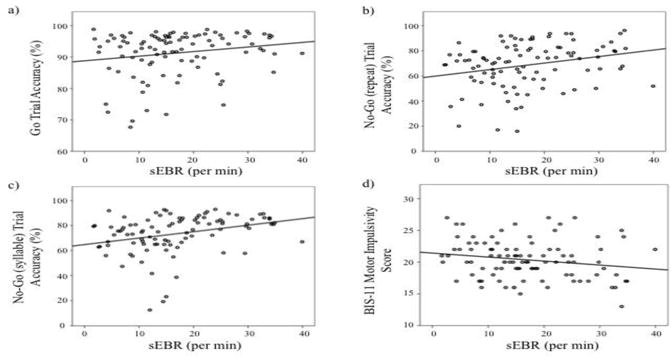
Studies consistently implicate aberrance of the brain's reward-processing and decision-making networks in disorders featuring high levels of impulsivity, such as attention-deficit hyperactivity disorder, substance use disorder, and psychopathy. However, less is known about the neurobiological determinants of individual differences in impulsivity in the general population. In this study of 105 healthy adults, we examined relationships between impulsivity and three neurobiological metrics - gray matter volume, resting-state functional connectivity, and spontaneous eye-blink rate, a physiological indicator of central dopaminergic activity. Impulsivity was measured both by performance on a task of behavioral inhibition (go/no-go task) and by self-ratings of attentional, motor, and non-planning impulsivity using the Barratt Impulsiveness Scale (BIS-11). Overall, we found that less gray matter in medial orbitofrontal cortex and paracingulate gyrus, greater resting-state functional connectivity between nodes of the basal ganglia-thalamo-cortical network, and lower spontaneous eye-blink rate were associated with greater impulsivity. Specifically, less prefrontal gray matter was associated with higher BIS-11 motor and non-planning impulsivity scores, but was not related to task performance; greater correlated resting-state functional connectivity between the basal ganglia and thalamus, motor cortices, and prefrontal cortex was associated with worse no-go trial accuracy on the task and with higher BIS-11 motor impulsivity scores; lower spontaneous eye-blink rate was associated with worse no-go trial accuracy and with higher BIS-11 motor impulsivity scores. These data provide evidence that individual differences in impulsivity in the general population are related to variability in multiple neurobiological metrics in the brain's reward-processing and decision-making networks.
Keywords: Basal ganglia; Gray matter volume; Healthy adults; Impulsivity; Prefrontal cortex; Resting-state functional connectivity; Spontaneous eye-blink rate.
Copyright © 2017 Elsevier Inc. All rights reserved.
Conflict of interest statement
Dr. Richard J. Davidson is the founder, president, and serves on the board of directors for the non-profit organization, Healthy Minds Innovations, Inc. In addition, Dr. Davidson serves on the board of directors for the Mind and Life Institute.
Figures
References
-
- Andersson JLR, Jenkinson M, Smith SM. Non-linear optimisation. FMRIB technical report TR07JA1 2007a
-
- Andersson JLR, Jenkinson M, Smith SM. Non-linear registration, aka Spatial normalisation. FMRIB technical report TR07JA2 2007b
-
- Aron AR, Dowson JH, Sahakian BJ, Robbins TW. Methylphenidate improves response inhibition in adults with attention-deficit/hyperactivity disorder. Biol Psychiatry. 2003;54:1465–1468. - PubMed
-
- Ashburner J, Friston KJ. Voxel-based morphometry–the methods. Neuroimage. 2000;11:805–821. - PubMed
MeSH terms
Grants and funding
LinkOut - more resources
Full Text Sources
Other Literature Sources
Miscellaneous
