


Ethnicity Influences Phenotype and Outcomes in Inflammatory Bowel Disease: A Systematic Review and Meta-analysis of Population-based Studies
- PMID: 28603049
- PMCID: PMC5722715
- DOI: 10.1016/j.cgh.2017.05.047
Ethnicity Influences Phenotype and Outcomes in Inflammatory Bowel Disease: A Systematic Review and Meta-analysis of Population-based Studies
Abstract
Background & aims: Inflammatory bowel diseases (IBDs) (Crohn's disease [CD], ulcerative colitis) are global diseases. Similarities and differences in disease presentation and outcomes across different geographic regions and ethnic groups have not been compared previously.
Methods: We performed a systematic review and meta-analysis of population-based cohort studies examining the phenotype and outcome of IBD across ethnic groups categorized as Whites, Blacks, Hispanics, and Asians. Further stratification was performed by migration status (native or immigrant). Pooled proportions of disease location, behavior, medication, and surgery use were calculated by using a random-effects model and compared statistically.
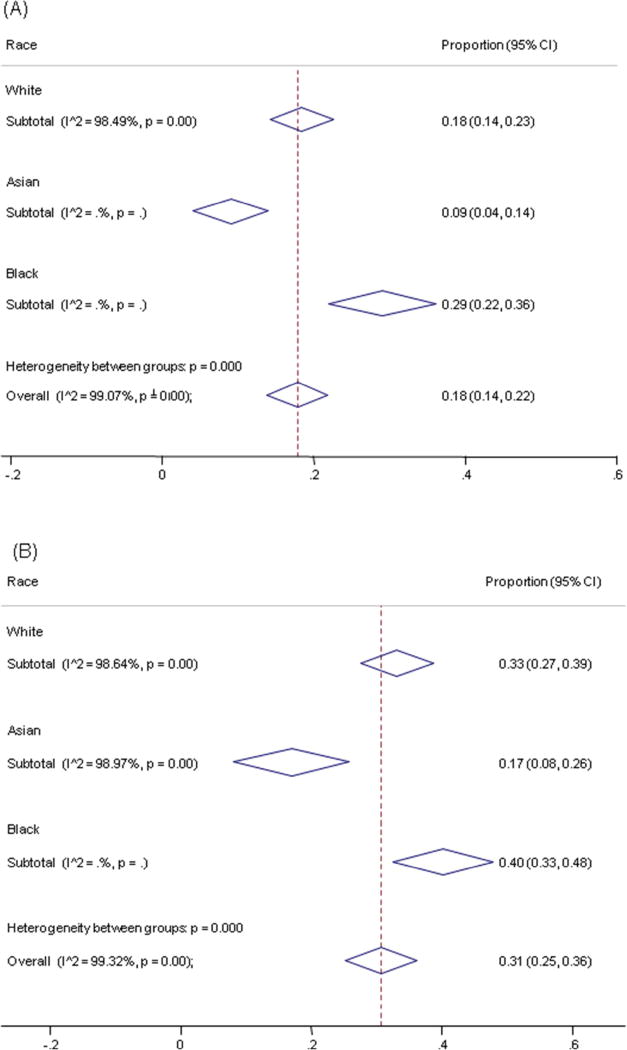
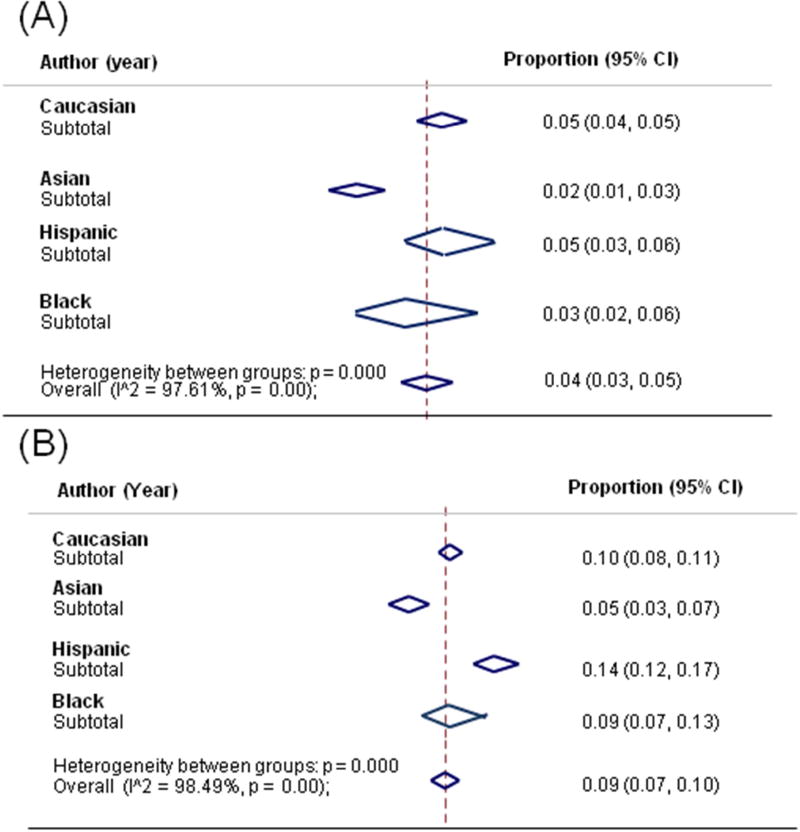
Results: Our final analysis included 198 unique studies reporting outcomes on 525,425 IBD patients (Caucasian, 65%; Asian, 30%; Hispanic, 2%; and Black, 1%). CD in Asians but not other ethnicities demonstrated a strong male predominance. Family history of IBD was infrequent in Asian patients. Both Black and Asian CD patients demonstrated perianal involvement more frequently. Surgery for both CD and UC was less common in Asians than Caucasians. Compared with native residents, a family history of IBD was reported more often among immigrant IBD patients, but no significant differences were noted in phenotype.
Conclusions: We demonstrate significant variation in the demographic distribution, familial predisposition, phenotype, and outcomes of IBD between Caucasians, Blacks, Hispanics, and Asians. There is need for further study to understand the biology behind this variation.
Keywords: Behavior; Crohn’s Disease; Ethnicity; Race; Surgery; Ulcerative Colitis.
Copyright © 2018 AGA Institute. Published by Elsevier Inc. All rights reserved.
Conflict of interest statement
Figures

Comment in
-
Ethnoracial, Geographic, and Socioeconomic Disparities and Variations in Inflammatory Bowel Disease.Clin Gastroenterol Hepatol. 2018 Jul;16(7):1176-1177. doi: 10.1016/j.cgh.2018.03.001. Epub 2018 Mar 11. Clin Gastroenterol Hepatol. 2018. PMID: 29535055 No abstract available.
-
Reply.Clin Gastroenterol Hepatol. 2018 Jul;16(7):1177. doi: 10.1016/j.cgh.2018.03.015. Clin Gastroenterol Hepatol. 2018. PMID: 29914642 No abstract available.
References
-
- Loftus EV., Jr Clinical epidemiology of inflammatory bowel disease: Incidence, prevalence, and environmental influences. Gastroenterology. 2004;126:1504–17. - PubMed
-
- Cosnes J, Gower-Rousseau C, Seksik P, et al. Epidemiology and natural history of inflammatory bowel diseases. Gastroenterology. 2011;140:1785–94. - PubMed
-
- Bernstein CN, Blanchard JF, Rawsthorne P, et al. Epidemiology of Crohn’s disease and ulcerative colitis in a central Canadian province: A population-based study. American Journal of Epidemiology. 1999;149:916–924. - PubMed
-
- Molodecky NA, Soon IS, Rabi DM, et al. Increasing incidence and prevalence of the inflammatory bowel diseases with time, based on systematic review. Gastroenterology. 2012;142:46–54. e42; quiz e30. - PubMed
-
- Thia KT, Loftus EV, Jr, Sandborn WJ, et al. An update on the epidemiology of inflammatory bowel disease in Asia. Am J Gastroenterol. 2008;103:3167–82. - PubMed
Publication types
MeSH terms
Substances
Grants and funding
LinkOut - more resources
Full Text Sources
Other Literature Sources
