Review
. 2017 Sep;15(9):531-543.
doi: 10.1038/nrmicro.2017.50. Epub 2017 Jun 12.

Transmission of the gut microbiota: spreading of health

Affiliations
Review

Transmission of the gut microbiota: spreading of health

Hilary P Browne et al. Nat Rev Microbiol. 2017 Sep.

Abstract

Transmission of commensal intestinal bacteria between humans could promote health by establishing, maintaining and replenishing microbial diversity in the microbiota of an individual. Unlike pathogens, the routes of transmission for commensal bacteria remain unappreciated and poorly understood, despite the likely commonalities between both. Consequently, broad infection control measures that are designed to prevent pathogen transmission and infection, such as oversanitation and the overuse of antibiotics, may inadvertently affect human health by altering normal commensal transmission. In this Review, we discuss the mechanisms and factors that influence host-to-host transmission of the intestinal microbiota and examine how a better understanding of these processes will identify new approaches to nurture and restore transmission routes that are used by beneficial bacteria.


Conflict of interest statement

Competing interests statement

The authors declare no competing interests.

Figures
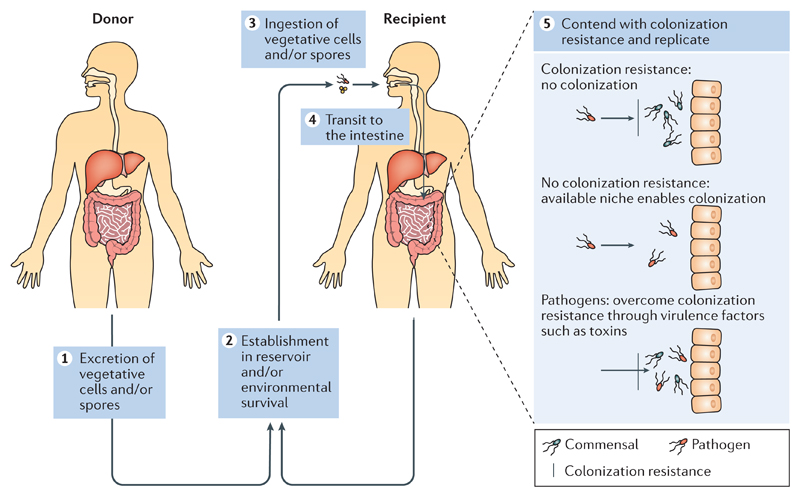
Figure 1
Figure 1. Transmission of pathogenic and commensal intestinal bacteria.
Intestinal pathogens and commensal bacteria use similar mechanisms to transmit between hosts. Egestion from the host in faecal matter is the first stage in transmission (step 1). To promote dispersal and subsequent ingestion by a new host, pathogens may induce diarrhoea in the donor. Once in the external environment, survival mechanisms, such as aerotolerance, viable but non-culturable dormancy and sporulation, are used by these predominately anaerobic bacteria to survive and transmit. Environmental reservoirs, such as people, food, animals and the built environment, will function as a source or sink for transmission (step 2). Once ingested by a new host (step 3), the bacterium transits to the intestines (step 4). Competition from the resident microbiota can prevent colonization (step 5, see colonization resistance); however, bacteria can colonize if a niche is unoccupied (step 5, see no colonization resistance). The restoration of bacterial species functions to maintain colonization resistance and promote the diversity of health-associated bacteria in the gut. Pathogens can overcome colonization resistance through the induction of the expression of virulence factors, such as toxins, which can lead to inflammation and perturb the resident microbiota (step 5, see pathogens). Metabolism of nutrients and replication promote persistence and support further replication and subsequent onward transmission as the recipient now becomes a donor.
Figure 2
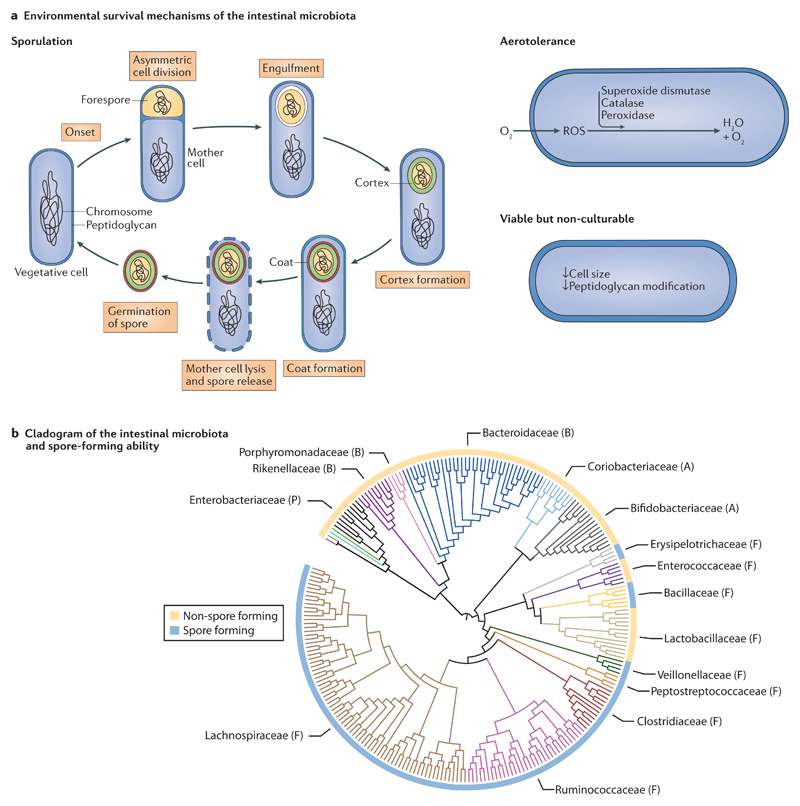
Figure 2. Environmental survival mechanisms and sporulation transmission dynamics of the intestinal microbiota.
a | Environmental survival mechanisms. Sporulation is a feature of specific members of the Firmicutes phylum and involves a series of well-defined stages that incorporate a complete structural remodelling of the bacterial cell to form a resilient spore. Aerotolerance through the degradation of harmful reactive oxygen species (ROS) that can accumulate in the bacterial cell is primarily, but not exclusively, a feature of aerobic bacteria. Presented is a simplified representation of the key elements. The viable but non-culturable state includes some morphological changes, but the extent and characteristics of this phenotype in the intestinal microbiota are unknown. b | Representative cladogram of the main human intestinal microbiota families and their associated sporulation ability. Internal clade colours represent different taxonomic families. Family names are presented, with the phylum that the family belongs to indicated by a letter in brackets: P, Proteobacteria; B, Bacteroidetes; A, Actinobacteria and F, Firmicutes. The most abundant families that have the greatest known metabolic outputs in the intestinal microbiota are the Bacteroidaceae, Ruminococcaceae and Lachnospiraceae families. The circle that surrounds the cladogram indicates known sporulation ability. Not all bacterial species in a taxon that contains spore-forming species have been demonstrated to form spores.
Figure 3
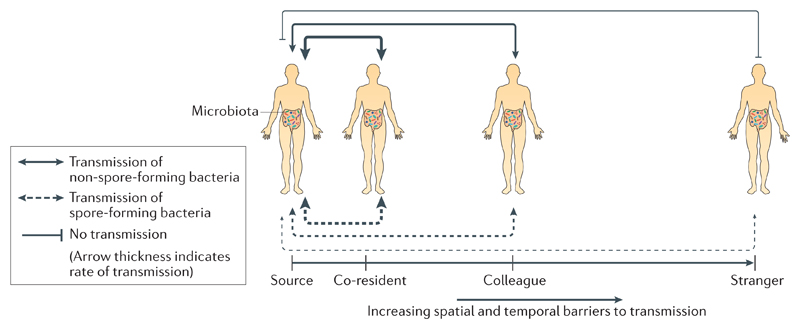
Figure 3. Inter-host transmission dynamics of spore-forming and non-spore-forming intestinal bacteria.
A hypothetical model to explain the different transmission dynamics of spore-forming and non-spore-forming bacteria. Owing to their resistance to environmental stresses and aerotolerance, spore-forming bacteria are not as spatially and temporally restricted during transmission as non-spore-forming bacteria. For individuals who are in regular contact with, and close proximity to, each other (for example, co-residents) both spore-forming bacteria and non-spore-forming bacteria can transmit with the same efficiency. However, as spatial and temporal distances increase, non-spore-forming oxygen-sensitive bacteria will become restricted in their ability to transmit until eventually transmission will not be possible. As spore-forming bacteria can remain viable for extended periods of time in external aerobic environments, they are not reliant on close contact between individuals to transmit. For example, spores that are shed by an individual can potentially be acquired by another individual weeks later.
Figure 4
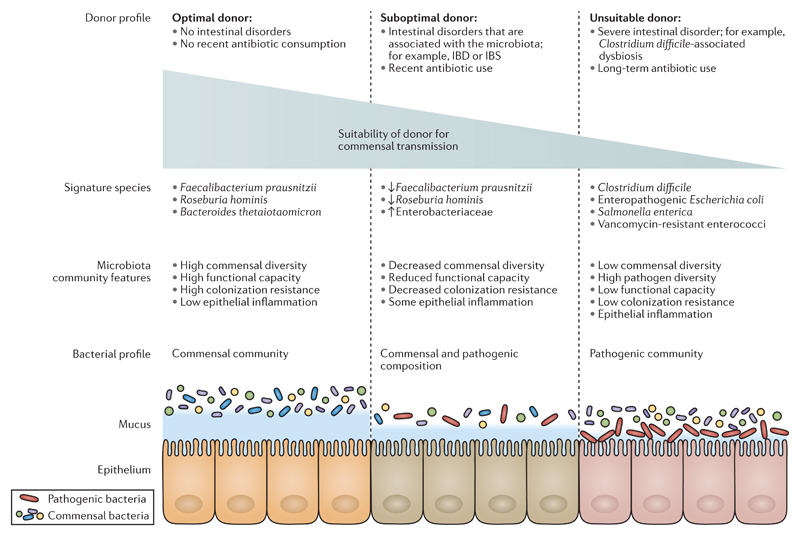
Figure 4. Transmission of commensal intestinal bacteria is influenced by donor health status.
Healthy donors who have no history of intestinal disorders or recent antibiotic treatment will typically have a diverse intestinal microbiota that exhibits high colonization resistance. Healthy donors are optimal donors of commensal microorganisms because they will regularly contribute health-associated bacteria to their environment. Conversely, donors who have lower levels of commensal diversity, decreased colonization resistance and a higher proportion of pathogenic bacteria are not considered optimal donors. These suboptimal and unsuitable donors would be more likely to shed pathogenic bacteria into the external environment that are not beneficial to human health. The signature species that categorize donors in this model are not comprehensive and are included on the basis of current research in the field. IBD, inflammatory bowel disease; IBS, irritable bowel syndrome. Figure is adapted with permission from REF., Wiley.

References

    1. Whitman WB, Coleman DC, Wiebe WJ. Prokaryotes: the unseen majority. Proc Natl Acad Sci USA. 1998;95:6578–6583. - PMC - PubMed
    1. Sekirov I, Russell SL, Antunes LCM, Finlay BB. Gut microbiota in health and disease. Physiol Rev. 2010;90:859–904. - PubMed
    1. Louis P, Hold GL, Flint HJ. The gut microbiota, bacterial metabolites and colorectal cancer. Nat Rev Microbiol. 2014;12:661–672. - PubMed
    1. Lawley TD, Walker AW. Intestinal colonization resistance. Immunology. 2013;138:1–11. - PMC - PubMed
    1. Human Microbiome Project Consortium. Structure, function and diversity of the healthy human microbiome. Nature. 2012;486:207–214. [This landmark study characterizes the microbiota across different human body sites.] - PMC - PubMed

MeSH terms