


Problem Management Plus (PM+) in the management of common mental disorders in a specialized mental healthcare facility in Pakistan; study protocol for a randomized controlled trial
- PMID: 28603552
- PMCID: PMC5465445
- DOI: 10.1186/s13033-017-0147-1
Problem Management Plus (PM+) in the management of common mental disorders in a specialized mental healthcare facility in Pakistan; study protocol for a randomized controlled trial
Erratum in
-
Correction to: Problem Management Plus (PM+) in the management of common mental disorders in a specialized mental healthcare facility in Pakistan; study protocol for a randomized controlled trial.Int J Ment Health Syst. 2018 Sep 27;12:53. doi: 10.1186/s13033-018-0231-1. eCollection 2018. Int J Ment Health Syst. 2018. PMID: 30275875 Free PMC article.
Abstract
Background: The World Health Organization (WHO) has developed Problem Management Plus (PM+), a 5-session, psychological intervention program delivered by trained non-specialist that addresses common mental disorders. The objectives of this study are to evaluate effectiveness and cost-effectiveness of PM+ in a specialized mental health care facility in Pakistan.
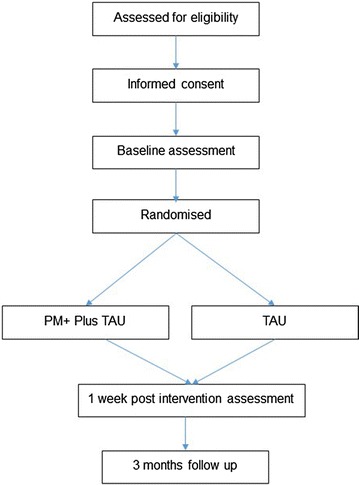
Methods: A single blind individual randomized controlled trial (RCT) will be carried out in the outpatient department of a specialized mental healthcare facility in Rawalpindi, Pakistan. After informed consent, patients with high psychological distress (General Health Questionnaire-12 (score >2) and functional impairment (WHO Disability Assessment Schedule 2.0 score >16) will be randomised to PM+ plus treatment as usual (n = 96) or TAU only (n = 96). The primary outcome is the psychological distress, measured by levels of anxiety and depression on the Hospital Anxiety and Depression Scale and improvement in functioning as measured by WHODAS at 20 weeks after baseline. Secondary outcomes include improvement in symptoms of depression, post-traumatic stress disorder, levels of social support and cost effectiveness evaluation. Qualitative interviews will be conducted to evaluate the process of implementing PM+ including barriers and facilitators in implementation and possibility of integration of PM+ program in specialized mental health care facilities in Pakistan.
Discussion: The results of this study will be helpful in evaluating the effectiveness of the approach of training non specialists, based in the specialized mental health care facilities in delivering evidence based psychological interventions in the low resource settings. Trial registration Australian New Zealand Clinical Trials Registry, ACTRN12616000381482. Registered Retrospectively on March 23, 2016.
Keywords: Anxiety; Cognitive behavioural therapy; Common mental disorders; Depression; Integration; Low and middle income countries; Low resource settings; Non-specialist counsellors; Psychotherapy; Scale-up; Task-shifting; Trans-diagnostic; mhGAP.
References
-
- Assembly UG. Transforming our world: the 2030 Agenda for sustainable development. Resolution adopted by the general assembly on 25 September 2015. New York: United Nations; 2015. http://www.unorg/ga/search/view_docasp.
-
- Whiteford HA, Degenhardt L, Rehm J, Baxter AJ, Ferrari AJ, Erskine HE, Charlson FJ, Norman RE, Flaxman AD, Johns N, et al. Global burden of disease attributable to mental and substance use disorders: findings from the Global Burden of Disease Study 2010. Lancet. 2013;382(9904):1575–1586. doi: 10.1016/S0140-6736(13)61611-6. - DOI - PubMed
LinkOut - more resources
Full Text Sources
Other Literature Sources
Medical
