Review
. 2017 May 26:7:215.
doi: 10.3389/fcimb.2017.00215. eCollection 2017.

The Type IX Secretion System (T9SS): Highlights and Recent Insights into Its Structure and Function

Affiliations
Review

The Type IX Secretion System (T9SS): Highlights and Recent Insights into Its Structure and Function

Anna M Lasica et al. Front Cell Infect Microbiol. .

Abstract

Protein secretion systems are vital for prokaryotic life, as they enable bacteria to acquire nutrients, communicate with other species, defend against biological and chemical agents, and facilitate disease through the delivery of virulence factors. In this review, we will focus on the recently discovered type IX secretion system (T9SS), a complex translocon found only in some species of the Bacteroidetes phylum. T9SS plays two roles, depending on the lifestyle of the bacteria. It provides either a means of movement (called gliding motility) for peace-loving environmental bacteria or a weapon for pathogens. The best-studied members of these two groups are Flavobacterium johnsoniae, a commensal microorganism often found in water and soil, and Porphyromonas gingivalis, a human oral pathogen that is a major causative agent of periodontitis. In P. gingivalis and some other periodontopathogens, T9SS translocates proteins, especially virulence factors, across the outer membrane (OM). Proteins destined for secretion bear a conserved C-terminal domain (CTD) that directs the cargo to the OM translocon. At least 18 proteins are involved in this still enigmatic process, with some engaged in the post-translational modification of T9SS cargo proteins. Upon translocation across the OM, the CTD is removed by a protease with sortase-like activity and an anionic LPS is attached to the newly formed C-terminus. As a result, a cargo protein could be secreted into the extracellular milieu or covalently attached to the bacterial surface. T9SS is regulated by a two-component system; however, the precise environmental signal that triggers it has not been identified. Exploring unknown systems contributing to bacterial virulence is exciting, as it may eventually lead to new therapeutic strategies. During the past decade, the major components of T9SS were identified, as well as hints suggesting the possible mechanism of action. In addition, the list of characterized cargo proteins is constantly growing. The actual structure of the translocon, situated in the OM of bacteria, remains the least explored area; however, new technical approaches and increasing scientific attention have resulted in a growing body of data. Therefore, we present a compact up-to-date review of this topic.

Keywords: Porphyromonas gingivalis; T9SS; gliding motility; pathogenesis; proteins; secretion; virulence.


Figures
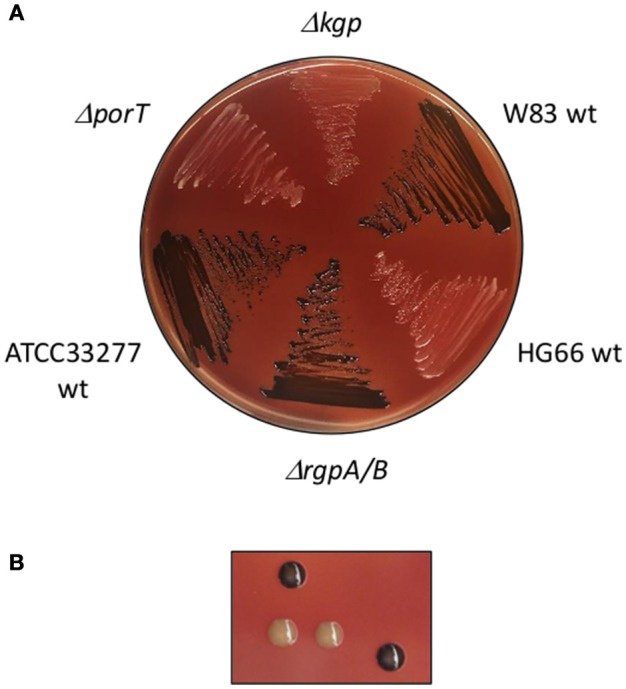
Figure 1
Figure 1
Pigmentation of various P. gingivalis W83 strains. (A) The wild-type P. gingivalis W83 and ATCC33277 strains grown anaerobically on blood agar plates present brown/black pigmentation due to heme accumulation. This phenotype is in a great part dependent on Kgp gingipain activity on the cell surface. P. gingivalis strains deficient in Kgp activity yield beige colonies which darken over the time. Arginine gingipains (RgpA/B) are not involved in this process and their deletion does not influence pigmentation. Strains impaired in T9SS e.g., ΔporT lack pigmentation which is never restored. Due to the absence of A-LPS in the P. gingivalis HG66 strain all gingipains and other T9SS cargo proteins are not associated with the cell membrane, but secreted into extracellular milieu resulting in white phenotype. (B) Single colonies of P. gingivalis strains grown for 7 days showing black or white pigmentation.
Figure 2
Figure 2
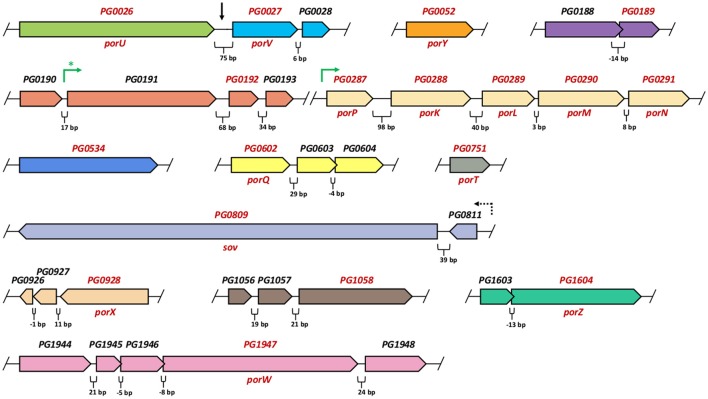
Arrangement of P. gingivalis W83 genes encoding T9SS components. Genes are grouped according to in silico operon predictions, reflecting direction of transcripts (Dam et al., ; Mao et al., ; Pertea et al., ; Taboada et al., 2012). Gaps in the genome are indicated by the slashes. Intervals between adjacent genes or overlapping regions (in base pairs-bp) are marked below each section. Each transcription unit is shown in different color. Genes encoding T9SS components are depicted in red font. Black vertical arrow shows continuous region (75 bp) between PG0026 (porU) and PG0027 (porV) but the two genes were predicted to transcribe independently. Green arrows indicate operons that were confirmed experimentally (Taguchi et al., ; Vincent et al., 2017). Green asterisk denotes proved single transcription unit for the PG0191-PG0192-PG0193 genes (in P. gingivalis ATCC33277 strain), however co-transcription of preceding the PG0190 gene (17 bp interval) was not investigated (Taguchi et al., 2015). The PG0809 (Sov) gene was re-sequenced and confirmed to consist of the two combined genes PG0809 and PG0810, mis-annotated in W83 genome as separate ORFs (Saiki and Konishi, 2007). A dashed arrow denotes indirect evidence that PG0809 (Sov) and PG0811 may be co-transcribed. It was shown that sigma factor SigP (regulator of other por genes) binds to the region preceding PG0811 but not the one before PG0809 (Kadowaki et al., 2016).
Figure 3
Figure 3
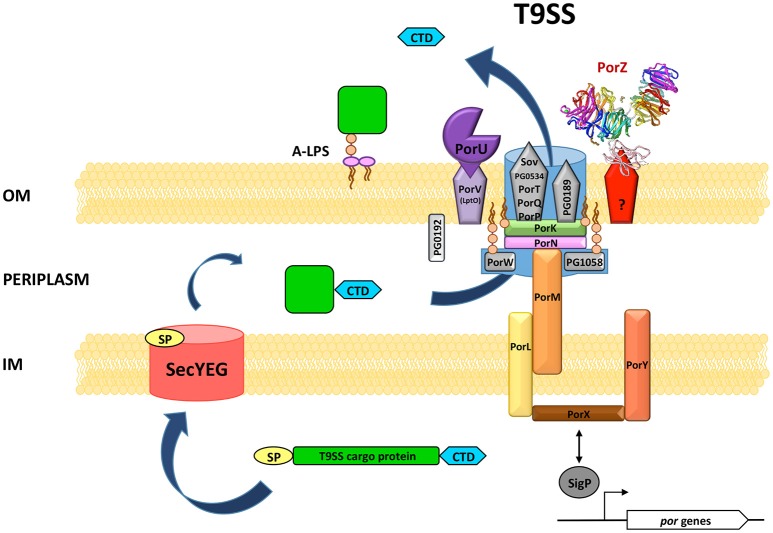
Hypothetical model of the structure and function of P. gingivalis T9SS. The overall translocon structure and the protein(s) forming a pore in the OM (outer membrane) have not yet been characterized. Therefore, it is shown as a background blue shape accommodating known components. Interacting proteins are situated in close proximity. OM β-barrel proteins are depicted as pentagons. PorZ is presently the only T9SS protein with the known atomic structure. The mode of its association with the translocon is not yet defined. PorK, PorW, and PG1058 are lipoproteins anchored into the inner surface of the OM. PG0192 protein precise localization and possible interactions are not known. A T9SS cargo protein is equipped with two sorting signals: N-terminal signal peptide (SP) directing the protein to the general secretion system SecYEG and conserved C-terminal domain (CTD) recognized by T9SS. After translocation through the IM (inner membrane) most proteins acquire their proper fold in the periplasm. Next, CTD directs the protein for further translocation across the OM through T9SS. Finally, CTD is cleaved off by PorU sortase and a secreted protein is modified by attachment of A-LPS resulting in the anchorage of cargo protein to the cell surface. Two component system PorX/PorY and sigma factor SigP have regulatory effect on por genes. Although, they are not physical elements of T9SS, PorX was shown in vitro to interact with PorL.

References

    1. Abaibou H., Chen Z., Olango G. J., Liu Y., Edwards J., Fletcher H. M. (2001). vimA gene downstream of recA is involved in virulence modulation in Porphyromonas gingivalis W83. Infect. Immun. 69, 325–335. 10.1128/IAI.69.1.325-335.2001 - DOI - PMC - PubMed
    1. Abby S. S., Cury J., Guglielmini J., Neron B., Touchon M., Rocha E. P. (2016). Identification of protein secretion systems in bacterial genomes. Sci. Rep. 6:23080. 10.1038/srep23080 - DOI - PMC - PubMed
    1. Abdallah A. M., Gey van Pittius N. C., Champion P. A., Cox J., Luirink J., Vandenbroucke-Grauls C. M., et al. . (2007). Type VII secretion–mycobacteria show the way. Nat. Rev. Microbiol. 5, 883–891. 10.1038/nrmicro1773 - DOI - PubMed
    1. Baka Z., Gyorgy B., Geher P., Buzas E. I., Falus A., Nagy G. (2012). Citrullination under physiological and pathological conditions. Joint Bone Spine 79, 431–436. 10.1016/j.jbspin.2012.01.008 - DOI - PubMed
    1. Benedyk M., Mydel P. M., Delaleu N., Plaza K., Gawron K., Milewska A., et al. . (2016). Gingipains: critical factors in the development of aspiration pneumonia caused by Porphyromonas gingivalis. J. Innate Immun. 8, 185–198. 10.1159/000441724 - DOI - PMC - PubMed

MeSH terms