Review
. 2016 Sep;2(9):467-474.
doi: 10.1016/j.trecan.2016.07.004.

Malignant Mesothelioma: Time to Translate?

Affiliations
Review

Malignant Mesothelioma: Time to Translate?

Andrea Napolitano et al. Trends Cancer. 2016 Sep.

Abstract

Malignant mesothelioma is an aggressive cancer largely associated with asbestos exposure. In this review, we will discuss the significant advancements in our understanding of its genetics and molecular biology and their translational relevance. Remarkable findings included the discovery of germline and somatic mutations of BRCA1 associated protein-1 (BAP1) in patients, and the genome-wide characterization of pathways altered in mesothelioma that could be potentially exploited to design novel therapeutic approaches. Nevertheless, the clinical translation of these molecular findings has been slow and insufficient. In order to rapidly move translation from the bench to the bedside, we believe that cooperative research efforts have to be further endorsed and promoted at all levels.

Keywords: BAP1; malignant mesothelioma; therapy; translation.


Conflict of interest statement

CONFLICT OF INTEREST MC has pending patent applications on BAP1 and provides consultation for MM expertise and diagnosis. AN declares no conflict of interest.

Figures
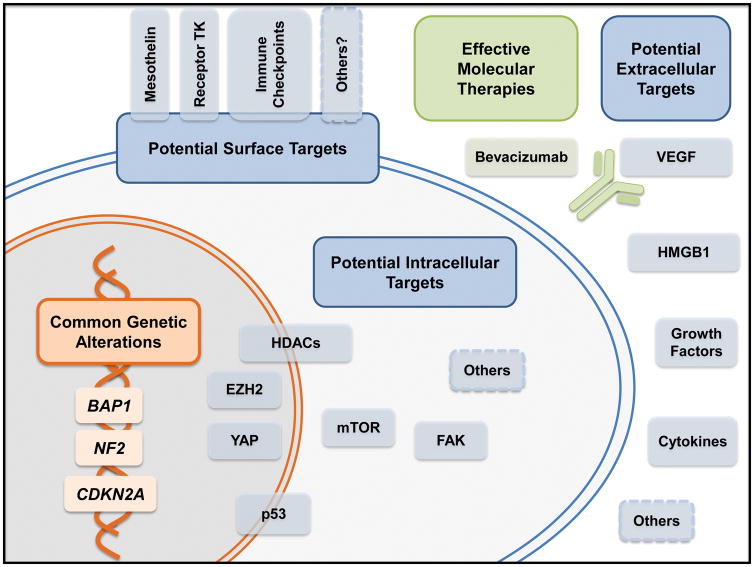
Figure 1 (Key Figure)
Figure 1 (Key Figure). Potential molecular targets in malignant mesothelioma
The most common genetic mutations in mesothelioma are in the tumor suppressor genes BAP1, NF2, and CDKN2A. Although these molecules cannot be directly targeted, therapies can aim at surrogate intracellular targets whose activity is as a consequence increased or necessary. Promising therapies currently undergoing clinical trials include the use of monoclonal antibodies to target surface molecules specific for mesothelioma (e.g., mesothelin) and immune checkpoint (e.g. CTLA-4, PD1, PDL1). Inhibition of VEGF with the monoclonal antibody bevacizumab has been proven effective in a phase III clinical trial. Other potential soluble targets whose translational relevance is being currently investigated are also shown.

References

    1. Carbone M, et al. Malignant mesothelioma: facts, myths, and hypotheses. J Cell Physiol. 2012;227(1):44–58. - PMC - PubMed
    1. Henley SJ, et al. Mesothelioma incidence in 50 states and the District of Columbia, United States, 2003– 2008. Int J Occup Environ Health. 2013;19(1):1–10. - PMC - PubMed
    1. Carbone M, Yang H. Molecular pathways: targeting mechanisms of asbestos and erionite carcinogenesis in mesothelioma. Clin Cancer Res. 2012;18(3):598–604. - PMC - PubMed
    1. Sluis-Cremer GK, et al. The mortality of amphibole miners in South Africa, 1946–80. Br J Ind Med. 1992;49(8):566–75. - PMC - PubMed
    1. Bononi A, et al. Latest developments in our understanding of the pathogenesis of mesothelioma and the design of targeted therapies. Expert Rev Respir Med. 2015;9(5):633–54. - PMC - PubMed

Substances