


Bolus Insulin Dose Error Distributions Based on Results From Two Clinical Trials Comparing Blood Glucose Monitoring Systems
- PMID: 28604064
- PMCID: PMC5950998
- DOI: 10.1177/1932296817713025
Bolus Insulin Dose Error Distributions Based on Results From Two Clinical Trials Comparing Blood Glucose Monitoring Systems
Abstract
Background: In 2 previous clinical trials, fingertip capillary blood samples were evaluated using prespecified blood glucose monitoring systems (BGMSs) and a reference YSI glucose analyzer. In post hoc analyses, hypothetical insulin doses were calculated using these blood glucose measurements; dosing errors were compared for each trial.
Method: For each blood glucose measurement, premeal bolus insulin dosing was determined for a hypothetical person, assuming a 60-g carbohydrate meal and 100-mg/dL target blood glucose level (adjusting 1/25 insulin sensitivity and 1/15 insulin:carbohydrate ratio inputs to account for BGMS measurement error). Dosing error was the difference between doses calculated using the BGMS and YSI results.
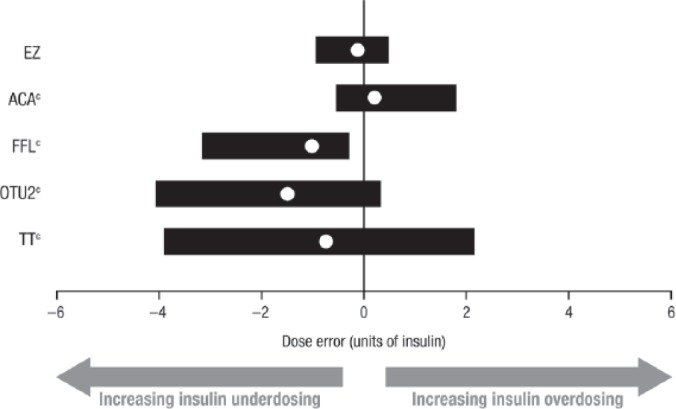
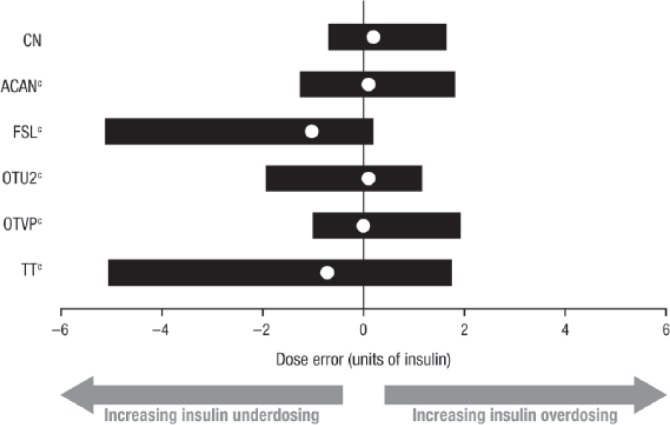
Results: In Clinical Trial 1, 95% dose error ranges (in units of insulin) were: CONTOUR®NEXT EZ BGMS (EZ), -0.9 to 0.5; Accu-Chek® Aviva BGMS (ACA), -0.5 to 1.8; FreeStyle Freedom Lite® BGMS (FFL), -3.2 to -0.3; OneTouch® Ultra®2 BGMS (OTU2), -4.1 to 0.3; and Truetrack® BGMS (TT), -3.9 to 2.2. In Clinical Trial 2, these ranges were: CONTOUR®NEXT BGMS (CN), -0.7 to 1.7; Accu-Chek® Aviva Nano BGMS (ACAN), -1.3 to 1.8; FreeStyle Lite® BGMS (FSL), -5.1 to 0.2; OTU2, -1.9 to 1.2; OneTouch® Verio® Pro BGMS (OTVP), -1.0 to 1.9; and TT, -5.1 to 1.7. Within each trial, EZ and CN had statistically significantly smaller insulin dose error ranges than other BGMSs ( P <0.0001).
Conclusions: The ranges of insulin dose errors were statistically significantly smaller with EZ and CN than with all other BGMSs in this post hoc analysis. Differences in BGMS accuracy could result in clinically important differences in insulin dosing.
Keywords: blood glucose monitoring; diabetes management; dosing errors; insulin; self-monitoring of blood glucose.
Conflict of interest statement
Figures
References
-
- Pettus J, Stenger P, Schachner HC, et al. Testing versus guessing blood glucose values: impact on self-care behaviors in type 2 diabetes. Curr Med Res Opin. 2014;30(9):1795-1802. - PubMed
-
- Boyd JC, Bruns DE. Quality specifications for glucose meters: assessment by simulation modeling of errors in insulin dose. Clin Chem. 2001;47(2):209-214. - PubMed
Publication types
MeSH terms
Substances
LinkOut - more resources
Full Text Sources
Other Literature Sources
Medical
Research Materials
