


Review
doi: 10.1038/onc.2017.184.
Epub 2017 Jun 12.
LncRNA-mediated regulation of cell signaling in cancer
Affiliations
- PMID: 28604750
- PMCID: PMC6450570
- DOI: 10.1038/onc.2017.184
Item in Clipboard
Review
LncRNA-mediated regulation of cell signaling in cancer
Oncogene.
.
Abstract
To date, a large number of long non-coding RNAs (lncRNAs) have been recently discovered through functional genomics studies. Importantly, lncRNAs have been shown, in many cases, to function as master regulators for gene expression and thus, they can play a critical role in various biological functions and disease processes including cancer. Although the lncRNA-mediated gene expression involves various mechanisms, such as regulation of transcription, translation, protein modification, and the formation of RNA-protein or protein-protein complexes, in this review, we discuss the latest developments primarily in important cell signaling pathways regulated by lncRNAs in cancer.
Figures
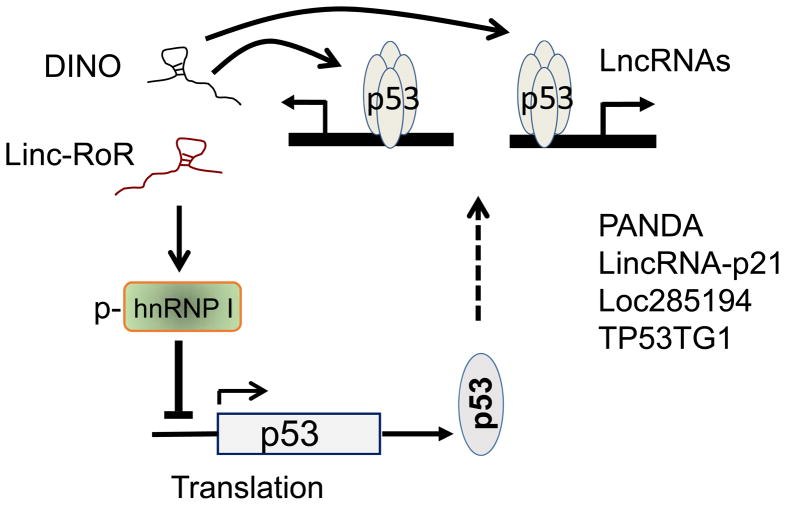
Both DINO and Linc-RoR are p53 transcriptional targets. While DINO stabilizes p53, Linc-RoR inhibits p53 translation.
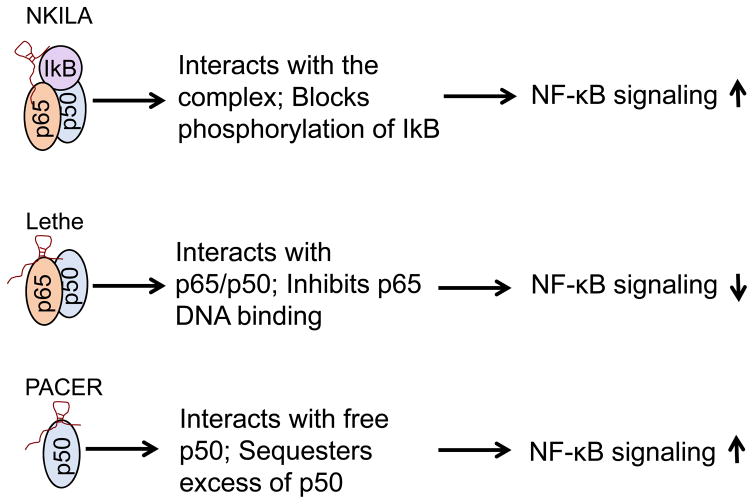
Both NKILA and PACER serve as an NF-κB promoter. On the other hand, Lethe suppresses NF-κB activity.
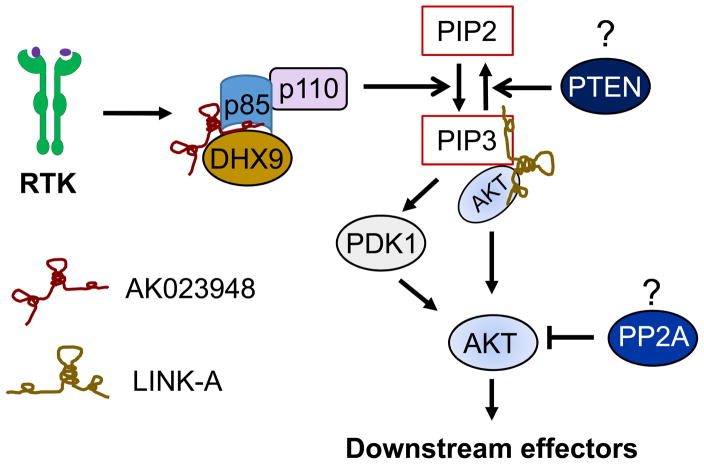
AK023948 promotes AKT activity by stabilizing p85, a regulatory subunit of PI3K; LINK-A facilitates the interaction of AKT and PIP3, stimulating AKT activity. It remains to be determined whether lncRNAs can interact with PTEN or PP2A and thus impact AKT activity.
References
Publication types
MeSH terms
Substances
Grants and funding
LinkOut - more resources
Full Text Sources
Other Literature Sources
