


Deltamethrin resistance in Aedes aegypti results in treatment failure in Merida, Mexico
- PMID: 28604781
- PMCID: PMC5481028
- DOI: 10.1371/journal.pntd.0005656
Deltamethrin resistance in Aedes aegypti results in treatment failure in Merida, Mexico
Abstract
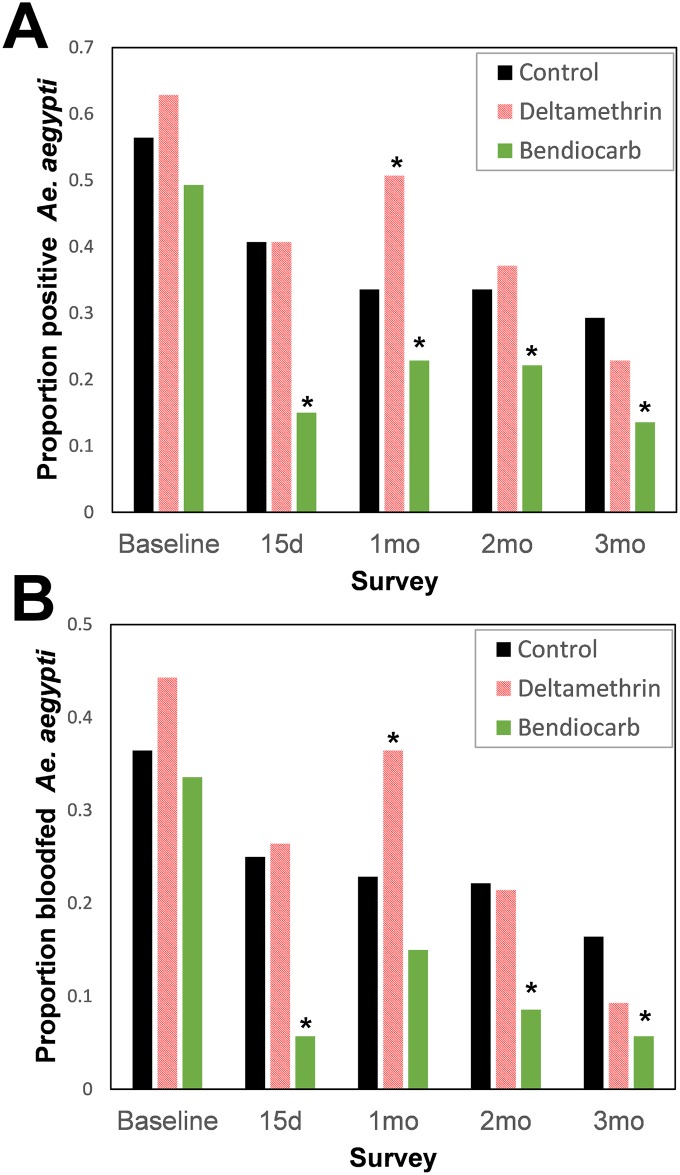
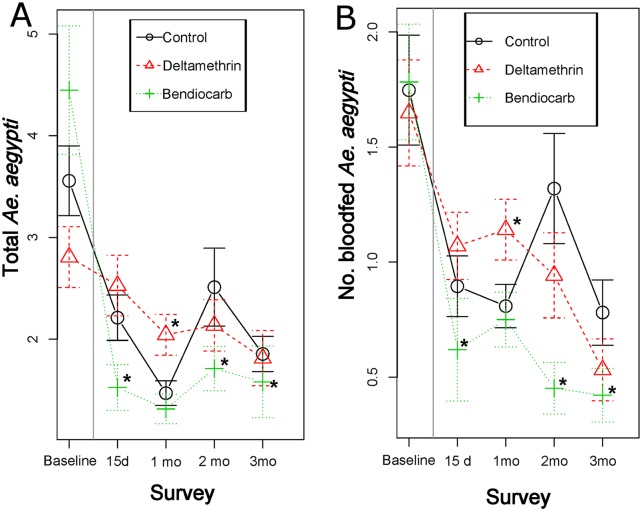
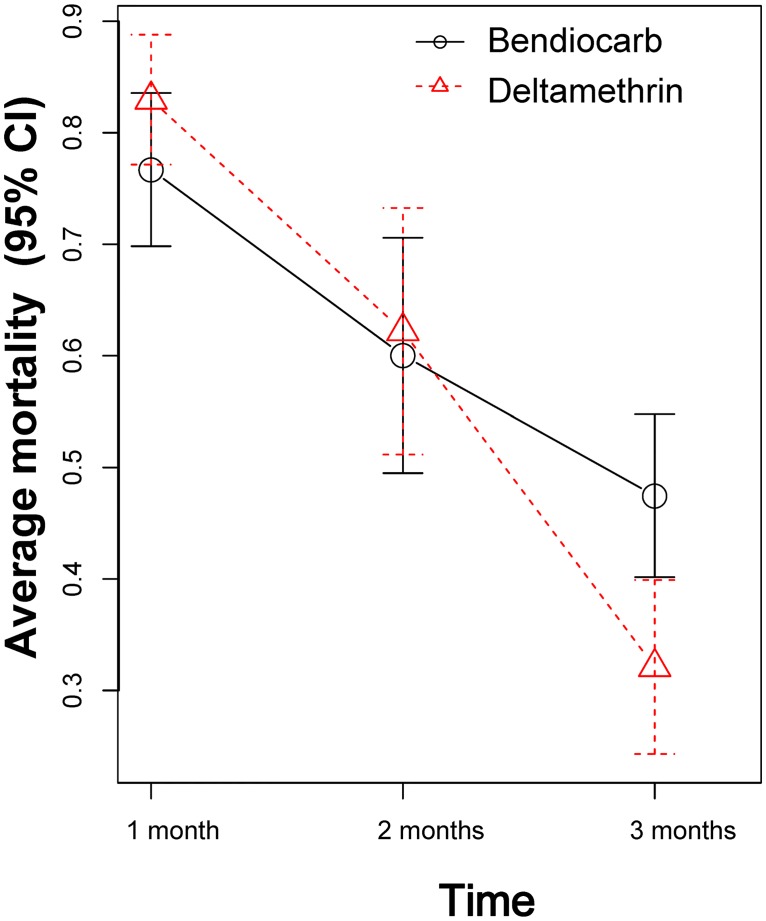
The operational impact of deltamethrin resistance on the efficacy of indoor insecticide applications to control Aedes aegypti was evaluated in Merida, Mexico. A randomized controlled trial quantified the efficacy of indoor residual spraying (IRS) against adult Ae. aegypti in houses treated with either deltamethrin (to which local Ae. aegypti expressed a high degree of resistance) or bendiocarb (to which local Ae. aegypti were fully susceptible) as compared to untreated control houses. All adult Ae. aegypti infestation indices during 3 months post-spraying were significantly lower in houses treated with bendiocarb compared to untreated houses (odds ratio <0.75; incidence rate ratio < 0.65) whereas no statistically significant difference was detected between the untreated and the deltamethrin-treated houses. On average, bendiocarb spraying reduced Ae. aegypti abundance by 60% during a 3-month period. Results demonstrate that vector control efficacy can be significantly compromised when the insecticide resistance status of Ae. aegypti populations is not taken into consideration.
Conflict of interest statement
The authors have declared that no competing interests exist.
Figures
References
-
- Gubler DJ. Dengue, Urbanization and Globalization: The Unholy Trinity of the 21(st) Century. Trop Med Health. 2011;39(4 Suppl):3–11. doi: 10.2149/tmh.2011-S05 . - DOI - PMC - PubMed
-
- Kraemer MU, Sinka ME, Duda KA, Mylne AQ, Shearer FM, Barker CM, et al. The global distribution of the arbovirus vectors Aedes aegypti and Ae. albopictus. Elife. 2015;4:e08347 doi: 10.7554/eLife.08347 . - DOI - PMC - PubMed
-
- Wikan N, Smith DR. Zika virus: history of a newly emerging arbovirus. Lancet Infect Dis. 2016;16(7):e119–26. doi: 10.1016/S1473-3099(16)30010-X . - DOI - PubMed
-
- Grobbelaar AA, Weyer J, Moolla N, Jansen van Vuren P, Moises F, Paweska JT. Resurgence of Yellow Fever in Angola, 2015–2016. Emerg Infect Dis. 2016;22(10):1854–5. doi: 10.3201/eid2210.160818 . - DOI - PMC - PubMed
-
- Lednicky J, De Rochars VM, Elbadry M, Loeb J, Telisma T, Chavannes S, et al. Mayaro Virus in Child with Acute Febrile Illness, Haiti, 2015. Emerg Infect Dis. 2016;22(11):2000–2. doi: 10.3201/eid2211.161015 . - DOI - PMC - PubMed
MeSH terms
Substances
LinkOut - more resources
Full Text Sources
Other Literature Sources
