. 2017 Jun 12;17(1):136.
doi: 10.1186/s12862-017-0987-y.

Improved mitochondrial amino acid substitution models for metazoan evolutionary studies

Affiliations

Improved mitochondrial amino acid substitution models for metazoan evolutionary studies

Vinh Sy Le et al. BMC Evol Biol. .

Abstract

Background: Amino acid substitution models play an essential role in inferring phylogenies from mitochondrial protein data. However, only few empirical models have been estimated from restricted mitochondrial protein data of a hundred species. The existing models are unlikely to represent appropriately the amino acid substitutions from hundred thousands metazoan mitochondrial protein sequences.

Results: We selected 125,935 mitochondrial protein sequences from 34,448 species in the metazoan kingdom to estimate new amino acid substitution models targeting metazoa, vertebrates and invertebrate groups. The new models help to find significantly better likelihood phylogenies in comparison with the existing models. We noted remarkable distances from phylogenies with the existing models to the maximum likelihood phylogenies that indicate a considerable number of incorrect bipartitions in phylogenies with the existing models. Finally, we used the new models and mitochondrial protein data to certify that Testudines, Aves, and Crocodylia form one separated clade within amniotes.

Conclusions: We introduced new mitochondrial amino acid substitution models for metazoan mitochondrial proteins. The new models outperform the existing models in inferring phylogenies from metazoan mitochondrial protein data. We strongly recommend researchers to use the new models in analysing metazoan mitochondrial protein data.

Keywords: Invertebrates; Metazoa; Mitochondrial amino acid substitution models; Vertebrates.


Figures
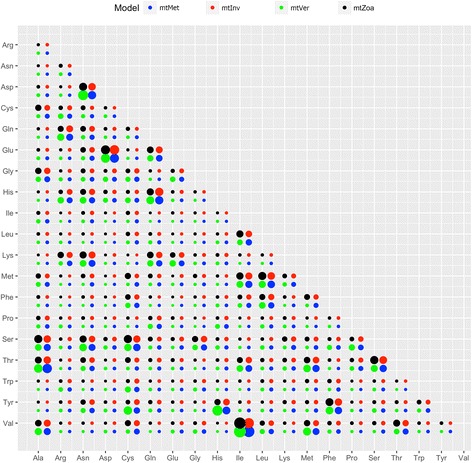
Fig. 1
Fig. 1
Amino acid exchangeability rates of the mtMet, mtInv, mtVer, and mtZoa models. There are some considerable difference between mtZoa and the new models
Fig. 2
Fig. 2
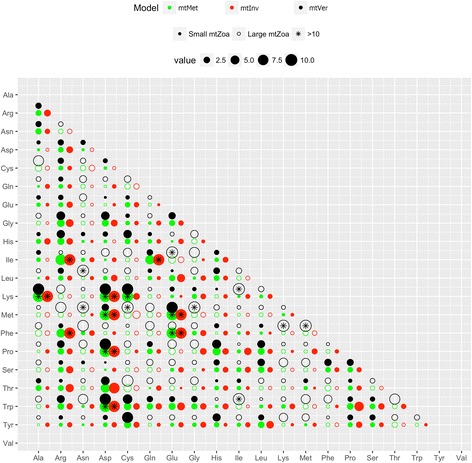
The ratio of exchangeability rates between mtZoa and mtMet/mtVer/mtInv models. The size of one circle represents the exchangeability rate between mtZoa and other models. The solid (unfilled) circles represent exchangeability rates where mtZoa is smaller (bigger) than the three models. For visualization, the large ratios are trimmed at 10 and marked with ‘*’
Fig. 3
Fig. 3
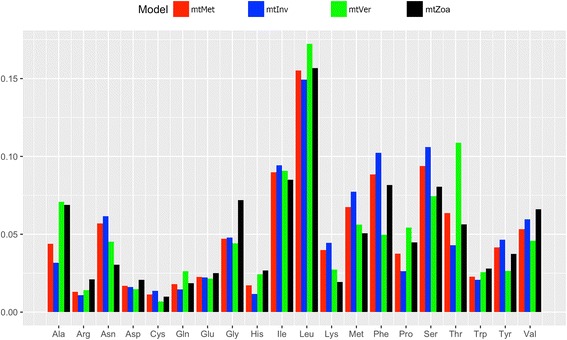
Amino acid frequencies of the mtMet, mtInv, mtVer, and mtZoa models. There are some considerable difference between mtZoa and the new models
Fig. 4
Fig. 4
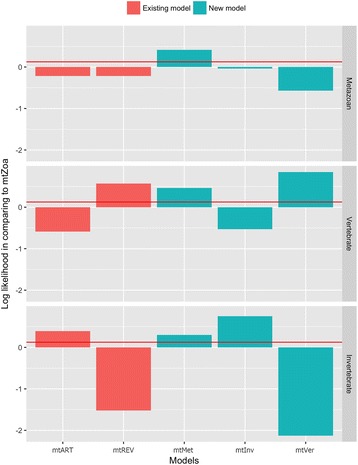
Difference per site between log-likelihood of phylogenies with mtZoa and that with the existing models (mtREV and mtArt), and the new models (mtMet, mtVer, and mtVer). The red line represents the improvement of LG from WAG
Fig. 5
Fig. 5
We used the approximately unbiased SH test to compute the confidence levels for phylogenies with the new and existing models on metazoan, vertebrate and invertebrate testing datasets. For each testing alignment D, we computed the site-wise log likelihoods for every (T i, M i|D) where M i is one of six mt models and T i is the phylogeny of D under M i. The CONSEL program was used for assessing the confidence levels for each (T i, M i|D)
Fig. 6
Fig. 6
We used the approximately unbiased SH test (explanations are given in Fig. 5) to compute the confidence levels for phylogenies with six mt models (mtMet, mtVer, mtInv, mtArt, mtREV, and mtZoa) on metazoan, vertebrate and invertebtate testing datasets
Fig. 7
Fig. 7
Unrooted binary trees T ,  T , and true tree T 0 each has 7 bipartitions. The bipartitions that in T but not in T  is {(12| 345), (124| 35)}. The bipartitions that in T but not in T is {(15| 234), (152| 34)}. The Robinson and Foulds distance between T and T is four. The set S of all bipartitions in T and T  is 12345,12435,15234,15234,12345,21345,31245,41235,51234. As the set S consists of 2 incorrect bipartitions (i.e., (124| 35) and (15| 234)), the worse tree must contain at least one incorrect bipartition (a quarter of the Robinson and Foulds distance between T and T )
Fig. 8
Fig. 8
We used the approximately unbiased SH test to examine tree topologies on metazoan, vertebrate and invertebrate testing datasets. For each testing alignment D, we determined its best-fit model M b. We fixed tree topologies, but reoptimised other parameters (i.e., branch lengths, parameters of rate heterogeneity model) under the best-fit model M b. Then we used the CONSEL program to assess the confidence levels for every tree topologies
Fig. 9
Fig. 9
Location of Turtles in Amiphiona. The Testudines clade including two clades (Pleurodira and Cryptodira) is located within the clade of Crocodylia and Aves

References

    1. Gray IC, Barnes MR. Amino acid properties and consequences of substitutions. Bioinforma. Genet. Chichester, UK: John Wiley & Sons. Ltd. 2003;4:289–304.
    1. Benner S a, Cohen MA, Gonnet GH. Amino acid substitution during functionally constrained divergent evolution of protein sequences. Protein Eng. 1994, p. 1323–32. - PubMed
    1. Dang CC, Le QS, Gascuel O, Le VS. FLU, an amino acid substitution model for influenza proteins. BMC Evol Biol. 2010;10:99. doi: 10.1186/1471-2148-10-99. - DOI - PMC - PubMed
    1. Nickle DC, Heath L, Jensen MA, Gilbert PB, Mullins JI, Kosakovsky Pond SL. HIV-Specific Probabilistic Models of Protein Evolution. Pybus O, editor. PLoS One 2007, 2:e503. - PMC - PubMed
    1. Rota-Stabelli O, Yang Z, Telford MJ. MtZoa: a general mitochondrial amino acid substitutions model for animal evolutionary studies. Mol Phylogenet Evol. 2009;52:268–272. doi: 10.1016/j.ympev.2009.01.011. - DOI - PubMed

Substances

LinkOut - more resources