. 2017 Jun 12;10(1):291.
doi: 10.1186/s13071-017-2206-5.

The importance of patient compliance in repeated rounds of mass drug administration (MDA) for the elimination of intestinal helminth transmission

Affiliations

The importance of patient compliance in repeated rounds of mass drug administration (MDA) for the elimination of intestinal helminth transmission

Sam H Farrell et al. Parasit Vectors. .

Abstract

Background: Systematic non-compliance to chemotherapeutic treatment among a portion of the eligible population is thought to be a major obstacle to the elimination of helminth infections by mass drug administration (MDA). MDA for helminths is repeated at defined intervals such as yearly or every 2 years, as a consequence of the inability of the human host to develop fully protective immunity to reinfection. As such, how an individual complies to these repeated rounds of MDA can have a significant impact on parasite transmission. The importance of this factor is poorly understood at present. Few epidemiological studies have examined longitudinal trends in compliance in the many communities in areas of endemic helminth infection that are undergoing MDA. Reducing systematic non-compliance will obviously increase the number of individuals treated, but it may also alter the dynamics of parasite transmission.

Methods: Here we develop an individual-based stochastic model of helminth transmission and MDA treatment to investigate how different patterns of compliance influence the impact of MDA for two groups of helminths, the soil transmitted nematode infections and the schistosome parasites. We study the effect of several alternative treatment and compliance patterns on the dynamics of transmission.

Results: We find that the impact of different compliance patterns, ranging from random treatment at each round of chemotherapy to systematic non-compliance by a proportion of the population, is very dependent on both transmission intensity in a defined setting and the type of infection that the treatment is targeted at. Systematic non-compliance has a greater impact on the potential for elimination of Schistosoma mansoni transmission by intensive MDA, than it does on Ascaris lumbricoides.

Conclusions: We discuss the implications of our findings for the prioritisation of resources in MDA programmes and for monitoring and evaluation programme design. The key message generated by the analyses is that great care must be taken to record individual longitudinal patterns of compliance at each round of MDA as opposed to just recording overall coverage.

Keywords: Compliance; Mass Drug Administration; Mathematical modelling; Schistosomiasis; Soil-transmitted Helminths; Systematic non-compliance.


Figures
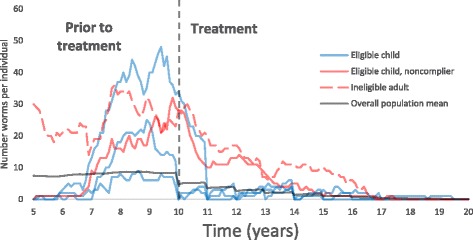
Fig. 1
Fig. 1
An illustrative selection of worm burdens over time in five individuals set against the mean worm burden in the human population. X-axis: year of simulation. Y-axis: the number of parasites per individual host. Part of the population is treated and benefits immediately while untreated individuals benefit over time via ‘herd effects’ through natural worm mortality as infectious material in the environment is reduced. Four children are born in year five and are eligible for treatment. Three are treated under a semi-systematic treatment setting, and attend most treatments. One systematically does not comply with treatment. One adult is ineligible and does not receive treatment. Treatments are annual with eight rounds from year 10 onwards (parameter values as defined in Table 2)
Fig. 2
Fig. 2
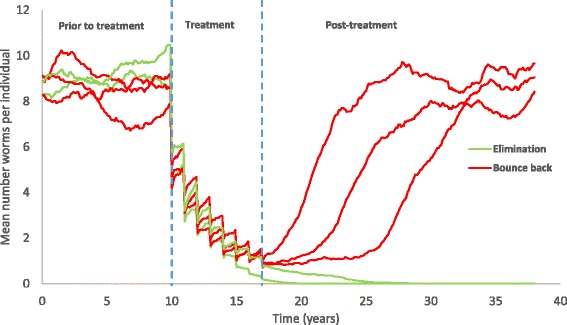
An illustration of five simulation repeats, showing stochastic variability and the impact of treatment. X-axis: year of simulation. Y-axis: the mean number of parasites in each independent population. In two repeats, elimination is successful, in three others the parasite population bounces back
Fig. 3
Fig. 3
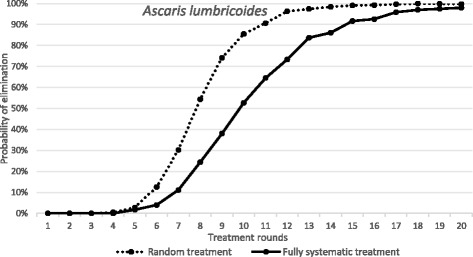
The dependence of probability of elimination of A. lumbricoides on the number of annual treatment rounds. X-axis: the number of treatment rounds. Y-axis: the proportion of 1000 repeats in which elimination is achieved, in a random treatment scenario (all individuals treated at random, 75% pre-SAC and SAC coverage) and a fully systematic treatment scenario (75% of pre-SAC and SAC always treated, remaining population never treated). Parameter values as defined in Table 2
Fig. 4
Fig. 4
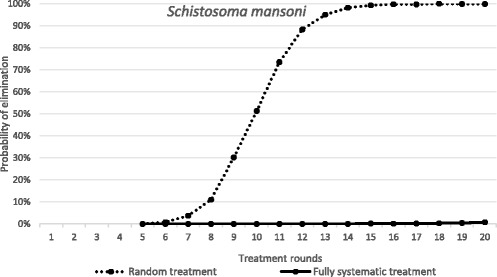
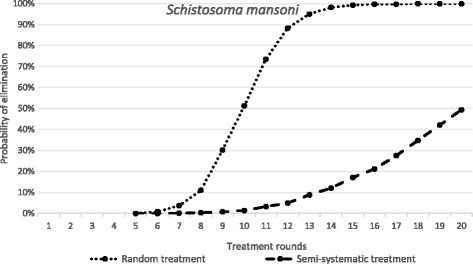
The dependence of probability of elimination of S. mansoni on the number of annual treatment rounds. X-axis: the number of treatment rounds. Y-axis: the proportion of 1000 repeats in which elimination is achieved, in a random treatment scenario (all individuals treated at random, 75% SAC and 30% adult coverage) and a fully systematic treatment scenario (75% SAC and 30% adults always treated, remaining population never treated). Parameter values as defined in Table 2
Fig. 5
Fig. 5
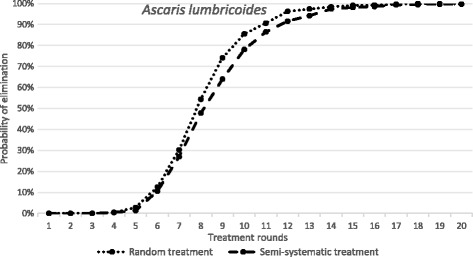
The dependence of probability of elimination of A. lumbricoides on the number of annual treatment rounds. X-axis: the number of treatment rounds. Y-axis: the proportion of 1000 repeats in which elimination is achieved, in a random treatment scenario (all individuals treated at random, 75% pre-SAC and SAC coverage) and a semi-systematic treatment scenario (individuals attend according to a personal propensity, 75% pre-SAC and SAC coverage). Parameter values as defined in Table 2
Fig. 6
Fig. 6
The dependence of probability of elimination of S. mansoni on the number of annual treatment rounds. X-axis: the number of treatment rounds. Y-axis: the proportion of 1000 repeats in which elimination is achieved, in a random treatment scenario (all individuals treated at random, 75% SAC and 30% adult coverage) and a semi-systematic treatment scenario (individuals attend according to a personal propensity, 75% SAC and 30% adult coverage). Parameter values as defined in Table 2
Fig. 7
Fig. 7
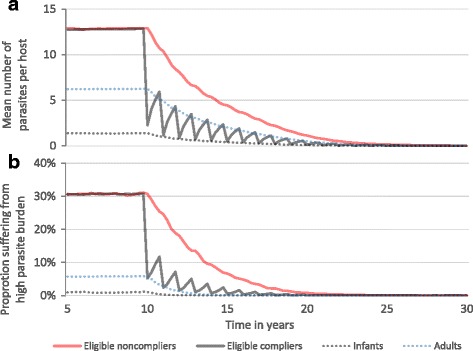
Grouped parasite burdens in an A. lumbricoides-endemic area. Pre-SAC and SAC are eligible for annual treatment at 75% coverage. For illustration, treatment continues indefinitely. X-axis: year of simulation. Y-axis: across 1000 repeat simulations; (a) mean parasite burden, (b) proportion of each group suffering from high worm burden. Parameter values as defined in Table 2. The definition of high parasite burden is given in [32]
Fig. 8
Fig. 8
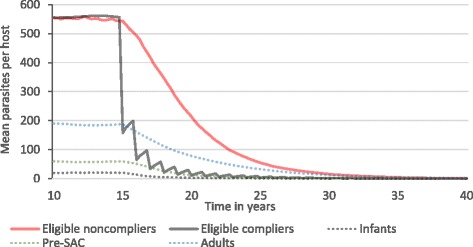
Grouped mean parasite burdens in an S. mansoni-endemic area. SAC are eligible for annual treatment at 75% coverage. For illustration, treatment continues indefinitely. X-axis: year of simulation. Y-axis: mean parasite burden across 1000 repeat simulations. Parameter values as defined in Table 2

References

    1. Anderson RM, Turner HC, Truscott JE, Hollingsworth TD, Brooker SJ. Should the goal for the treatment of soil transmitted helminth (STH) infections be changed from morbidity control in children to community-wide transmission elimination? PLoS Negl Trop Dis. 2015;9(8):e0003897. doi: 10.1371/journal.pntd.0003897. - DOI - PMC - PubMed
    1. Easton AV, Oliveira RG, O’Connell EM, Kepha S, Mwandawiro CS, Njenga SM, et al. Multi-parallel qPCR provides increased sensitivity and diagnostic breadth for gastrointestinal parasites of humans: field-based inferences on the impact of mass deworming. Parasit Vectors. 2016;9:38. doi: 10.1186/s13071-016-1314-y. - DOI - PMC - PubMed
    1. Pullan RL, Smith JL, Jasrasaria R, Brooker SJ. Global numbers of infection and disease burden of soil transmitted helminth infections in 2010. Parasit Vectors. 2014;7:37. doi: 10.1186/1756-3305-7-37. - DOI - PMC - PubMed
    1. Murray CJ, Vos T, Lozano R, Naghavi M, Flaxman AD, Michaud C, et al. Disability-adjusted life years (DALYs) for 291 diseases and injuries in 21 regions, 1990–2010: a systematic analysis for the Global Burden of Disease Study 2010. Lancet. 2012;380(9859):2197–223. doi: 10.1016/S0140-6736(12)61689-4. - DOI - PubMed
    1. Pullan RL, Brooker SJ. The global limits and population at risk of soil-transmitted helminth infections in 2010. Parasit Vectors. 2012;5:81. doi: 10.1186/1756-3305-5-81. - DOI - PMC - PubMed