. 2017:2017:4156361.
doi: 10.1155/2017/4156361. Epub 2017 May 9.

Antioxidant Treatment Induces Hyperactivation of the HPA Axis by Upregulating ACTH Receptor in the Adrenal and Downregulating Glucocorticoid Receptors in the Pituitary

Affiliations

Antioxidant Treatment Induces Hyperactivation of the HPA Axis by Upregulating ACTH Receptor in the Adrenal and Downregulating Glucocorticoid Receptors in the Pituitary

Jessika P Prevatto et al. Oxid Med Cell Longev. 2017.

Abstract

Glucocorticoid (GC) production is physiologically regulated through a negative feedback loop mediated by the GC, which appear disrupted in several pathological conditions. The inability to perform negative feedback of the hypothalamus-pituitary-adrenal (HPA) axis in several diseases is associated with an overproduction of reactive oxygen species (ROS); however, nothing is known about the effects of ROS on the functionality of the HPA axis during homeostasis. This study analyzed the putative impact of antioxidants on the HPA axis activity and GC-mediated negative feedback upon the HPA cascade. Male Wistar rats were orally treated with N-acetylcysteine (NAC) or vitamin E for 18 consecutive days. NAC-treated rats were then subjected to a daily treatment with dexamethasone, which covered the last 5 days of the antioxidant therapy. We found that NAC and vitamin E induced an increase in plasma corticosterone levels. NAC intensified MC2R and StAR expressions in the adrenal and reduced GR and MR expressions in the pituitary. NAC also prevented the dexamethasone-induced reduction in plasma corticosterone levels. Furthermore, NAC decreased HO-1 and Nrf2 expression in the pituitary. These findings show that antioxidants induce hyperactivity of the HPA axis via upregulation of MC2R expression in the adrenal and downregulation of GR and MR in the pituitary.


Figures
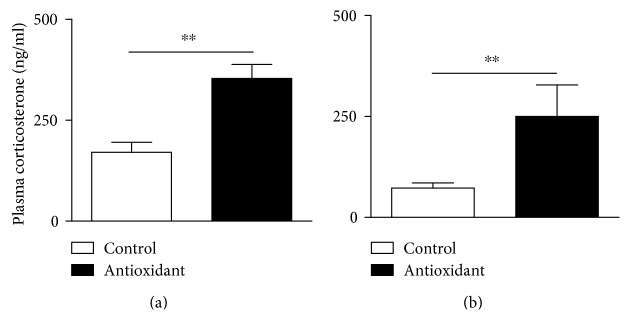
Figure 1
Figure 1
Antioxidant treatment increases circulating levels of plasma corticosterone in Wistar rats. (a) NAC (150 mg/kg, oral route) and (b) vitamin E (40 mg/kg, oral route) were given daily for 18 consecutive days. Untreated animals received an equal amount of vehicle (saline 0.9% or DMSO 0.1%). Data are expressed as the mean ± SEM of 6 animals. This result is a representative of two independent assays. ∗∗p < 0.01.
Figure 2
Figure 2
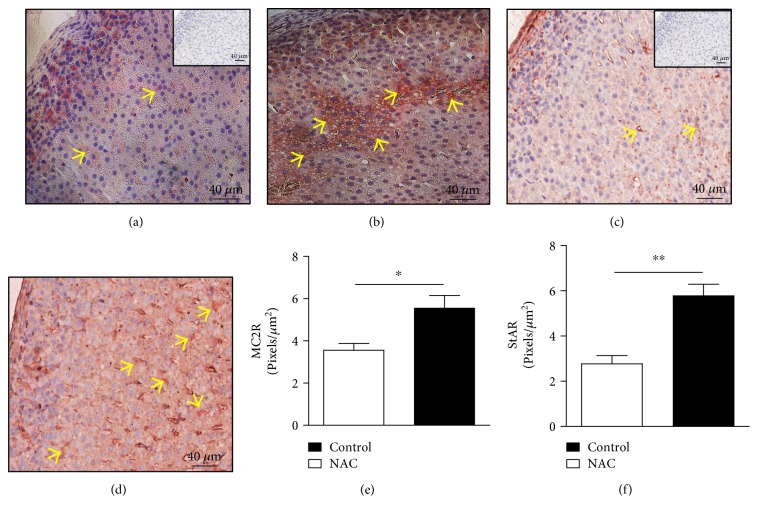
NAC induces an upregulation of MC2R and StAR expression in the zona fasciculata of the adrenal of Wistar rats. NAC (150 mg/kg, oral route) was given daily for 18 consecutive days and the analysis was made by immunohistochemistry. The panels show representative photomicrographs of adrenal expression of MC2R in the (a) control and (b) NAC-treated rats and StAR in (c) control and (d) NAC-treated rats. The quantification of pixels associated with MC2R and StAR expression is shown in (e) and (f), respectively. Inserts represent negative controls. Yellow arrows indicate immunolabelling of MC2R (a, b) and StAR (c, d) in the zona fasciculata of adrenals. Data are expressed as the mean ± SEM of 6 animals. This result is a representative of two independent assays. p < 0.05 and ∗∗p < 0.01.
Figure 3
Figure 3
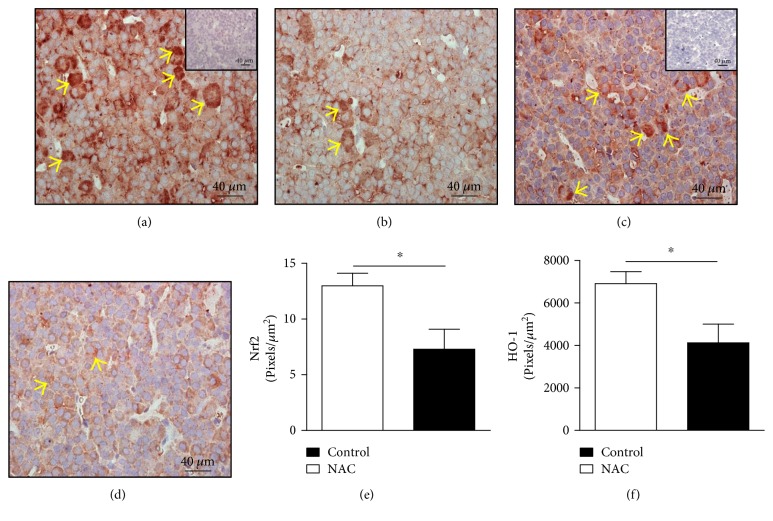
NAC reduces Nrf2 and HO-1 expression in the anterior pituitary of Wistar rats. NAC (150 mg/kg, oral route) was given daily for 18 consecutive days and analysis was made by immunohistochemistry. The panels show representative photomicrographs of pituitary expression of Nrf2 in (a) control and (b) NAC-treated rats and HO-1 in (c) control and (d) NAC-treated rats. The quantification of pixels associated with Nrf2 and HO-1 expression is shown in (e) and (f), respectively. Inserts represent negative controls. Yellow arrows indicate immunolabelling of Nrf2 (a, b) and HO-1 (c, d) in the anterior pituitary. Data are expressed as the mean ± SEM of 6 animals. This result is a representative of two independent assays. p < 0.05.
Figure 4
Figure 4
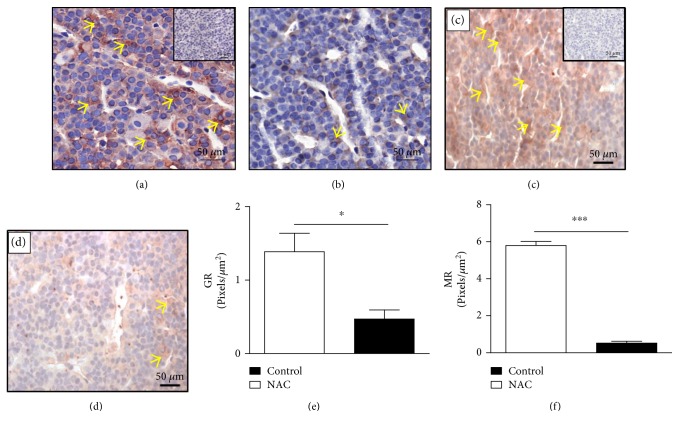
NAC decreases GR and MR expression in the anterior pituitary of Wistar rats. NAC (150 mg/kg, oral route) was given daily for 18 consecutive days and analysis was made by immunohistochemistry. The panels show representative photomicrographs of pituitary expression of GR in (a) control and (b) NAC-treated rats and MR in (c) control and (d) NAC-treated rats. The quantification of pixels associated with GR and MR expression is shown in (e) and (f), respectively. Inserts represent negative controls. Yellow arrows indicate immunolabelling of GR (a, b) and MR (c, d) in the anterior pituitary. Data are expressed as the mean ± SEM of 6 animals. This result is a representative of two independent assays. p < 0.05 and ∗∗∗p < 0.001.
Figure 5
Figure 5
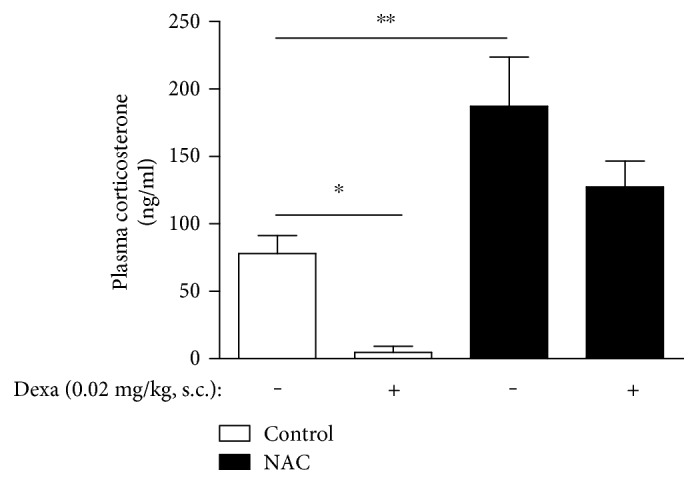
NAC impairs dexamethasone-induced negative feedback of the HPA axis in Wistar rats. NAC (150 mg/kg, oral route) was given daily for 18 consecutive days. Some groups of animals were injected with dexamethasone (0.02 mg/kg, s.c.) starting 13 days after the beginning of NAC treatment, daily during five consecutive days. Data are expressed as the mean ± SEM of 5 animals. This result is a representative of two independent assays. p < 0.05 and ∗∗p < 0.01.

References

    1. Kalyanaraman B. Teaching the basics of redox biology to medical and graduate students: oxidants, antioxidants and disease mechanisms. Redox Biology. 2013;1(1):244–257. doi: 10.1016/j.redox.2013.01.014. - DOI - PMC - PubMed
    1. Ma Q. Role of nrf2 in oxidative stress and toxicity. Annual Review of Pharmacology and Toxicology. 2013;53(1):401–426. doi: 10.1146/annurev-pharmtox-011112-140320. - DOI - PMC - PubMed
    1. Kardeh S., Ashkani-Esfahani S., Alizadeh A. M. Paradoxical action of reactive oxygen species in creation and therapy of cancer. European Journal of Pharmacology. 2014;735(1):150–168. doi: 10.1016/j.ejphar.2014.04.023. - DOI - PubMed
    1. Nordgren M., Fransen M. Peroxisomal metabolism and oxidative stress. Biochimie. 2014;98:56–62. doi: 10.1016/j.biochi.2013.07.026. - DOI - PubMed
    1. Narayanan K. B., Park H. H. Pleiotropic functions of antioxidant nanoparticles for longevity and medicine. Advances in Colloid and Interface Science. 2013;201-202:30–42. doi: 10.1016/j.cis.2013.10.008. - DOI - PubMed

LinkOut - more resources