


Accuracy and precision of smartphone applications and commercially available motion sensors in multiple sclerosis
- PMID: 28607720
- PMCID: PMC5433404
- DOI: 10.1177/2055217316634754
Accuracy and precision of smartphone applications and commercially available motion sensors in multiple sclerosis
Abstract
Background: There is increased interest in the application of smartphone applications and wearable motion sensors among multiple sclerosis (MS) patients.
Objective: This study examined the accuracy and precision of common smartphone applications and motion sensors for measuring steps taken by MS patients while walking on a treadmill.
Methods: Forty-five MS patients (Expanded Disability Status Scale (EDSS) = 1.0-5.0) underwent two 500-step walking trials at comfortable walking speed on a treadmill. Participants wore five motion sensors: the Digi-Walker SW-200 pedometer (Yamax), the UP2 and UP Move (Jawbone), and the Flex and One (Fitbit). The smartphone applications were Health (Apple), Health Mate (Withings), and Moves (ProtoGeo Oy).
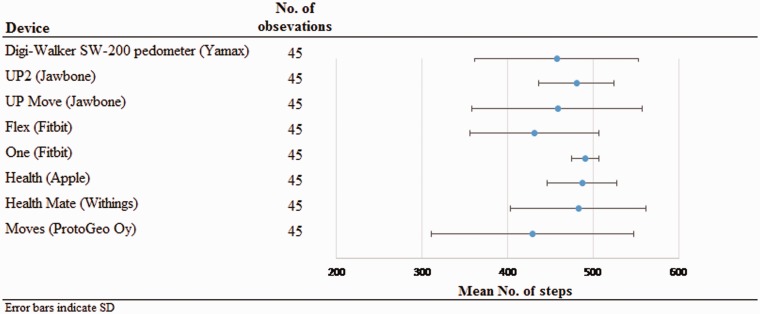
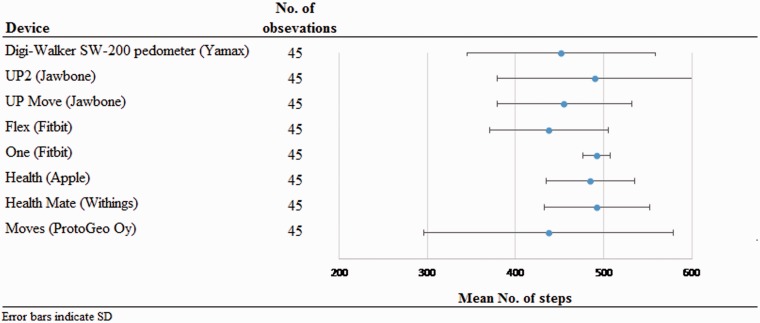
Results: The Fitbit One had the best absolute (mean = 490.6 steps, 95% confidence interval (CI) = 485.6-495.5 steps) and relative accuracy (1.9% error), and absolute (SD = 16.4) and relative precision (coefficient of variation (CV) = 0.0), for the first 500-step walking trial; this was repeated with the second trial. Relative accuracy was correlated with slower walking speed for the first (rs = -.53) and second (rs = -.53) trials.
Conclusion: The results suggest that the waist-worn Fitbit One is the most precise and accurate sensor for measuring steps when walking on a treadmill, but future research is needed (testing the device across a broader range of disability, at different speeds, and in real-life walking conditions) before inclusion in clinical research and practice with MS patients.
Keywords: Fitbit; MS; Motion sensors; smartphone applications; steps.
Figures
References
-
- Motl RW, Learmonth YC, Pilutti LA, et al. Top 10 research questions related to physical activity and multiple sclerosis. Res Q Exerc Sport 2015; 86: 117–129. - PubMed
-
- McIninch J, Datta S, DasMahapatra P, et al. Remote tracking of walking activity in MS patients in a real-world setting (P3.209). Neurology 2015; 84(14 Supplement): P3.209.
-
- Case MA, Burwick HA, Volpp KG, et al. Accuracy of smartphone applications and wearable devices for tracking physical activity data. JAMA 2015; 313: 625–626. - PubMed
-
- Kurtzke JF. Rating neurologic impairment in multiple sclerosis: An Expanded Disability Status Scale (EDSS). Neurology 1983; 33: 1444–1452. - PubMed
-
- Motl RW, Snook EM. Confirmation and extension of the validity of the Multiple Sclerosis Walking Scale-12 (MSWS-12). J Neurol Sci 2008; 268: 69–73. - PubMed
LinkOut - more resources
Full Text Sources
Other Literature Sources
