


Risk of psychosis in refugees: a literature review
- PMID: 28608852
- PMCID: PMC5537641
- DOI: 10.1038/tp.2017.119
Risk of psychosis in refugees: a literature review
Abstract
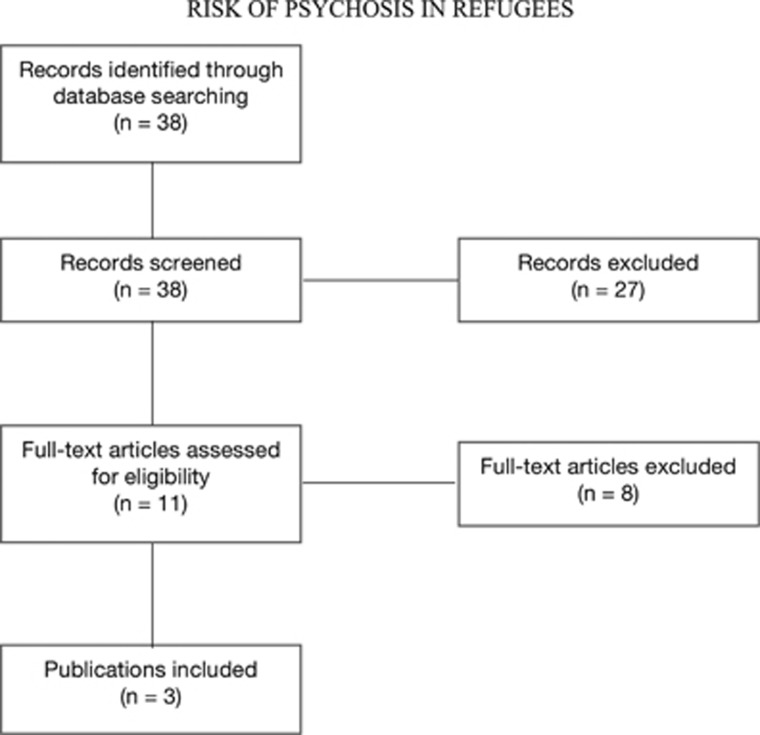
Conflicts and precarious living conditions resulted in the arrival of large numbers of refugees in Europe and especially in Germany. Evidence suggests that immigrant populations are at elevated risk of psychotic disorders. Considering the traumatic pre- and post-migratory adversities refugees may have encountered, people granted refugee status may even be more susceptible to psychosis than non-refugee migrants. The aim of this literature review is to summarise and interpret recent research on the incidence or prevalence of psychotic disorders in refugees, additionally focusing on the aspects of gender and Middle Eastern provenance. A systematic search in PubMed was performed in the time from 20 to 28 May 2016. Relevant literature was limited to articles describing cohort studies conducted in Western industrialised countries. Articles published between 1 June 2006 and 28 May 2016 were analysed. Content relating to psychotic disorders in refugees was reviewed and summarised. The selected studies showed an increased risk of psychotic disorders in refugees compared with both the indigenous population and non-refugee. migrants. The elevated risk was more pronounced in refugee men. A particularly high risk in refugees of Middle Eastern origin could not be inferred. The higher susceptibility to psychotic disorders in refugees emphasises the need for the development and implementation of adequate prevention strategies. Clinicians and people working in a refugee setting should be aware of early signs and symptoms of psychosis. Further research is required to evaluate post-migratory experiences and investigate the population of refugees affected by the current humanitarian crisis.
Conflict of interest statement
The authors declare no conflict of interest.
Figures
References
-
- Amnesty International. People on the move. Available athttps://www.amnesty.org/en/what-we-do/people-on-the-move/?gclid=CO6p-o6fmM0CFeIp... (accessed 8 June 2016).
-
- United Nations High Commissioner for Refugees (UNHCR, 11 July 2016). UNHCR viewpoint: 'Refugee' or 'migrant' – Which is right? Available fromhttp://www.unhcr.org/news/latest/2016/7/55df0e556/unhcr-viewpoint-refugee-migra... (accessed 15 July 2016).
-
- UNHCR (2015). UNHCR Statistical Yearbook 2014, 14th edition. Avaialble fromhttp://www.unhcr.org/statistics/country/566584fc9/unhcr-statistical-yearbook-20... (accessed 7 June 2016).
-
- Bundesamt für Migration und Flüchtlinge, (BAMF 2016). Migrationsbericht 2015 – Zentrale Ergebnisse. Available athttp://www.bamf.de/SharedDocs/Anlagen/DE/Publikationen/Migrationsberichte/migra... (accessed 8 February 2017).
-
- BAMF (2016). Das Bundesamt in Zahlen 2015 – Asyl. Available athttps://www.bamf.de/SharedDocs/Anlagen/DE/Publikationen/Broschueren/bundesamt-in... (accessed 13 June 2016).
Publication types
MeSH terms
LinkOut - more resources
Full Text Sources
Other Literature Sources
Medical
