


Disilicate-Assisted Iron Electrolysis for Sequential Fenton-Oxidation and Coagulation of Aqueous Contaminants
- PMID: 28609093
- PMCID: PMC6287740
- DOI: 10.1021/acs.est.7b01184
Disilicate-Assisted Iron Electrolysis for Sequential Fenton-Oxidation and Coagulation of Aqueous Contaminants
Abstract
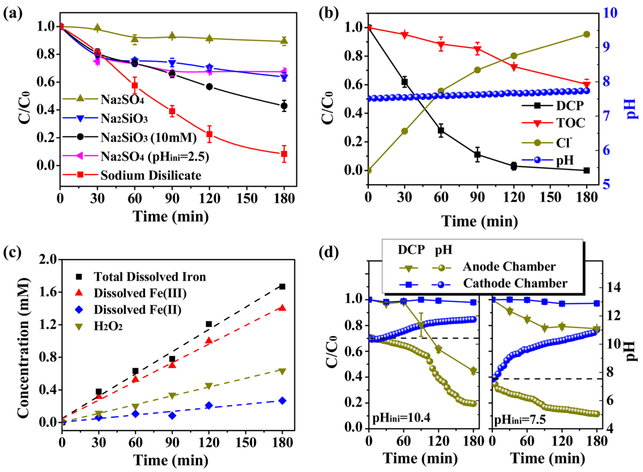
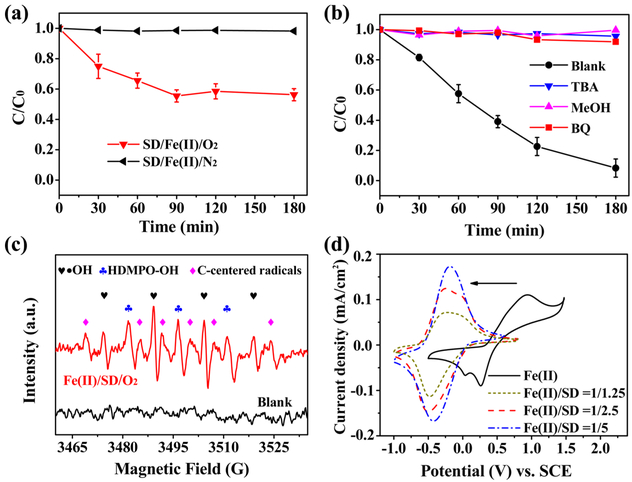
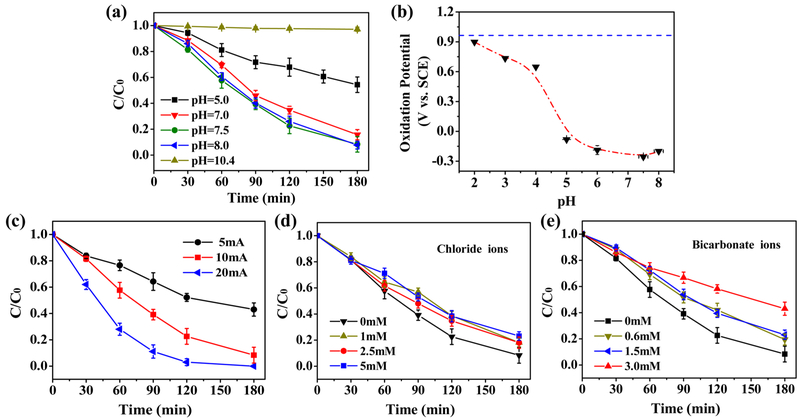
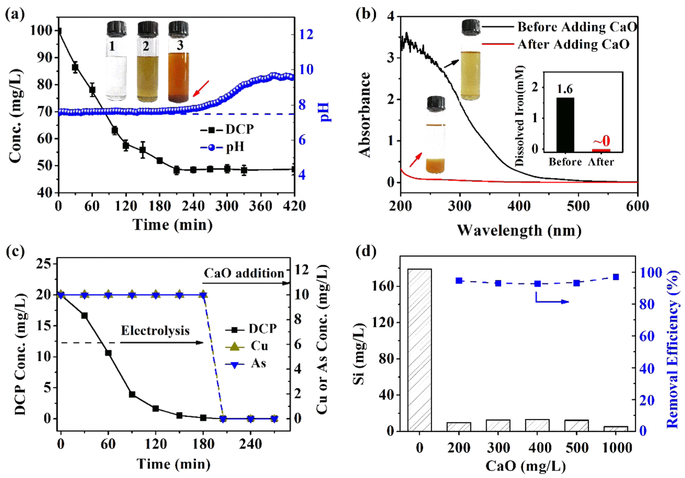
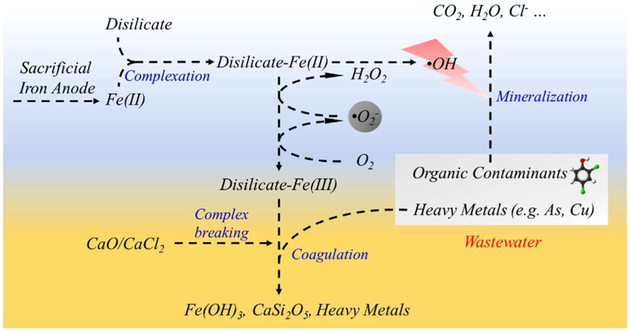
Sodium disilicate (SD), an inorganic and environmentally friendly ligand, is introduced into the conventional iron electrolysis system to achieve an oxidizing Fenton process to degrade organic pollutants. Electrolytic ferrous ions, which are complexed by the disilicate ions, can chemically reduce dioxygen molecules via consecutive reduction steps, producing H2O2 for the Fenton-oxidation of organics. At the near-neutral pH (from 6 to 8), the disilicate-Fe(II) complexes possess strong reducing capabilities; therefore, a near-neutral pH rather than an acid condition is preferable for the disilicate-assisted iron electrolysis (DAIE) process. Following the DAIE process, the different complexing capacities of disilicate for ferrous/ferric ions and calcium ions can be used to break the disilicate-iron complexes. The addition of CaO or CaCl2 can precipitate ferrous/ferric ions, disilicates and possibly heavy metals in the wastewater. Compared to previously reported organic and phosphorus ligands, SD is a low-cost inorganic agent that does not lead to secondary pollution, and would not compete with the target organic pollutants for •OH; therefore, it would greatly expand the application fields of the O2 activation process. The combination of DAIE and CaO treatments is envisioned to be a versatile and affordable method for treating wastewater with complicated pollutants (e.g., mixtures of biorefractory organics and heavy metals).
Figures
References
-
- Martínez-Huitle CA; Rodrigo MA; Sirés I; Scialdone O Single and coupled electrochemical processes and reactors for the abatement of organic water pollutants: a critical review. Chem. Rev 2015, 115 (24), 13362–13407. - PubMed
-
- Martínez-Huitle CA; Brillas E Decontamination of wastewaters containing synthetic organic dyes by electrochemical methods: a general review. Appl. Catal., B 2009, 87 (3), 105–145.
-
- Brillas E; Sirés I; Oturan MA Electro-Fenton process and related electrochemical technologies based on Fenton’s reaction chemistry. Chem. Rev 2009, 109 (12), 6570–6631. - PubMed
-
- Brillas E; Mur E; Sauleda R; Sanchez L; Peral J; Domènech X; Casado J Aniline mineralization by AOP’s: anodic oxidation, photocatalysis, electro-Fenton and photoelectro-Fenton processes. Appl. Catal., B 1998, 16 (1), 31–42.
-
- Zhao B; Li X; Wang P 2, 4-Dichlorophenol Degradation by an Integrated Process: Photoelectrocatalytic Oxidation and E-Fenton Oxidation. Photochem. Photobiol 2007, 83 (3), 642–646. - PubMed
MeSH terms
Substances
Grants and funding
LinkOut - more resources
Full Text Sources
Other Literature Sources
