


Exosomal Markers (CD63 and CD9) Expression Pattern Using Immunohistochemistry in Resected Malignant and Nonmalignant Pancreatic Specimens
- PMID: 28609367
- PMCID: PMC5494969
- DOI: 10.1097/MPA.0000000000000847
Exosomal Markers (CD63 and CD9) Expression Pattern Using Immunohistochemistry in Resected Malignant and Nonmalignant Pancreatic Specimens
Abstract
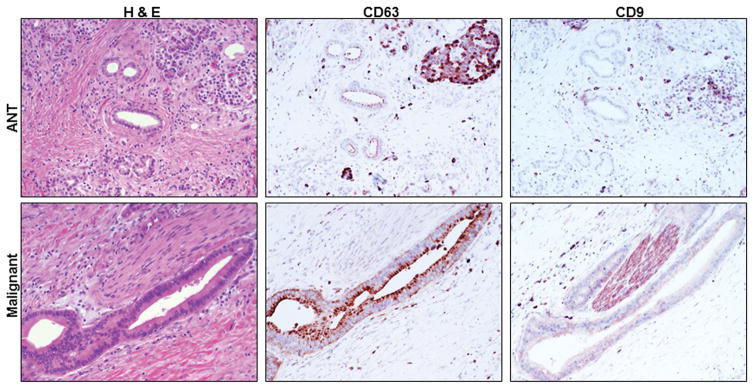
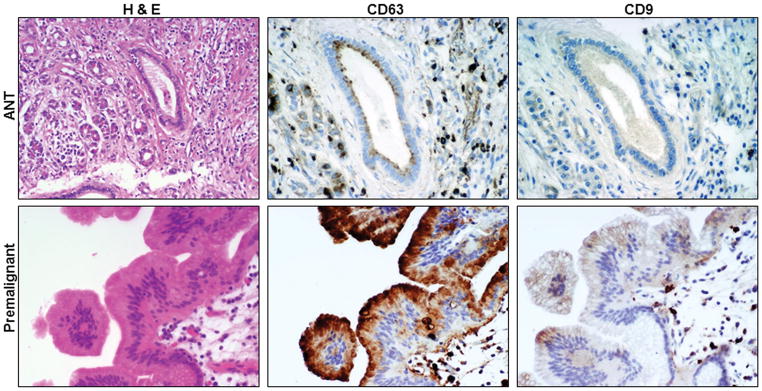
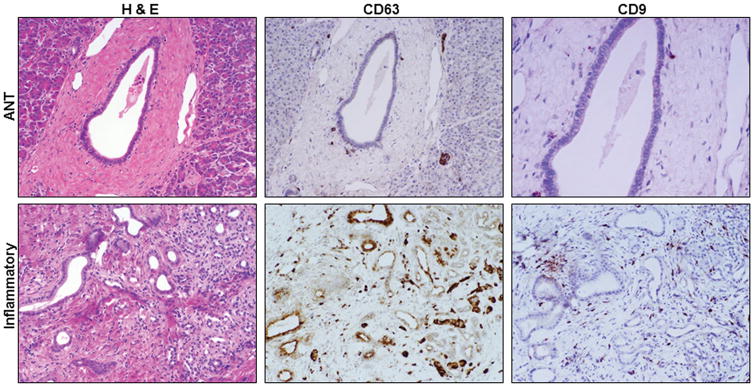
Objectives: Exosomes are important mediators in intercellular communications and play a role in cancer progression and metastasis. Exosomal membranes are enriched in endosome-specific tetraspanins (CD9 and CD63). Here, we explored the expression of CD63 and CD9 utilizing immunohistochemistry in malignant and nonmalignant cells in 29 resected pancreatic specimens (RPSs) of mixed racial background.
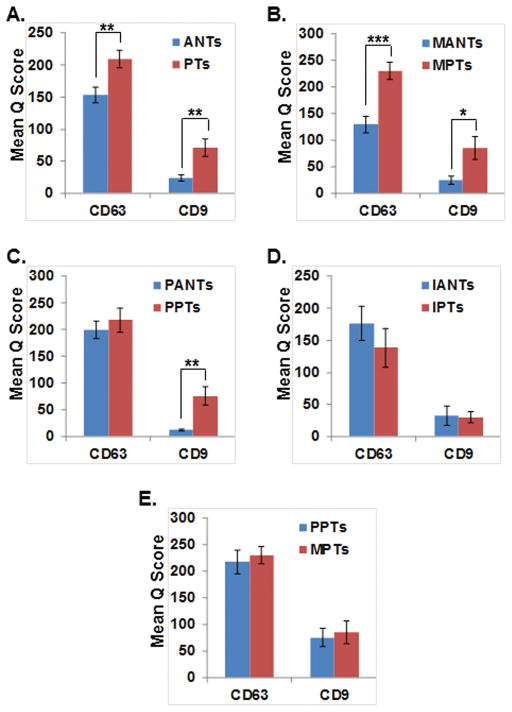
Methods: The pathologic tissues (PTs) and adjacent normal tissues (ANTs) in each RPS were stained for CD63 and CD9. Two pathologists independently scored the expression of CD63 and CD9. Staining intensity was graded from 1 to 3. Staining percentage was estimated in 10% increments. An average Quick score (Q score) (intensity × percentage of staining) was calculated. Unpaired t test was used for statistical analysis.
Results: The mean multiplicative Q score for CD63 and CD9 expression is higher in PTs (209 and 72) compared with ANTs (154 and 24) (P = 0.0041, P = 0.0018), respectively. The Mean Q score for CD63 and CD9 expression is higher in the malignant PTs (231 and 85) compared with ANTs (129 and 25) (P < 0.0001 and P < 0.0124).
Conclusions: Exosomal markers (CD63 and CD9) expression assessment using immunohistochemistry is feasible in RPS. The expression of CD63 and CD9 is higher in PTs and malignant PTs compared with their ANTs.
Conflict of interest statement
Figures
References
MeSH terms
Substances
Grants and funding
LinkOut - more resources
Full Text Sources
Other Literature Sources
Medical
Miscellaneous
