Review
. 2017 Oct:46:31-37.
doi: 10.1016/j.sbi.2017.05.012. Epub 2017 Jun 10.

Cryo-EM of bacterial pili and archaeal flagellar filaments

Affiliations
Review

Cryo-EM of bacterial pili and archaeal flagellar filaments

Edward H Egelman. Curr Opin Struct Biol. 2017 Oct.

Abstract

Recent advances in cryo-electron microscopy (cryo-EM) have opened up the possibility that a large class of biological structures, helical polymers, may now be readily reconstructed at near-atomic resolution. This will have a huge impact, since most of these structures are unlikely to be crystallized. This review focuses on new cryo-EM studies involving three classes of bacterial pili (chaperone-usher, mating, and Type IV) as well as on archaeal flagellar filaments. While it has long been known that one domain within archaeal flagellar filaments is homologous to a domain within bacterial Type IV pilins, the new studies shed light on how homologous and even highly conserved subunits can pack together in different ways with only small changes in sequence.


Conflict of interest statement

I have no conflicts of interest.

Figures
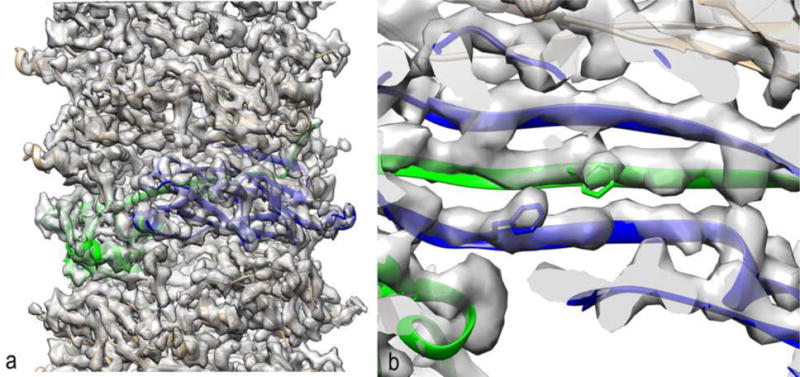
Figure 1
Figure 1
The first near-atomic resolution structure of a chaperone-usher pilus [23]. (a) Two adjacent subunits are colored (green and blue). The contacts with subunits above and below the two colored protomers are much weaker than the contacts between adjacent subunits along the 1-start helix, allowing this structure to uncoil into a thin strand while subunits are still attached to each other. (b) A segment of the P pilus reconstruction and model shows how a β-strand of one subunit (green) is donated to form part of the β-sheet of another subunit (blue). Two aromatic residue are shown (Phe13 in green and Phe35 in blue) to illustrate how threading the sequence through the reconstructed volume was quite unambiguous at this resolution (3.8 Å).
Figure 2
Figure 2
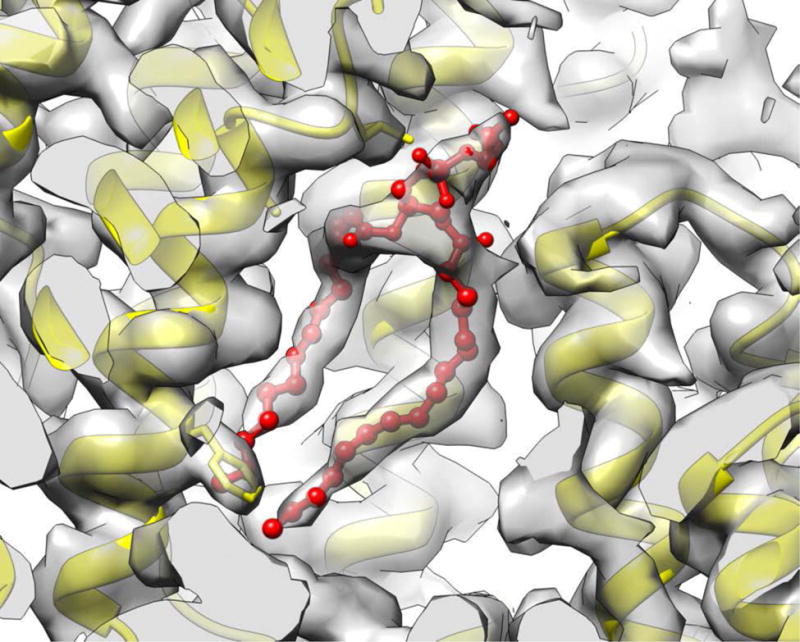
Phospholipid molecules (red) are very clearly resolved in the cryo-EM reconstruction of a pED208 mating pilus [30]. Surprisingly, a substantial part of the interface between the hydrophobic α-helices of the protein subunits (yellow) is mediated by the hydrophobic acyl chains. The polar head groups are facing the lumen of this tubular structure, changing the surface electrostatic potential.
Figure 3
Figure 3
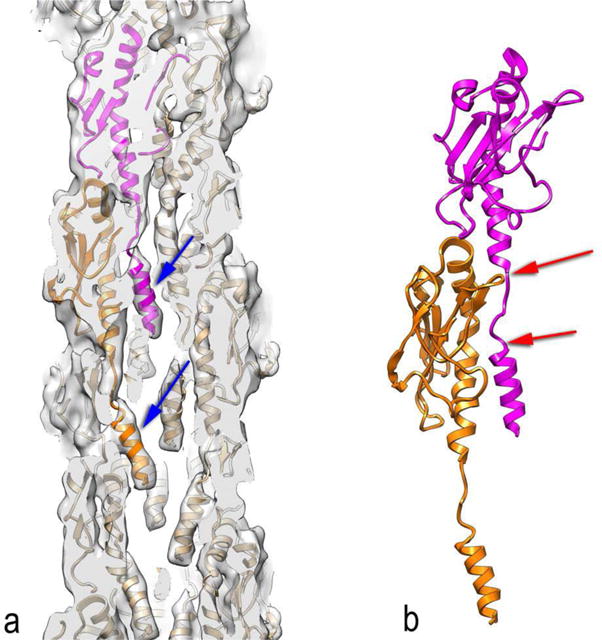
A bacterial Type IV pilus. (a) Although the resolution of the cryo-EM reconstruction (~ 6 Å) was modest [41], it is clear that the very N-terminal portion of the subunits (blue arrows) are not part of a single long continuous α-helix as seen in several crystal structures. Rather, this region is separated from the remainder of the α-helix by a melted region seen above the blue arrows. (b) Two subunits from the model in (a) are shown, where the melted region is indicated by the two red arrows. This melting allows the very N-terminal portion of the magenta subunit to maintain contacts with the globular region of the orange subunit, while the melted region can be stretched. In addition, further residues may also become part of this melted region.
Figure 4
Figure 4
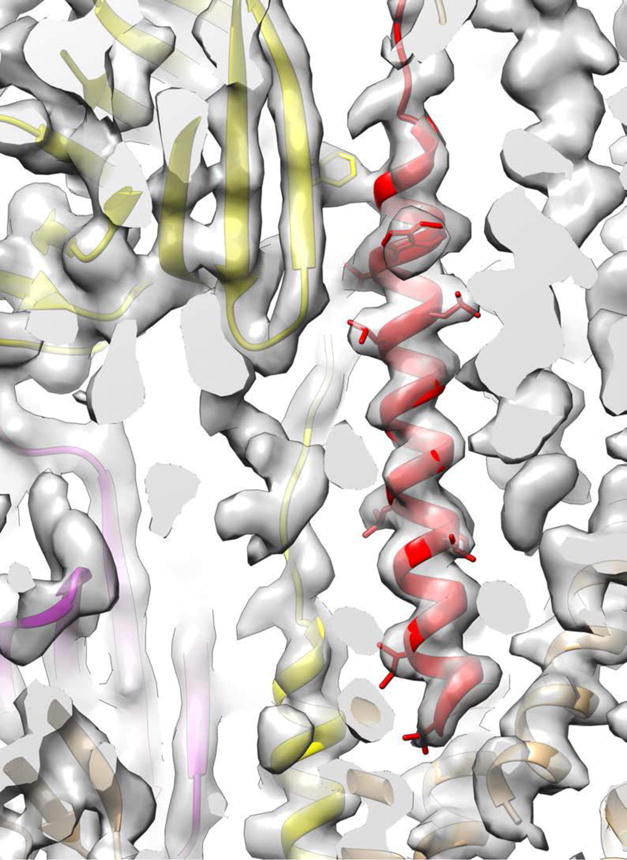
A small portion of the Iho670 flagellar-like filament reconstruction and atomic model [46], with a few sidechains shown. The red N-terminal helix is homologous with the N-terminal helix present in bacterial Type IV pili, but the packing of helices in these filaments is very different, and this helix is continuous in the flagellar-like filament but not in at least some bacterial pili.

References

    1. Egelman EH. The current revolution in cryo-em. Biophys J. 2016;110(5):1008–1012. - PMC - PubMed
    1. Subramaniam S, Earl LA, Falconieri V, Milne JL, Egelman EH. Resolution advances in cryo-em enable application to drug discovery. Curr Opin Struct Biol. 2016:41, 194–202. - PMC - PubMed
    1. Bai XC, McMullan G, Scheres SH. How cryo-em is revolutionizing structural biology. Trends Biochem Sci. 2015;40(1):49–57. - PubMed
    1. Li X, Mooney P, Zheng S, Booth CR, Braunfeld MB, Gubbens S, Agard DA, Cheng Y. Electron counting and beam-induced motion correction enable near-atomic-resolution single-particle cryo-em. Nature methods. 2013;10(6):584–590. - PMC - PubMed
    1. Liao M, Cao E, Julius D, Cheng Y. Structure of the trpv1 ion channel determined by electron cryo-microscopy. Nature. 2013;504(7478):107–112. - PMC - PubMed

MeSH terms

LinkOut - more resources