


Overcoming multiple myeloma drug resistance in the era of cancer 'omics'
- PMID: 28610537
- PMCID: PMC6152877
- DOI: 10.1080/10428194.2017.1337115
Overcoming multiple myeloma drug resistance in the era of cancer 'omics'
Abstract
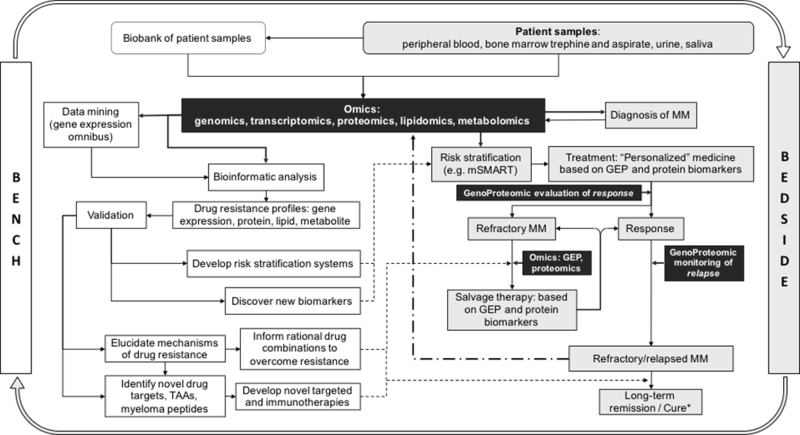
Multiple myeloma (MM) is among the most compelling examples of cancer in which research has markedly improved the length and quality of lives of those afflicted. Research efforts have led to 18 newly approved treatments over the last 12 years, including seven in 2015. However, despite significant improvement in overall survival, MM remains incurable as most patients inevitably, yet unpredictably, develop refractory disease. Recent advances in high-throughput 'omics' techniques afford us an unprecedented opportunity to (1) understand drug resistance at the genomic, transcriptomic, and proteomic level; (2) discover novel diagnostic, prognostic, and therapeutic biomarkers; (3) develop novel therapeutic targets and rational drug combinations; and (4) optimize risk-adapted strategies to circumvent drug resistance, thus bringing us closer to a cure for MM. In this review, we provide an overview of 'omics' technologies in MM biomarker and drug discovery, highlighting recent insights into MM drug resistance gleaned from the use of 'omics' techniques. Moving from the bench to bedside, we also highlight future trends in MM, with a focus on the potential use of 'omics' technologies as diagnostic, prognostic, or response/relapse monitoring tools to guide therapeutic decisions anchored upon highly individualized, targeted, durable, and rationally informed combination therapies with curative potential.
Keywords: Multiple myeloma; bench to bedside; drug resistance; genomics; immunomics; immunotherapy; metabolomics; omics; proteomics; transcriptomics; translational medicine.
Figures
References
-
- Palumbo A, Anderson K. Multiple Myeloma. The New England Journal of Medicine 2011;364:1046–1060. - PubMed
-
- San Miguel JF. Introduction to a series of reviews on multiple myeloma. Blood 2015. - PubMed
-
- Nooka AK, Kastritis E, Dimopoulos MA, Lonial S. Treatment options for relapsed and refractory multiple myeloma. Blood 2015;125:3085–3099. - PubMed
Publication types
MeSH terms
Substances
Grants and funding
LinkOut - more resources
Full Text Sources
Other Literature Sources
Medical
