


Parental decision making involvement and decisional conflict: a descriptive study
- PMID: 28610580
- PMCID: PMC5470309
- DOI: 10.1186/s12887-017-0899-4
Parental decision making involvement and decisional conflict: a descriptive study
Abstract
Background: Decisional conflict is a state of uncertainty about the best treatment option among competing alternatives and is common among adult patients who are inadequately involved in the health decision making process. In pediatrics, research shows that many parents are insufficiently involved in decisions about their child's health. However, little is known about parents' experience of decisional conflict. We explored parents' perceived decision making involvement and its association with parents' decisional conflict.
Method: We conducted a descriptive survey study in a pediatric tertiary care hospital. Our survey was guided by validated decisional conflict screening items (i.e., the SURE test). We administered the survey to eligible parents after an ambulatory care or emergency department consultation for their child.
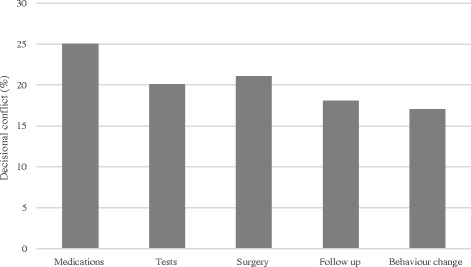
Results: Four hundred twenty-nine respondents were included in the analysis. Forty-eight percent of parents reported not being offered treatment options and 23% screened positive for decisional conflict. Parents who reported being offered options experienced less decisional conflict than parents who reported not being offered options (5% vs. 42%, p < 0.001). Further, parents with options were more likely to: feel sure about the decision (RR 1.08, 95% CI 1.02-1.15); understand the information (RR 1.92, 95% CI 1.63-2.28); be clear about the risks and benefits (RR 1.12, 95% CI 1.05-1.20); and, have sufficient support and advice to make a choice (RR 1.07, 95% CI 1.03-1.11).
Conclusion: Many parents in our sample experienced decisional conflict after their clinical consultation. Involving parents in the decision making process might reduce their risk of decisional conflict. Evidence based interventions that support parent decision making involvement, such as shared decision making, should be evaluated and implemented in pediatrics as a strategy to reduce parents' decisional conflict.
Keywords: Decisional conflict; Family centered care; Parents; Pediatrics; Shared decision making.
Figures
References
-
- Frank LS, Callery P. Re-thinking family-centered care across the continuum of children’s healthcare. Child: Health Care and Development. 2004;30(3):265–277. - PubMed
MeSH terms
LinkOut - more resources
Full Text Sources
Other Literature Sources
