


Immediate versus delayed postpartum use of levonorgestrel contraceptive implants: a randomized controlled trial in Uganda
- PMID: 28610898
- PMCID: PMC6310612
- DOI: 10.1016/j.ajog.2017.06.005
Immediate versus delayed postpartum use of levonorgestrel contraceptive implants: a randomized controlled trial in Uganda
Abstract
Background: Use of long-acting, highly effective contraception has the potential to improve women's ability to avoid short interpregnancy intervals, which are associated with an increased risk of maternal morbidity and mortality, and preterm delivery. In Uganda, contraceptive implants are not routinely available during the immediate postpartum period.
Objective: The purpose of this study was to compare the proportion of women using levonorgestrel contraceptive implants at 6 months after delivery in women randomized to immediate or delayed insertion.
Study design: This was a randomized controlled trial among women in Kampala, Uganda. Women who desired contraceptive implants were randomly assigned to insertion of a 2-rod contraceptive implant system containing 75 mg of levonorgestrel immediately following delivery (within 5 days of delivery and before discharge from the hospital) or delayed insertion (6 weeks postpartum). The primary outcome was implant utilization at 6 months postpartum.
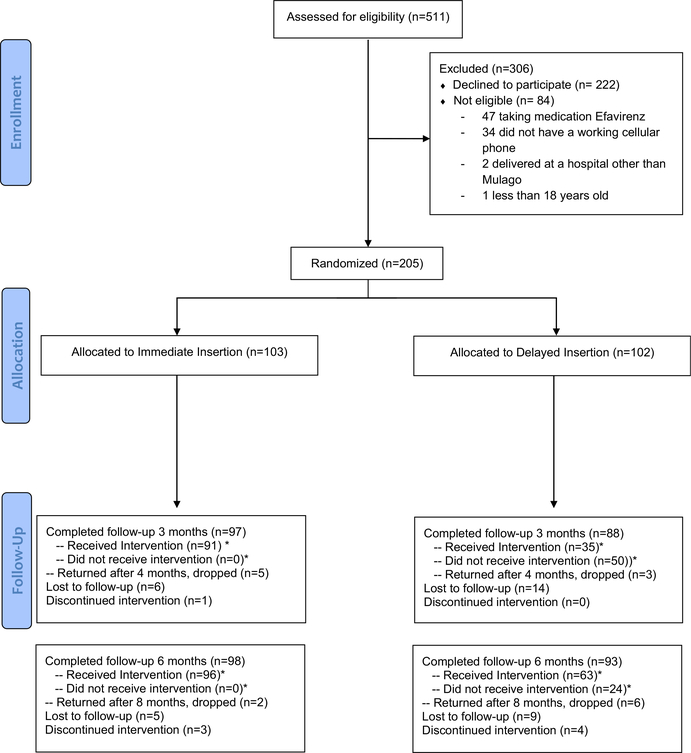
Results: From June to October 2015, 205 women were randomized, 103 to the immediate group and 102 to the delayed group. Ninety-three percent completed the 6 month follow-up visit. At 6 months, implant use was higher in the immediate group compared with the delayed group (97% vs 68%; P < .001), as was the use of any highly effective contraceptive (98% vs 81%; P = .001). Women in the immediate group were more satisfied with the timing of implant placement. If given the choice, 81% of women in the immediate group and 63% of women in the delayed group would choose the same timing of placement again (P = .01). There were no serious adverse events in either group.
Conclusion: Offering women the option of initiating contraceptive implants in the immediate postpartum period has the potential to increase contraceptive utilization, decrease unwanted pregnancies, prevent short interpregnancy intervals, and help women achieve their reproductive goals.
Trial registration: ClinicalTrials.gov NCT02341027.
Keywords: contraception; immediate postpartum contraception; levonorgestrel contraceptive implants; postpartum.
Copyright © 2017 Elsevier Inc. All rights reserved.
Conflict of interest statement
The authors report no conflict of interest.
Figures
References
-
- Alkema L, Kantorova V, Menozzi C, Biddlecom A. National, regional, and global rates and trends in contraceptive prevalence and unmet need for family planning between 1990 and 2015: a systematic and comprehensive analysis. Lancet 2013;381:1642–52. - PubMed
-
- Uganda Bureau of Statistics and ICF International. Uganda Demographic and health survey, 2013. Kampala, Uganda: Uganda Bureau of Statistics; and Calverton, MD: ICF International.
-
- Jacobstein R, Polis CB. Progestin-only contraception: injectables and implants. Best Pract Res Clin Obstet Gynaecol 2014;28: 795–806. - PubMed
-
- Ministry of Health, Uganda. The national policy guidelines and service standards for sexual and reproductive health and rights, 4th ed. Kampala, Uganda: Reproductive Health Division, Ministry of Health, Uganda; 2016.
-
- Morse JE, Rowen TS, Steinauer J, Byamugisha J, Kakaire O. A qualitative assessment of Ugandan women’s perceptions and knowledge of contraception. Int J Gynaecol Obstet 2014;124:30–3. - PubMed
Publication types
MeSH terms
Substances
Associated data
Grants and funding
LinkOut - more resources
Full Text Sources
Other Literature Sources
Medical
