. 2017 Jun 13;8(3):e00705-17.
doi: 10.1128/mBio.00705-17.

The Aspergillus fumigatus CrzA Transcription Factor Activates Chitin Synthase Gene Expression during the Caspofungin Paradoxical Effect

Affiliations

The Aspergillus fumigatus CrzA Transcription Factor Activates Chitin Synthase Gene Expression during the Caspofungin Paradoxical Effect

Laure Nicolas Annick Ries et al. mBio. .

Abstract

Aspergillus fumigatus is an opportunistic fungal pathogen that causes invasive aspergillosis (IA), a life-threatening disease in immunocompromised humans. The echinocandin caspofungin, adopted as a second-line therapy in combating IA, is a β-1,3-glucan synthase inhibitor, which, when used in high concentrations, reverts the anticipated A. fumigatus growth inhibition, a phenomenon called the "caspofungin paradoxical effect" (CPE). The CPE has been widely associated with increased chitin content in the cell wall due to a compensatory upregulation of chitin synthase-encoding genes. Here, we demonstrate that the CPE is dependent on the cell wall integrity (CWI) mitogen-activated protein kinase MpkAMPK1 and its associated transcription factor (TF) RlmARLM1, which regulate chitin synthase gene expression in response to different concentrations of caspofungin. Furthermore, the calcium- and calcineurin-dependent TF CrzA binds to and regulates the expression of specific chitin synthase genes during the CPE. These results suggest that the regulation of cell wall biosynthetic genes occurs by several cellular signaling pathways. In addition, CrzA is also involved in cell wall organization in the absence of caspofungin. Differences in the CPE were also observed between two A. fumigatus clinical isolates, which led to the identification of a novel basic leucine zipper TF, termed ZipD. This TF functions in the calcium-calcineurin pathway and is involved in the regulation of cell wall biosynthesis genes. This study therefore unraveled additional mechanisms and novel factors governing the CPE response, which ultimately could aid in developing more effective antifungal therapies.IMPORTANCE Systemic Aspergillus fumigatus infections are often accompanied by high mortality rates. The fungal cell wall is important for infection as it has immunomodulatory and immunoevasive properties. Paradoxical growth of A. fumigatus in the presence of high concentrations of the cell wall-disturbing agent caspofungin has been observed for more than a decade, although the mechanistic nature of this phenomenon remains largely uncharacterized. Here, we show that the CWI pathway components MpkA and RlmA as well as the calcium/calcineurin-responsive transcription factor CrzA regulate the expression of cell wall biosynthetic genes during the caspofungin paradoxical effect (CPE). Furthermore, an additional, novel calcium/calcineurin-responsive transcription factor was identified to play a role in cell wall biosynthesis gene expression during the CPE. This work paints a crucial role for calcium metabolism in the CPE and provides further insight into the complex regulation of cell wall biosynthesis, which could ultimately lead to the development of more efficient antifungal therapies.

Keywords: Aspergillus fumigatus; caspofungin; cell wall integrity pathway; paradoxical effect.


Figures

FIG 1
FIG 1
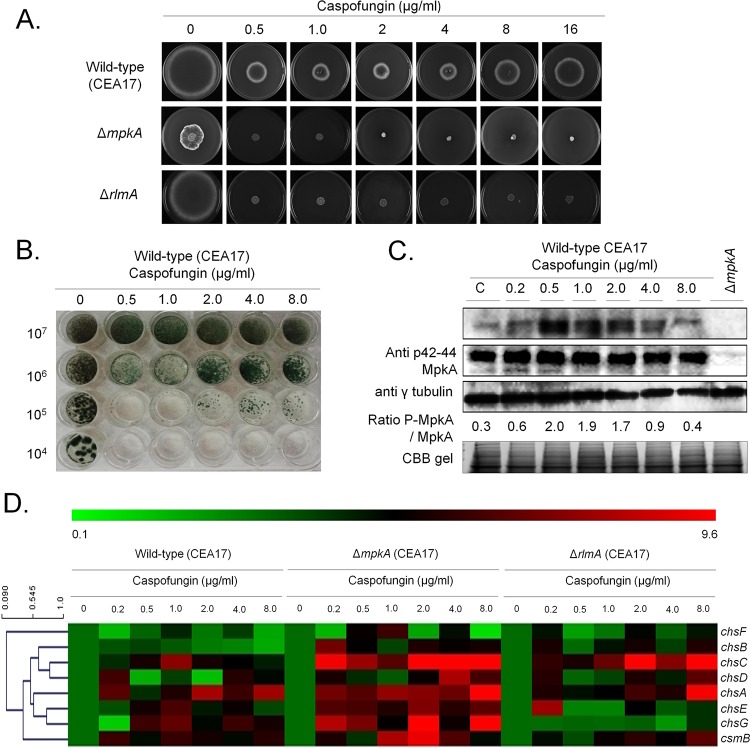
The MpkA-CWI integrity pathway is activated during the CPE. (A) A. fumigatus CEA17 conidia (104) were inoculated on solid minimal medium (MM) supplemented with glucose and different caspofungin concentrations for 5 days at 37°C. (B) Different concentrations of A. fumigatus CEA17 conidia (left) were inoculated in liquid MM supplemented with glucose and different caspofungin concentrations for 16 h at 37°C. (C) Western blotting assay of MpkA phosphorylation in response to increasing caspofungin concentrations. Anti-p44/42 MpkA or anti-44/42 MpkA antibodies were used to detect the phosphorylation of MpkA and total MpkA, respectively. Anti-γ-tubulin antibody was used as a loading control. Signal intensities were quantified using the ImageJ software, and ratios of (P)-MpkA to MpkA were calculated. A Coomassie brilliant blue (CBB) gel of the protein extract served as an additional loading control. (D) Heat map and hierarchical linkage clustering (as determined by MeV software) of RT-qPCRs of the chitin synthase gene mRNA accumulation in the presence of caspofungin in the wild-type, ΔmpkA, and ΔrlmA strains. Strains were grown for 16 h at 37°C and transferred to increasing caspofungin concentrations for 60 min. The results are expressed as the average of the fold increase of the control cDNA (without caspofungin) for a specific gene of three biological independent experiments (with 2 technical repetitions each; see Fig. S1).
FIG 2
FIG 2
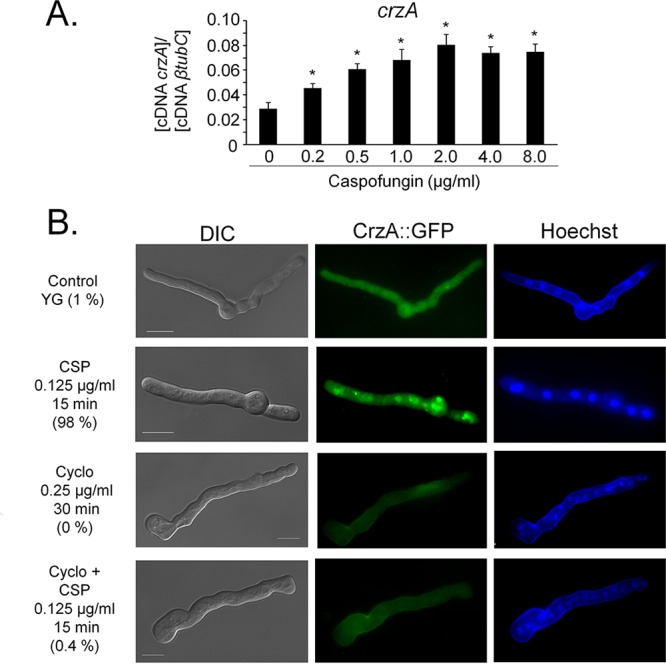
CrzA translocates to the nucleus upon caspofungin exposure. (A) The expression of crzA, as determined by RT-qPCR, is induced in the presence of caspofungin. The wild-type strain was grown for 16 h at 37°C and transferred to increasing caspofungin concentrations for 60 min. All gene expression was normalized by the amount of β-tubulin (tubC). Standard deviations present the average from 3 independent biological repetitions (each with 2 technical repetitions). Statistical analysis was performed using a one-way ANOVA with Dunnett’s post hoc test compared to the control condition (*, P < 0.05). (B) Cellular localization of the CrzA::GFP strain, as determined by microscopy, when grown for 16 h at 30°C and after incubation in the presence of caspofungin (CSP), cyclosporine (Cyclo), or both cyclosporine and caspofungin. The percentage of CrzA::GFP nuclear localization is indicated for each condition and is based on counting between 300 and 600 nuclei in 50 to 100 hyphal germlings of biological triplicates. Bars, 5 μm.
FIG 3
FIG 3
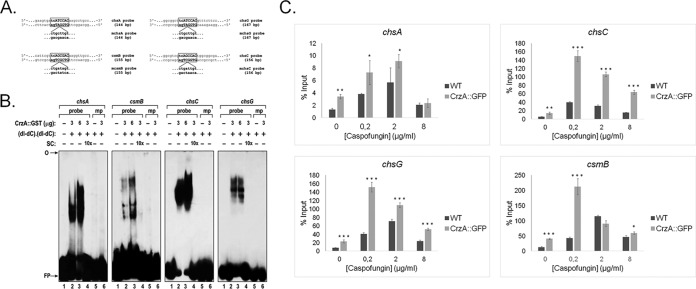
A. fumigatus CrzA transcription factor binds to the promoter regions of specific chitin synthase-encoding genes. (A) Schematic representation of the DNA probes (including mutated probes) of the chsA, csmB, chsC, and chsG promoter regions used during the electrophoretic mobility shift assays (EMSAs). (B) EMSAs using the GST::CrzA-tagged protein. Probes containing the endogenous or mutated CrzA motif were assayed for DNA-binding activity, using the recombinant GST::CrzA protein. The specificity of the DNA-protein binding was confirmed by adding specific competitors (cold DNA probes) and the mutated probes. SC, specific competitor; mp, mutated probes; FP, free probe. (C) ChIP-qPCR of the chsA, csmB, chsC, and chsG genes in the wild-type and CrzA::GFP strains when grown for 24 h in MM and then exposed to increasing concentrations of caspofungin for 1 h. Standard deviations present the average from two independent biological experiments (with 2 technical repetitions each). Statistical analysis was performed using a one-tailed, paired t test compared to the control condition (*, P < 0.05; **, P < 0.005; ***, P < 0.0005).
FIG 4
FIG 4
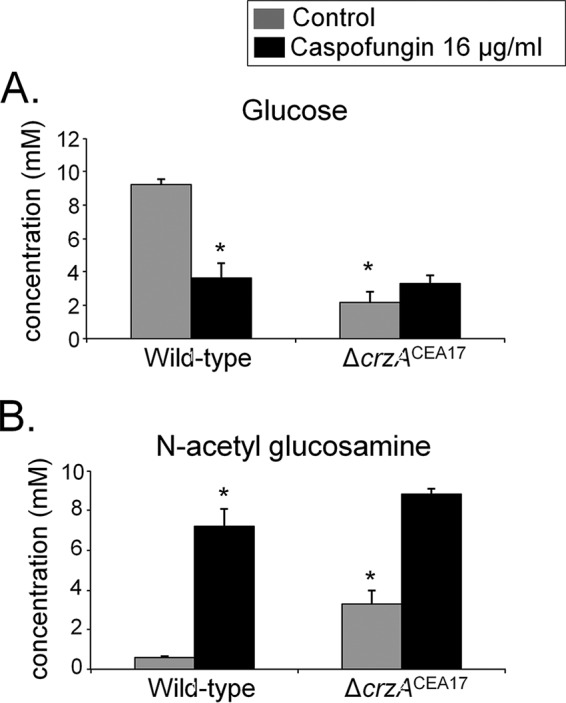
CrzA is important for cell wall composition in the absence of caspofungin. Glucose (A) and N-acetylglucosamine (NAG) (B) concentrations, as determined by high-performance liquid chromatography (HPLC), in mycelial extracts of the A. fumigatus wild-type (CEA17) and ΔcrzACEA17 strains when grown for 16 h in minimal medium (MM) at 37°C (control) and after a 1-h incubation in MM supplemented with 16 µg/ml caspofungin.
FIG 5
FIG 5
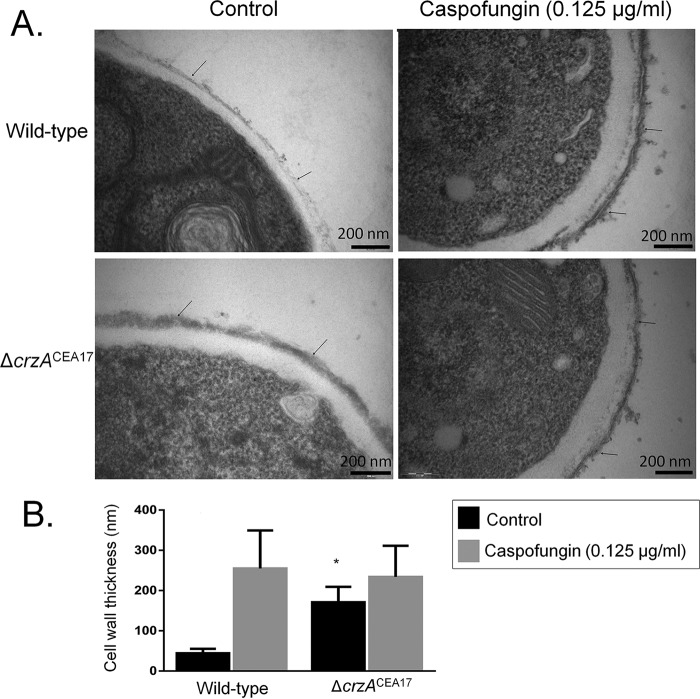
CrzA is involved in the cell wall integrity (CWI) response. (A) Transmission electron microscopy (TEM) of mycelial sections of the A. fumigatus wild-type (CEA17) and ΔcrzACEA17 strains when grown for 16 h in MM at 37°C (control) and after transfer to 0.125 µg/ml caspofungin for 2 h. Arrows indicate the external borders of the cell wall. (B) The cell wall thickness of 50 sections of different hyphal germlings (average of 4 sections per germling) was measured when grown under the same conditions as specified for panel A. Standard deviations present the average from the 50 measurements, and statistical analysis was performed using a one-tailed, paired t test compared to the control condition (*, P < 0.05).
FIG 6
FIG 6
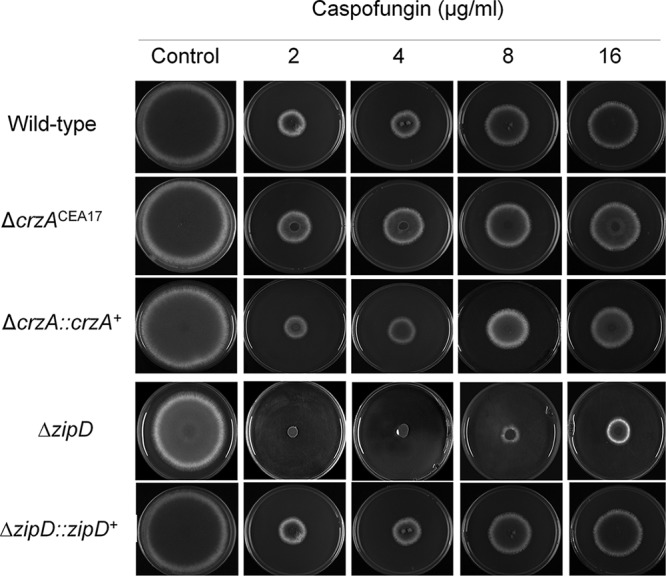
Deletion of crzA in strain CEA17 had no effect on the CPE response. A. fumigatus conidia (104) were inoculated on solid minimal medium (MM) supplemented with glucose and different caspofungin concentrations and grown for 5 days at 37°C.
FIG 7
FIG 7
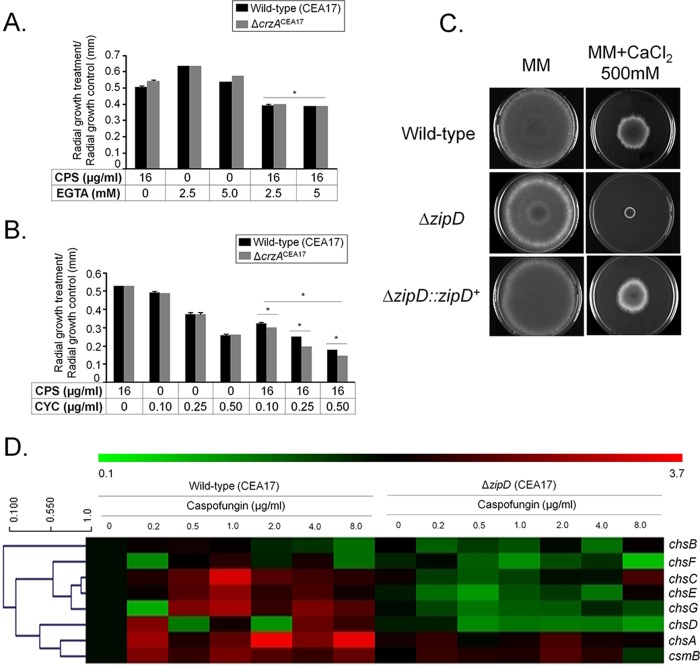
Identification of the transcription factor ZipD involved in the CPE. (A) The A. fumigatus wild-type (CEA17) and ΔcrzACEA17 strains were grown for 5 days at 37°C on solid minimal medium in the absence or presence of EGTA (2.5 and 5.0 mM) and caspofungin (CPS; 16 µg/ml). Results are expressed as the average of the radial diameter from three independent biological experiments of the treatment divided by the radial diameter of the control of three independent biological experiments (*, P < 0.001, as determined by t tests comparing the combined treatments to the single treatments). (B) Same as in panel A except that strains were grown in the presence of cyclosporine (CYC; 0.10, 0.25, and 0.50 µg/ml) and caspofungin (CPS; 16 µg/ml). (C) The wild-type CEA17, ΔzipDCEA17, and ΔzipD::zipD+ strains (104 conidia) were grown for 5 days at 37°C on solid MM supplemented with 0 mM and 500 mM CaCl2. (D) Heat map and hierarchical linkage clustering (as determined by MeV software) of RT-qPCRs of the chitin synthase gene mRNA accumulation in the presence of caspofungin in the wild-type and ΔzipD strains. Strains were grown for 16 h at 37°C and transferred to increasing caspofungin concentrations for 60 min. The results are expressed as the average fold increase of the control cDNA (without caspofungin) for a specific gene from three independent biological experiments (with 2 technical repetitions each; see Fig. S1).
FIG 8
FIG 8
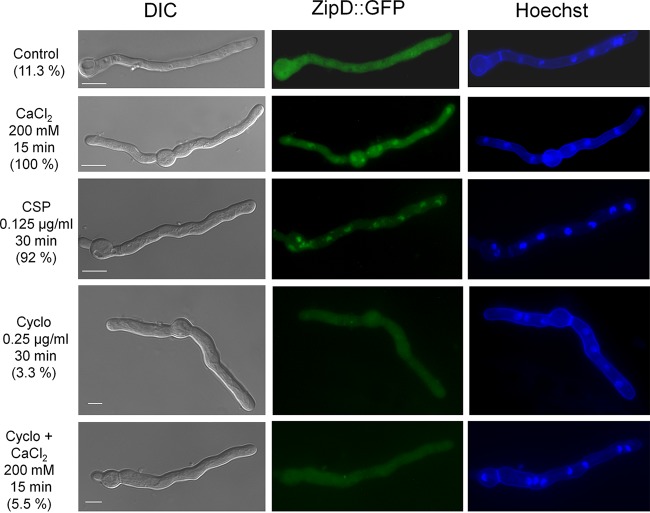
ZipD translocates to the nucleus in the presence of caspofungin and calcium. Cellular localization of the ZipD::GFP strain, as determined by microscopy, when grown for 16 h at 30°C and after incubation in the presence of CaCl2, caspofungin (CSP), cyclosporine (Cyclo), or both cyclosporine and CaCl2. The percentage of ZipD::GFP nuclear localization is indicated for each condition and based on counting between 300 and 600 nuclei of 50 to 100 hyphal germlings of biological triplicates. Bars, 5 μm.

References

    1. Steinbach WJ, Lamoth F, Juvvadi PR. 2015. Potential microbiological effects of higher dosing of echinocandins. Clin Infect Dis 61(Suppl 6):S669–S677. doi: 10.1093/cid/civ725. - DOI - PubMed
    1. Brakhage AA. 2005. Systemic fungal infections caused by Aspergillus species: epidemiology, infection process and virulence determinants. Curr Drug Targets 6:875–886. doi: 10.2174/138945005774912717. - DOI - PubMed
    1. Brown GD, Denning DW, Levitz SM. 2012. Tackling human fungal infections. Science 336:647. doi: 10.1126/science.1222236. - DOI - PubMed
    1. Brown GD, Denning DW, Gow NA, Levitz SM, Netea MG, White TC. 2012. Hidden killers: human fungal infections. Sci Transl Med 4:165rv13. doi: 10.1126/scitranslmed.3004404. - DOI - PubMed
    1. Lackner M, Lass-Flörl C. 2013. Up-date on diagnostic strategies of invasive aspergillosis. Curr Pharm Des 19:3595–3614. doi: 10.2174/13816128113199990323. - DOI - PubMed

MeSH terms

LinkOut - more resources