


Plasma ghrelin and leptin in patients with inflammatory bowel disease and its association with nutritional status
- PMID: 28611344
- PMCID: PMC5470380
- DOI: 10.4103/sjg.SJG_575_16
Plasma ghrelin and leptin in patients with inflammatory bowel disease and its association with nutritional status
Abstract
Background/aims: Ghrelin and leptin are thought to play a role in the loss of appetite in active inflammatory bowel disease (IBD). This study seeks to probe into the association of these markers with regards to IBD and the nutritional status of these patients. A case-control study was conducted between May 2015 and March 2016 at King Khalid University Hospital (KKUH). Thirty-one patients with IBD (both active and non-active) and forty-one healthy controls (both non-fasting and fasting) were recruited.
Patients and methods: Plasma ghrelin and leptin levels were determined using an enzyme immunoassay (EIA) technique. The nutritional status was determined through the standardized Mini-Nutritional Assessment (MNA) questionnaire.
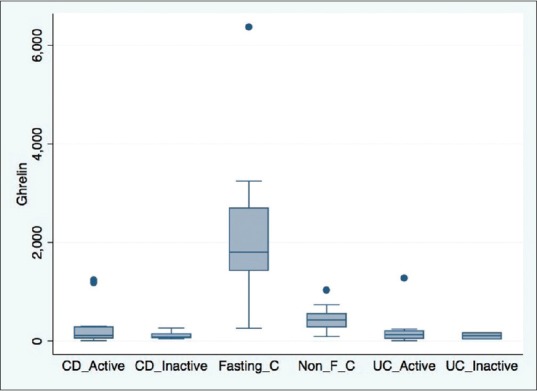
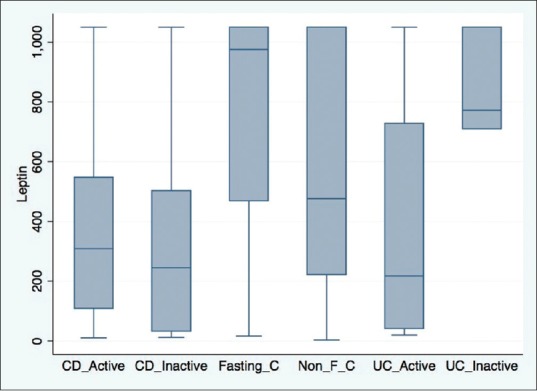
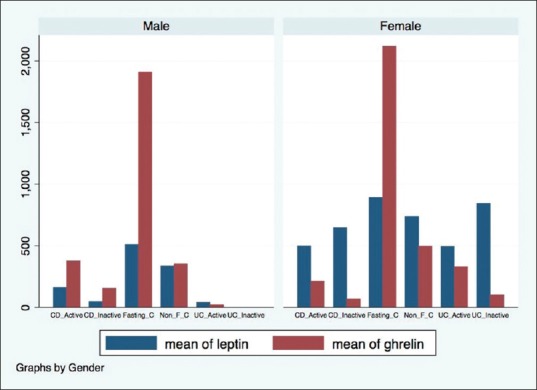
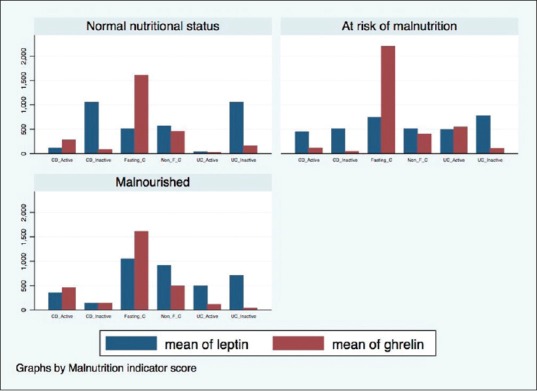
Results: The difference in the plasma ghrelin between active (263.7 pg/mL) and non-active (108 pg/mL) cases was significant (P= 0.02). The difference in mean plasma leptin level between active cases (229.4 pg/mL) vs. non-active cases (359.7 pg/mL) was insignificant (P= 0.4). In fasting (2028.6 pg/mL) and non-fasting controls (438.8 pg/mL), the mean plasma ghrelin values was significantly different (P< 0.01). In contrast, the plasma leptin level difference between fasting (727.3 pg/mL) and non-fasting (577 pg/mL) controls was insignificant (P= 0.14). There is a statistically significant association in mean ghrelin levels between the case group and the control group (P< 0.01). With regards to nutritional status, the mean MNA score of active cases compared to fasting controls was 18.8 ± 5 vs. 20.8 ± 3.8, respectively (P< 0.01) Conclusion: Ghrelin levels were lower in the active IBD cases compared to the inactive ones, signifying an underlying pathology as etiology to this phenomenon. Furthermore, ghrelin levels were significantly lower in both case groups compared to the controls. These findings, along with the disparity in the MNA scores, insinuate a possible link between hormone levels and the loss of appetite from which these patients suffer.
Conflict of interest statement
There are no conflicts of interest.
Figures
References
-
- Karmiris K, Koutroubakis IE, Kouroumalis EA. The emerging role of adipocytokines as inflammatory mediators in inflammatory bowel disease. Inflamm Bowel Dis. 2005;11:847–55. - PubMed
-
- Klok MD, Jakobsdottir S, Drent ML. The role of leptin and ghrelin in the regulation of food intake and body weight in humans: A review. Obes Rev. 2007;8:21–34. - PubMed
-
- Sung EZ, Da Silva NF, Goodyear S, McTernan PG, Sanger GJ, Nwokolo CU. Increased plasma ghrelin following infliximab in Crohn's disease. Aliment Pharmacol Ther. 2009;29:83–9. - PubMed
-
- Ates Y, Degertekin B, Erdil A, Yaman H, Dagalp K. Serum ghrelin levels in inflammatory bowel disease with relation to disease activity and nutritional status. Dig Dis Sci. 2008;53:2215–21. - PubMed
-
- Cekic C, Arabul M, Alper E, Pakoz ZB, Saritas E, Ünsal B, et al. Evaluation of the relationship between serum ghrelin, C-reactive protein and interleukin-6 levels, and disease activity in inflammatory bowel diseases. Hepatogastroenterology. 2013;61:1196–200. - PubMed
Publication types
MeSH terms
Substances
LinkOut - more resources
Full Text Sources