. 2017 Jun 13;7(1):3382.
doi: 10.1038/s41598-017-03308-5.

Identification of a gene cluster for telomestatin biosynthesis and heterologous expression using a specific promoter in a clean host

Affiliations

Identification of a gene cluster for telomestatin biosynthesis and heterologous expression using a specific promoter in a clean host

Keita Amagai et al. Sci Rep. .

Abstract

Telomestatin, a strong telomerase inhibitor with G-quadruplex stabilizing activity, is a potential therapeutic agent for treating cancers. Difficulties in isolating telomestatin from microbial cultures and in chemical synthesis are bottlenecks impeding the wider use. Therefore, improvement in telomestatin production and structural diversification are required for further utilization and application. Here, we discovered the gene cluster responsible for telomestatin biosynthesis, and achieved production of telomestatin by heterologous expression of this cluster in the engineered Streptomyces avermitilis SUKA strain. Utilization of an optimal promoter was essential for successful production. Gene disruption studies revealed that the tlsB, tlsC, and tlsO-T genes play key roles in telomestatin biosynthesis. Moreover, exchanging TlsC core peptide sequences resulted in the production of novel telomestatin derivatives. This study sheds light on the expansion of chemical diversity of natural peptide products for drug development.


Conflict of interest statement

The authors declare that they have no competing interests.

Figures
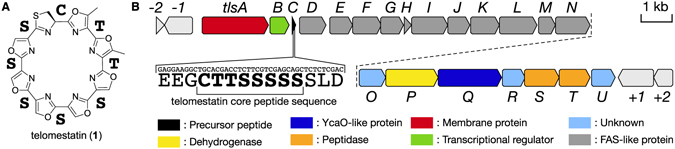
Figure 1
Figure 1
(A) The chemical structure of 1 and putative amino acid constitution from the structure. (B) Gene organization of 1 biosynthetic gene cluster found in S. anulatus 3533-SV4. Putative functions of each ORF in the 1 biosynthetic gene cluster are summarized in Table S1.
Figure 2
Figure 2
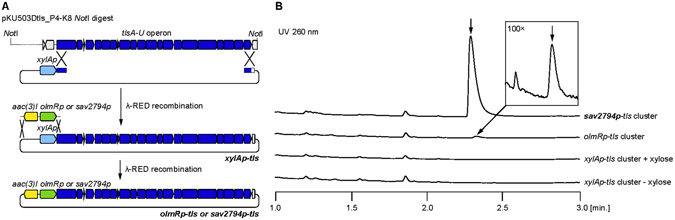
Promoter-assisted heterologous expression of 1 biosynthetic gene cluster in SUKA strain. (A) Overview of heterologous expression vector. (B) HPLC/MS analysis of metabolites produced by the SUKA17 strain, which was transformed with the tls gene cluster containing the xylA, olmR, and sav2794 gene promoters. The peak from the metabolites from SUKA17 (pKU492Acos::sav2794p::tls_cluster) showed a m/z ratio of 583 [M+H]+, corresponding to the authentic 1 molecule.
Figure 3
Figure 3
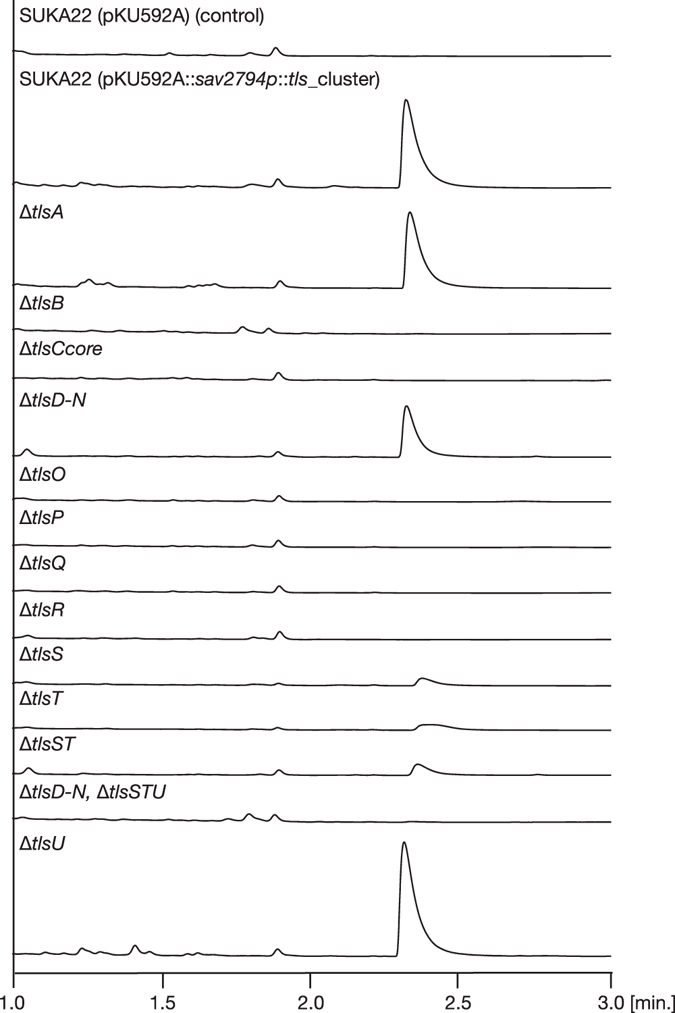
HPLC/MS analysis of metabolites produced by the SUKA22 strain, which was transformed with tls gene cluster containing each indicated tls gene deletion.
Figure 4
Figure 4
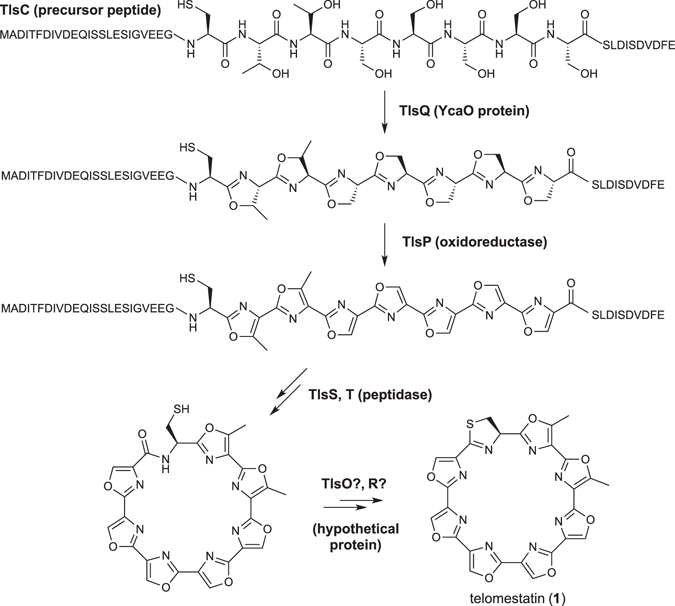
Proposed biosynthetic pathway for 1.
Figure 5
Figure 5
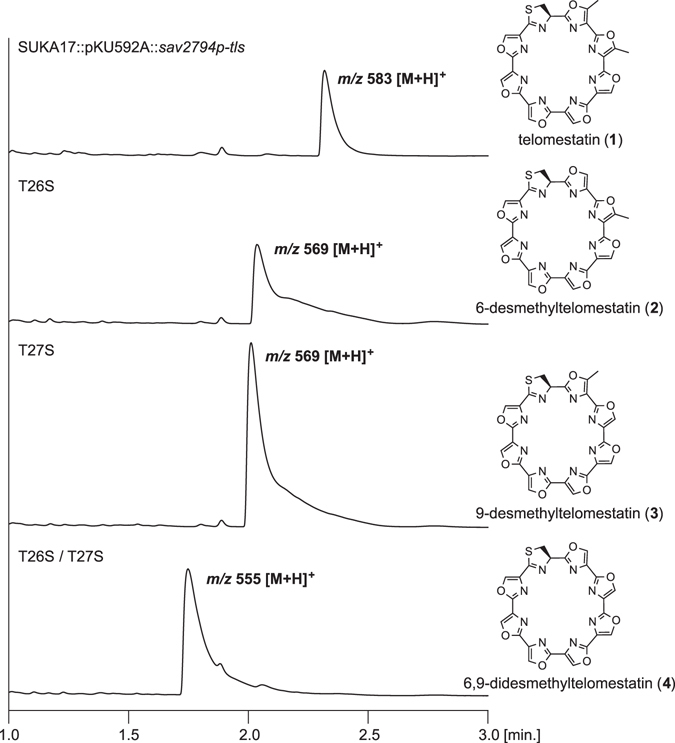
HPLC/MS analysis of metabolites produced in SUKA17, which was transformed with the tls gene cluster containing a mutation in tlsC.

References

    1. Shin-ya K, et al. Telomestatin, a Novel Telomerase Inhibitor from Streptomyces anulatus. J. Am. Chem. Soc. 2001;123:1262–1263. doi: 10.1021/ja005780q. - DOI - PubMed
    1. Kim M-Y, Vankayalapati H, Shin-ya K, Wierzba K, Hurley LH. Telomestatin, a Potent Telomerase Inhibitor That Interacts Quite Specifically with the Human Telomeric Intramolecular G-Quadruplex. J. Am. Chem. Soc. 2002;124:2098–2099. doi: 10.1021/ja017308q. - DOI - PubMed
    1. Tauchi T, et al. Activity of a novel G-quadruplex-interactive telomerase inhibitor, telomestatin (SOT-095), against human leukemia cells: involvement of ATM-dependent DNA damage response pathways. Oncogene. 2003;22:5338–5347. doi: 10.1038/sj.onc.1206833. - DOI - PubMed
    1. Tauchi T, et al. Telomerase inhibition with a novel G-quadruplex-interactive agent, telomestatin: in vitro and in vivo studies in acute leukemia. Oncogene. 2006;25:5719–5725. doi: 10.1038/sj.onc.1209577. - DOI - PubMed
    1. Wu Y, et al. Fanconi anemia group J mutation abolishes its DNA repair function by uncoupling DNA translocation from helicase activity or disruption of protein-DNA complexes. Blood. 2010;116:3780–3791. doi: 10.1182/blood-2009-11-256016. - DOI - PMC - PubMed

Publication types

MeSH terms

LinkOut - more resources