. 2017 May 29:8:880.
doi: 10.3389/fpls.2017.00880. eCollection 2017.

Involvement of Trichoderma harzianum Epl-1 Protein in the Regulation of Botrytis Virulence- and Tomato Defense-Related Genes

Affiliations

Involvement of Trichoderma harzianum Epl-1 Protein in the Regulation of Botrytis Virulence- and Tomato Defense-Related Genes

Eriston V Gomes et al. Front Plant Sci. .

Abstract

Several Trichoderma spp. are well known for their ability to: (i) act as important biocontrol agents against phytopathogenic fungi; (ii) function as biofertilizers; (iii) increase the tolerance of plants to biotic and abiotic stresses; and (iv) induce plant defense responses via the production and secretion of elicitor molecules. In this study, we analyzed the gene-regulation effects of Trichoderma harzianum Epl-1 protein during the interactions of mutant Δepl-1 or wild-type T. harzianum strains with: (a) the phytopathogen Botrytis cinerea and (b) with tomato plants, on short (24 h hydroponic cultures) and long periods (4-weeks old plants) after Trichoderma inoculation. Our results indicate that T. harzianum Epl-1 protein affects the in vitro expression of B. cinerea virulence genes, especially those involved in the botrydial biosynthesis (BcBOT genes), during the mycoparasitism interaction. The tomato defense-related genes were also affected, indicating that Epl-1 is involved in the elicitation of the salicylic acid pathway. Moreover, Epl-1 also regulates the priming effect in host tomato plants and contributes to enhance the interaction with the host tomato plant during the early stage of root colonization.

Keywords: Botrytis cinerea; Epl-1 protein; Trichoderma harzianum; fungus–plant interaction; mycoparasitism.


Figures
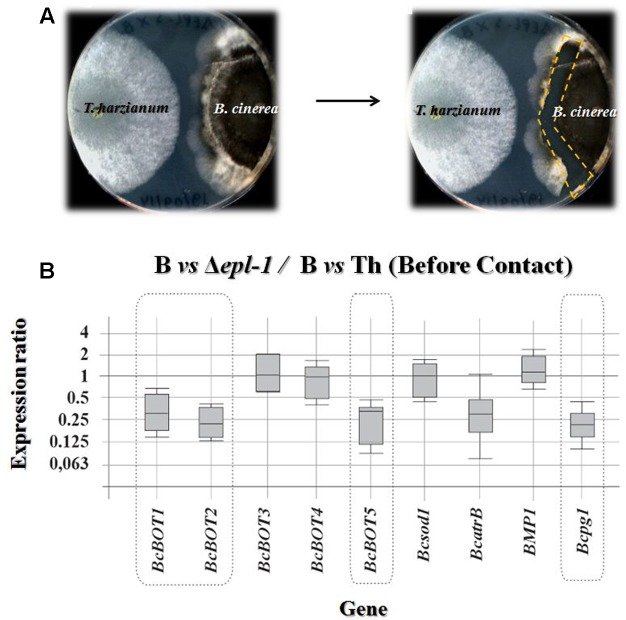
FIGURE 1
FIGURE 1
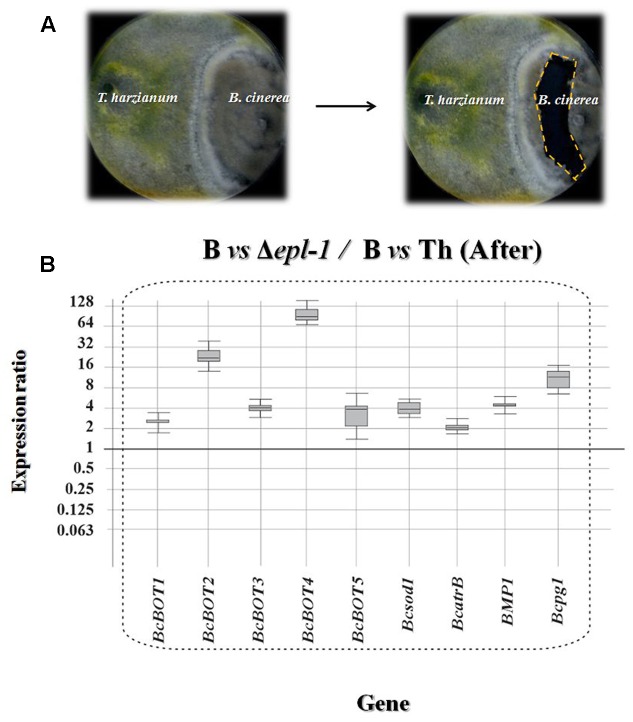
(A) Photographs showing confrontation plate assays between T. harzianum and B. cinerea before hyphae contact. The right panel shows the region from which the B. cinerea mycelia was extracted (dashed line). (B) qPCR analysis of the relative expression level of several Botrytis virulence genes in mycelia confronted with T. harzianum Δepl-1epl-1) in comparison with the level of expression in mycelia of the pathogen (B) confronted with T. harzianum wild type (Th) strain, in both cases before hyphae contact. The expression ratios as well as the statistic probability values were calculated using the REST2009 software (Pfaffl et al., 2002). Expression ratio values statistically significant [P(H1) < 0.05] are outlined by a broken line. Numeric values are included in Supplementary Table S1a. Boxes represent the interquartile range, or the middle 50% of observations. The dotted line represents the median gene expression. Whiskers represent the minimum and maximum observations.
FIGURE 2
FIGURE 2
(A) Photographs showing confrontation plate assays between T. harzianum and B. cinerea after hyphae contact. The right panel shows the region from which the B. cinerea mycelia was extracted (dashed line). (B) qPCR analysis of the relative expression level of several Botrytis virulence genes in mycelia confronted with T. harzianum Δepl-1epl-1) in comparison with the level of expression in mycelia of the pathogen (B) confronted with T. harzianum wild type (Th) strain after hyphae contact. Comparative calculations and graphic representations were carried out as indicated in the legend of Figure 1. Numeric values are included in Supplementary Table S1a.
FIGURE 3
FIGURE 3
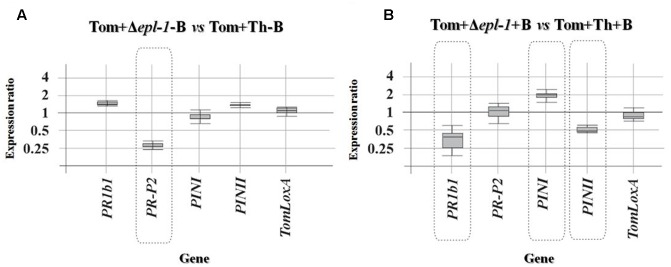
Relative expression ratios of defense-related genes belonging to the SA and JA defense-related pathways in 4-week-old tomato plants (Tom) inoculated with the T. harzianum Δepl-1 mutant (Δepl-1) versus plants inoculated with T. harzianum wild-type strain (Th). (A) Plants not infected with the pathogen B. cinerea B05.10 (–B). (B) Plants infected with the pathogen B. cinerea B05.10 (+B). Comparative calculations and graphic representations were carried out as indicated in the legend of Figure 1. Numeric values are included in Supplementary Table S2A.
FIGURE 4
FIGURE 4
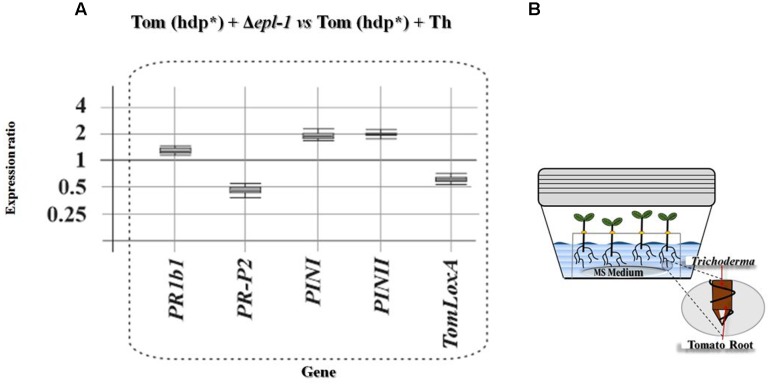
Relative expression ratios of tomato defense-related genes in hydroponic cultures. (A) Relative expression levels of defense-related genes belonging to the SA and JA pathways in tomato (Tom) hydroponic cultures (hdp) inoculated with T. harzianum Δepl-1epl-1) versus those inoculated with the T. harzianum wild-type (Th) strains. (B) Illustrative scheme of the hydroponic culture box of tomato plants inoculated with T. harzianum strains. Comparative calculations and graphic representations were carried out as indicated in the legend of Figure 1. Numeric values are included in Supplementary Table S3a.
FIGURE 5
FIGURE 5
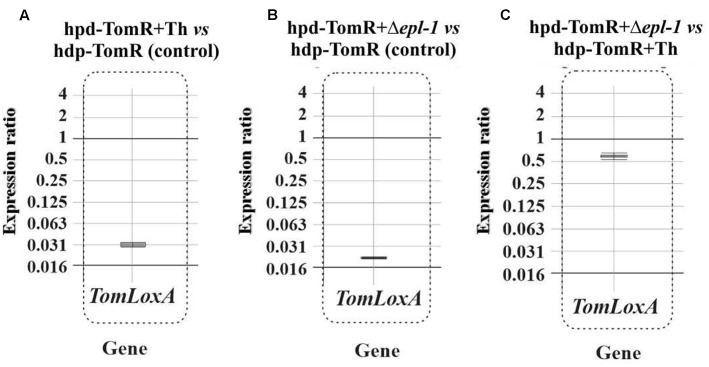
qPCR analysis of TomLoxA expression in hydroponic tomato roots (hdp-TomR) 24 h after T. harzianum strains inoculation as a reference gene for tomato roots colonization in: (A) Tomato plants inoculated with T. harzianum wild-type (Th) strain versus non-inoculated plants. (B) Tomato plants inoculated with T. harzianum Δepl-1 strain versus non-inoculated plants. (C) Fold change of relative gene expression of Tomato plants inoculated with T. harzianum wild-type versus expression in Tomato plants inoculated with Δepl-1 mutant. qPCR comparative calculations and graphic representations were carried out as indicated in the legend of Figure 1. Numeric values are included in Supplementary Table S4a.

References

    1. Ahn I. P., Lee S. W., Suh S. C. (2007). Rhizobacteria-induced priming in Arabidopsis is dependent on ethylene, jasmonic acid, and NPR1. Mol. Plant Microbe Interact. 20 759–768. 10.1094/MPMI-20-7-0759 - DOI - PubMed
    1. Alfano G., Ivey M. L. L., Cakir C., Bos J. I. B., Miller S. A., Madden L. V., et al. (2007). Systemic modulation of gene expression in tomato by Trichoderma hamatum 382. Phytopathology 97 429–437. 10.1094/PHYTO-97-4-0429 - DOI - PubMed
    1. Alimohammadi M., Lahiani M. H., Mcgehee D. (2017). Polyphenolic extract of InsP 5-ptase expressing tomato plants reduce the proliferation of MCF-7 breast cancer cells. PLoS ONE 12:e0175778 10.1371/journal.pone.0175778 - DOI - PMC - PubMed
    1. Almeida F. B. D. R., Cerqueira F. M., Silva R. D. N., Ulhoa C. J., Lima A. L. (2007). Mycoparasitism studies of Trichoderma harzianum strains against Rhizoctonia solani: evaluation of coiling and hydrolytic enzyme production. Biotechnol. Lett. 29 1189–1193. 10.1007/s10529-007-9372-z - DOI - PubMed
    1. Baccelli I., Luti S., Bernardi R., Scala A., Pazzagli L. (2014). Cerato-platanin shows expansin-like activity on cellulosic materials. Appl. Microbiol. Biotechnol. 98 175–184. 10.1007/s00253-013-4822-0 - DOI - PubMed

LinkOut - more resources