


Pancreatic Cancer is Associated with Peripheral Leukocyte Oxidative DNA Damage
- PMID: 28612585
- PMCID: PMC5555546
- DOI: 10.22034/APJCP.2017.18.5.1349
Pancreatic Cancer is Associated with Peripheral Leukocyte Oxidative DNA Damage
Abstract
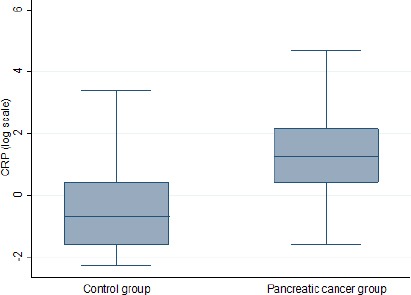
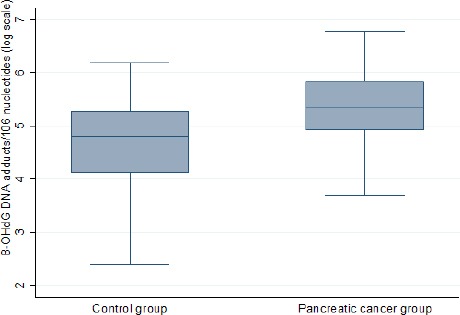
Background: DNA damage accumulation has been linked to the cancer phenotype. The purpose of this study was to compare the levels of DNA base 8-hydroxy-2′-deoxyguanosine (8-OHdG) and C-reactive protein (CRP) inflammatory markers in healthy controls and pancreatic cancer patients from a hospital-based case-control study. Materials and Methods: Fifty-five pancreatic cancer patients and 55 healthy controls were enrolled from a pool of patients referred to the Endoscopic Ultrasound (EUS) center. Analysis of DNA content of peripheral blood cells was conducted for 8-OHdG with the 32P-postlabelling assay. Serum CRP levels were measured by high-sensitivity assays and demographic data for comparison were collected from individual medical records. Results: The group of cases showed significant increased median (IQR) 8-OHdG DNA adducts/106 nucleotides and CRP compared to the controls (208.8 (138.0-340.8) vs 121.8 (57.7-194.8) RAL value; P<0.001) and (3.5 (1.5-8.6) vs 0.5 (0.2-1.5) mg/L P<0.001). A number of conditional regression models confirmed associations of pancreatic cancer with oxidative DNA damage in peripheral leukocytes.Conclusions: Our findings suggest the importance of leukocyte 8-OHdG adducts as an indicator for systemic oxidative DNA damage in pancreatic cancer patients. In addition to increase in the CRP inflammatory marker, this supports the impact of inflammation in the occurrence of pancreatic cancer as well as inflammatory responses during cancer development.
Keywords: Pancreatic cancer; 8-hydroxy-2′-deoxyguanosine (8-OHdG); oxidative DNA damage.
Creative Commons Attribution License
Figures
References
-
- Ahmadloo N, Bidouei F, Omidvari S, et al. Pancreatic cancer in southern Iran. Iran Red Crescent Med J. 2010;12:624–30.
-
- Baron JA, Sandler RS. Nonsteroidal anti-inflammatory drugs and cancer prevention. Annu Rev Med. 2000;51:511–23. - PubMed
-
- Closa D, Folch-Puy E. Oxygen free radicals and the systemic inflammatory response. IUBMB Life. 2004;56:185–91. - PubMed
-
- Devanaboyina U, Gupta RC. Sensitive detection of 8-hydroxy-2’deoxyguanosine in DNA by 32P-postlabeling assay and the basal levels in rat tissues. Carcinogenesis. 1996;17:917–24. - PubMed
LinkOut - more resources
Full Text Sources
Research Materials
Miscellaneous
