. 2017 Aug 18;12(8):2062-2069.
doi: 10.1021/acschembio.7b00480. Epub 2017 Jun 28.

Protein Modification by Endogenously Generated Lipid Electrophiles: Mitochondria as the Source and Target

Affiliations

Protein Modification by Endogenously Generated Lipid Electrophiles: Mitochondria as the Source and Target

William N Beavers et al. ACS Chem Biol. .

Abstract

Determining the impact of lipid electrophile-mediated protein damage that occurs during oxidative stress requires a comprehensive analysis of electrophile targets adducted under pathophysiological conditions. Incorporation of ω-alkynyl linoleic acid into the phospholipids of macrophages prior to activation by Kdo2-lipid A, followed by protein extraction, click chemistry, and streptavidin affinity capture, enabled a systems-level survey of proteins adducted by lipid electrophiles generated endogenously during the inflammatory response. Results revealed a dramatic enrichment for membrane and mitochondrial proteins as targets for adduction. A marked decrease in adduction in the presence of MitoTEMPO demonstrated a primary role for mitochondrial superoxide in electrophile generation and indicated an important role for mitochondria as both a source and target of lipid electrophiles, a finding that has not been revealed by prior studies using exogenously provided electrophiles.


Figures
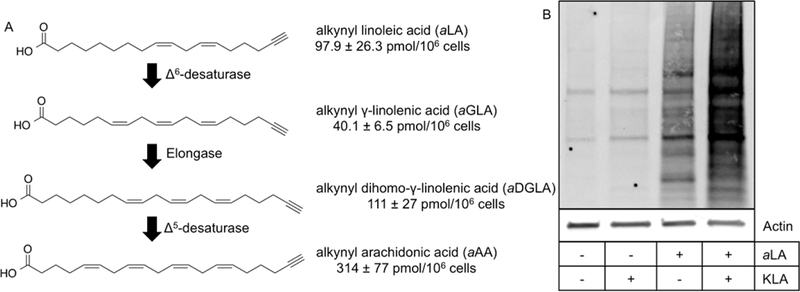
Figure 1.
Figure 1.
(A) aAA biosynthesized from aLA. Elongation products of aLA to aAA were measured in aLA-incorporated RAW264.7 macrophages. Quantities of each intermediate are the mean ± standard deviation of triplicate analyses. (B) KLA activation induces lipid electrophile protein adduction. Lipid electrophiles are generated during normal physiological processes of the cell (+aLA/-KLA), and increased adduction is measured across the proteome by endogenously formed lipid electrophiles in activated macrophages (+aLA/+KLA).
Figure 2.
Figure 2.
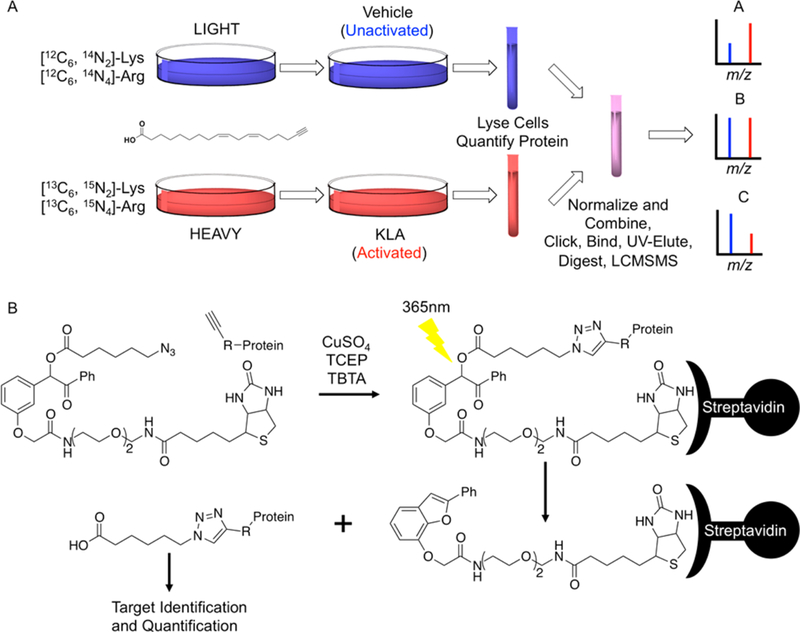
(A) SILAC workflow. Both heavy and light cell lines were incorporated with aLA. The light cell line was unactivated (vehicle control), while the heavy cell line was activated with KLA. After activation, the heavy and light cells were harvested and lysed, and the two samples were then combined in equal amounts of protein. Adducts were stabilized by reduction with NaBH4 and then attached to (B) UV-biotin by copper-mediated click chemistry for affinity enrichment of adducted proteins. MudPIT-MS/MS was used to analyze adducted proteins. (A) Three distinct protein classes can be observed that are described by different activated/unactivated ratios. Theoretical spectra for the three potential activated/unactivated ratios are seen for protein A where activated/unactivated > 1, protein B where activated/unactivated = 1, and protein C where activated/unactivated < 1.
Figure 3.
Figure 3.
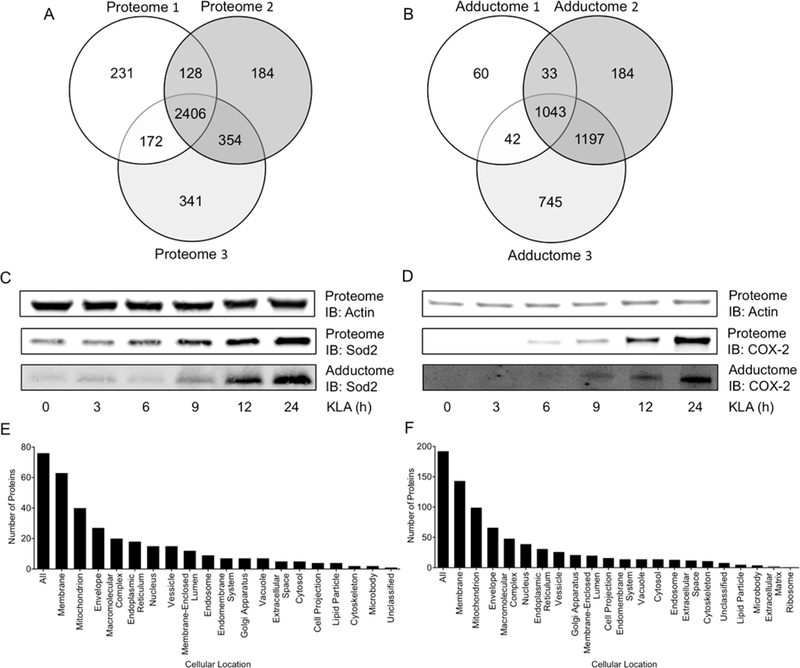
(A) Venn diagram depicting common proteins across three proteome replicates. In total, 3816 proteins were detected, with 2406 proteins common across all three proteome replicates. (B) Venn diagram depicting common proteins across three adductome replicates. In total, 3304 proteins were detected as adducted, with 1043 proteins commonly adducted across all three adductome replicates. (C) Affinity purification and Western blotting were used to confirm Sod2 as adducted by lipid electrophiles during macrophage activation. Both adduction and induction of Sod2 increase with time and at approximately the same rate. (D) Affinity purification and Western blotting were also used to confirm COX-2 as adducted by lipid electrophiles during macrophage activation. Both adduction and induction of COX-2 increase with time and at approximately the same rate. These blots show that induction is not driven by adduction for these candidate proteins. (E) Cellular compartment enrichment of the 192 most differentially expressed proteins during macrophage activation (P < 0.05, heavy/light > 1.5). The membrane and mitochondrion are the most heavily enriched cellular locations of proteins demonstrating increased expression. (F) Cellular compartment enrichment of the 76 most differentially adducted proteins by lipid electrophiles in activated macrophages (P < 0.05, heavy/light > 1.5). The membrane and mitochondrion are the most heavily enriched cellular locations of protein targets for lipid electrophiles.
Figure 4.
Figure 4.
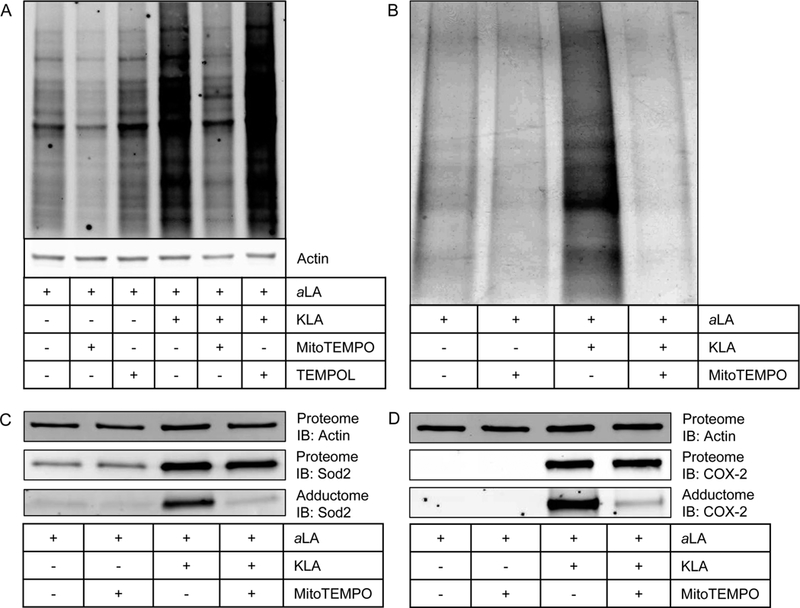
(A) Results of modulation of KLA-induced protein adduction by MitoTEMPO and TEMPOL. MitoTEMPO, a mitochondrially targeted superoxide scavenger, was able to reduce both physiological and pathophysiological protein adduction by lipid electrophiles compared to vehicle and KLA, respectively. TEMPOL, a ubiquitously dispersed superoxide scavenger, did not modulate electrophile formation in either physiological or pathophysiological settings. (B) Consistent with previous results, affinity-purified adducted protein is greatest in the KLA-activated macrophages. MitoTEMPO reduces total adducted protein in both the vehicle-treated and KLA-activated macrophages. (C) MitoTEMPO does not change the KLA-induced expression (Proteome) of Sod2 but does decrease the amount of Sod2 adduction (Adductome). (D) MitoTEMPO does not change the KLA-induced expression (Proteome) of Sod2 but does decrease the amount of Sod2 adduction (Adductome). These data indicate that both mitochondrial and nonmitochondrial targets are adducted by lipid electrophiles generated through a process that involves mitochondrial superoxide.

References

    1. Nathan C, and Ding A (2010) Nonresolving inflammation. Cell 140, 871–882. - PubMed
    1. West JD, and Marnett LJ (2006) Endogenous reactive intermediates as modulators of cell signaling and cell death. Chem. Res. Toxicol. 19, 173–194. - PubMed
    1. Kondo M, Shibata T, Kumagai T, Osawa T, Shibata N, Kobayashi M, Sasaki S, Iwata M, Noguchi N, and Uchida K (2002) 15-Deoxy-Delta(12,14)-prostaglandin J(2): the endogenous electrophile that induces neuronal apoptosis. Proc. Natl. Acad. Sci. U. S. A. 99, 7367–7372. - PMC - PubMed
    1. Kumagai T, Matsukawa N, Kaneko Y, Kusumi Y, Mitsumata M, and Uchida K (2004) A lipid peroxidation-derived inflammatory mediator: identification of 4-hydroxy-2-nonenal as a potential inducer of cyclooxygenase-2 in macrophages. J. Biol. Chem. 279, 48389–48396. - PubMed
    1. Markesbery WR, and Lovell MA (1998) Four- hydroxynonenal, a product of lipid peroxidation, is increased in the brain in Alzheimer’s disease. Neurobiol. Aging 19, 33–36. - PubMed

Publication types

LinkOut - more resources