Review
. 2017 Sep;26(5):411-418.
doi: 10.1097/MNH.0000000000000352.

The renal response to potassium stress: integrating past with present

Affiliations
Review

The renal response to potassium stress: integrating past with present

Cary R Boyd-Shiwarski et al. Curr Opin Nephrol Hypertens. 2017 Sep.

Abstract

Purpose of review: The current review combines past findings with recent advances in our understanding of the homeostatic response to potassium imbalance.

Recent findings: Following the ingestion of a dietary potassium load, a combination of extrarenal and renal mechanisms act to maintain extracellular K+ within a tight window. Through hormonal regulation and direct K+ sensing, the nephron is ideally suited to respond to wide shifts in external K+ balance. Current evidence indicates that dietary K+ loading triggers a coordinated kaliuretic response that appears to involve voltage-dependent changes in sodium transport across multiple nephron segments, including the proximal tubule, medullary loop of Henle, and distal tubule. Inhibition of sodium transport in these segments would accomplish the final goal of enhancing distal NaCl delivery, luminal flow, and K+ secretion in the aldosterone sensitive distal nephron (ASDN).

Summary: Ongoing research seeks to define the relationship between potassium and volume homeostasis by elucidating pathways that couple renal K+ sensing and tubular function during the potassium stress response.


Conflict of interest statement

Conflicts of interest

There are no conflicts of interest.

Figures
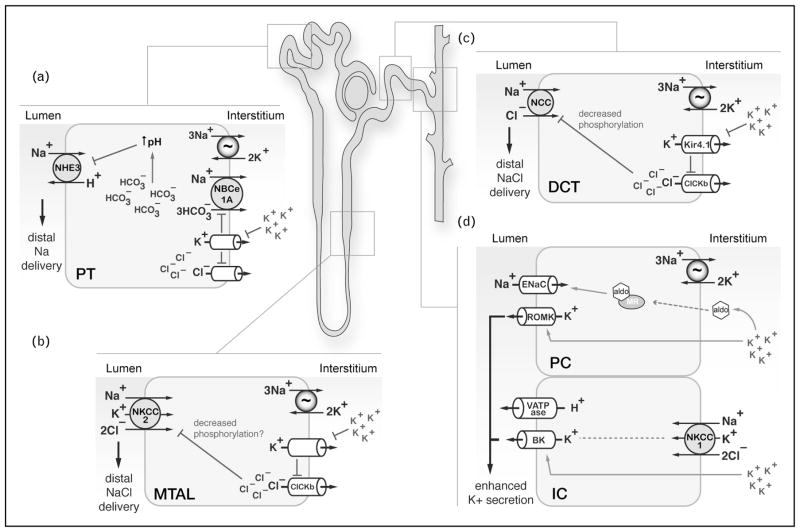
FIGURE 1
FIGURE 1
The renal response to hyperkalemia involves multiple nephron segments. Summary of proposed transport events occurring in various sections of the nephron during dietary potassium loading. Current evidence suggests that in the proximal tubule, medullary thick ascending limb, and distal convoluted tubule, hyperkalemia-induced depolarization events at the basolateral membrane diminish transcellular sodium reabsorption, enhancing distal Na+ delivery. (a) A mathematical model [27] suggests that depolarization suppresses bicarbonate reabsorption via electrogenic sodium bicarbonate cotransporter 1A (NBCe1A), resulting in cytosolic alkalinization and reduced sodium–hydrogen exchanger activity. (b) In the medullary thick ascending limb, increased interstitial [K+] caused by enhanced medullary recycling diminishes sodium reabsorption, likely via NKCC2. It has been proposed that this process is also linked to basolateral membrane depolarization, which may downregulate NKCC2 activity via dephosphorylation, though this remains to be tested empirically. (c) In the distal convoluted tubule, hyperkalemia depolarization downregulates Kir4.1 activity, which increases intracellular chloride levels, attenuating sodium chloride cotransporter phosphorylation and activity. (d) Blockade of sodium transport in these regions of the nephron enhance NaCl delivery to principal cells and intercalated cells of the connecting tubule and cortical collecting duct, where voltage dependent K+ secretion via epithelial sodium channel and renal outer medullary K+ channel and flow dependent K+ secretion via BK channels occur, respectively. The enhanced K+ secretion in the connecting tubule and cortical collecting duct occurs through both aldosterone-dependent and aldosterone-independent processes.

References

    1. Hayes J, Kalantar-Zadeh K, Lu JL, et al. Association of hypo- and hyperkalemia with disease progression and mortality in males with chronic kidney disease: the role of race. Nephron Clin Pract. 2012;120:c8–c16. - PMC - PubMed
    1. Chen Y, Chang AR, McAdams DeMarco MA, et al. Serum potassium, mortality, and kidney outcomes in the atherosclerosis risk in communities study. Mayo Clin Proc. 2016;91:1403–1412. - PMC - PubMed
    1. Sarafidis PA, Blacklock R, Wood E, et al. Prevalence and factors associated with hyperkalemia in predialysis patients followed in a low-clearance clinic. Clin J Am Soc Nephrol. 2012;7:1234–1241. - PMC - PubMed
    1. Kaplan B, Wang Z, Abecassis MM, et al. Frequency of hyperkalemia in recipients of simultaneous pancreas and kidney transplants with bladder drainage. Transplantation. 1996;62:1174–1175. - PubMed
    1. Greenlee M, Wingo CS, McDonough AA, et al. Narrative review: evolving concepts in potassium homeostasis and hypokalemia. Ann Intern Med. 2009;150:619–625. - PMC - PubMed
