Meta-Analysis
. 2017 Jun;96(24):e6884.
doi: 10.1097/MD.0000000000006884.

Third-line chemotherapy in advanced gastric cancer: A systematic review and meta-analysis

Affiliations
Meta-Analysis

Third-line chemotherapy in advanced gastric cancer: A systematic review and meta-analysis

Yu Zheng et al. Medicine (Baltimore). 2017 Jun.

Abstract

Backgound: Little information regarding to the survival advantage of third-line chemotherapy in advanced gastric cancer patients is available. The current study is designed to systematically review and perform meta-analysis on the effect of third-line chemotherapy on progressive or recurrent gastric cancer treatment.

Methods: After thorough searching of online databases, total 20 articles were included into qualitative systematic review and 6 of them were used to conduct qualitative meta-analysis.

Results: It was found that the third-line chemotherapy was superior to placebo or best supportive care in terms of prolonging median oval survival (OS) length and progress free survival (PFS) length (Hedges's g for OS = -0.315 ± 0.077, P < .001; and for PFS = -0.382 ± 0.098, P < .001). In addition, the third-line chemotherapy was favored (Hedges's g = 0.848, P < .001) in terms of overall survival rate (Hazard ratio = 0.679, 95% confidence interval: 0.565-0.816, P < .001) or tumor free survival rate (Hazard ratio = 0.561, 95% confidence interval: 0.444-0.709, P < .001).

Conclusion: The third-line chemotherapy is superior to the best supportive care in advanced gastric cancer patients who had been pretreated with first-line and second-line chemotherapy.


Conflict of interest statement

The authors have no conflicts of interest to disclose.

Figures
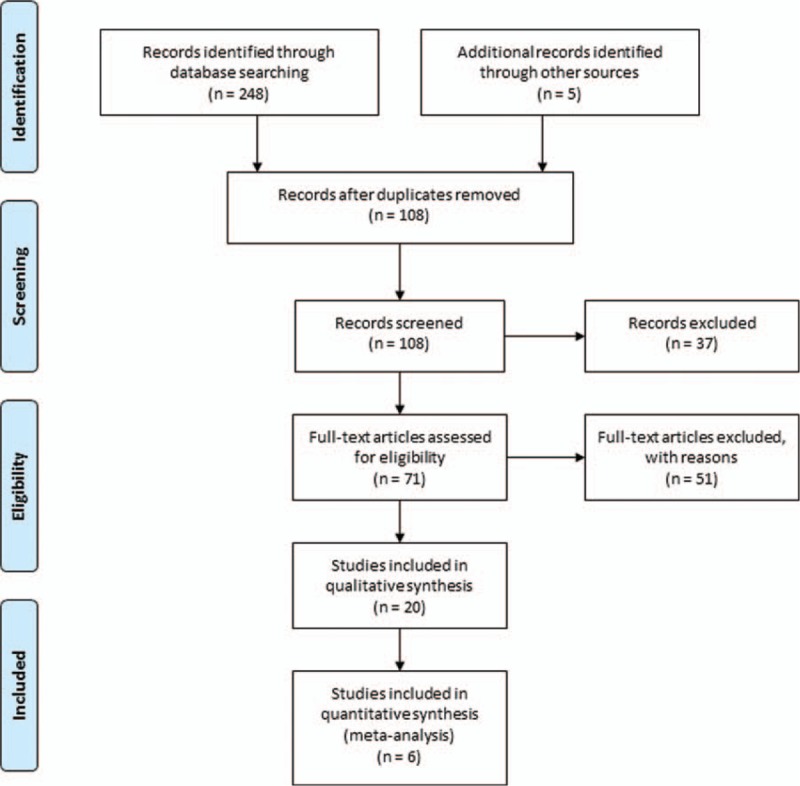
Figure 1
Figure 1
Flow diagram of literature search and eligible publication selection.
Figure 2
Figure 2
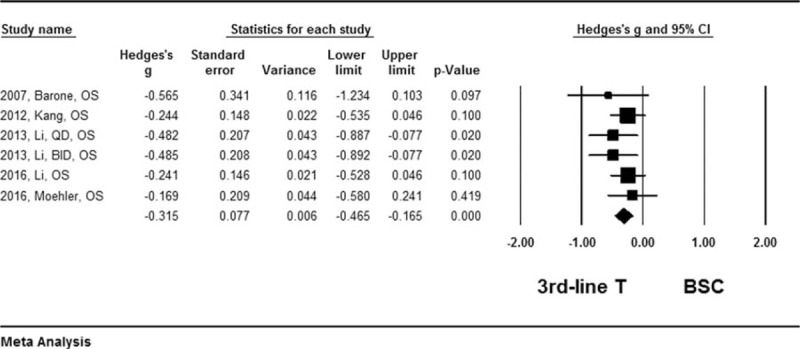
Forest plot for median survival length of overall survival. A fixed effect model was used due to non-significant heterogeneity of publications (I2 = 45.6%, P = .067). The effect size was assessed by Hedges's g and 95% CI, and the median survival length was in favors of third-line chemotherapy (Hedges's g = −0.315 ± 0.077, P < .001). 3rd-line T = third-line chemotherapy, BSC = best supportive care, CI =  confidence interval.
Figure 3
Figure 3
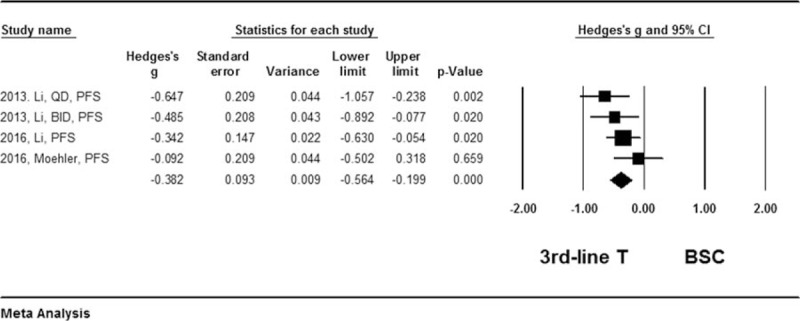
Forest plot for median survival length of progress free survival. A random effect model was used due to non-significant heterogeneity of publications (I2 = 87.2%, P = .003). The effect size was assessed by Hedges's g and 95% CI, and the median survival length was in favor of third-line chemotherapy (Hedges's g = −0.382 ± 0.093, P < .001). 3rd-line T = third-line chemotherapy, BSC = best supportive care, CI = confidence interval.
Figure 4
Figure 4
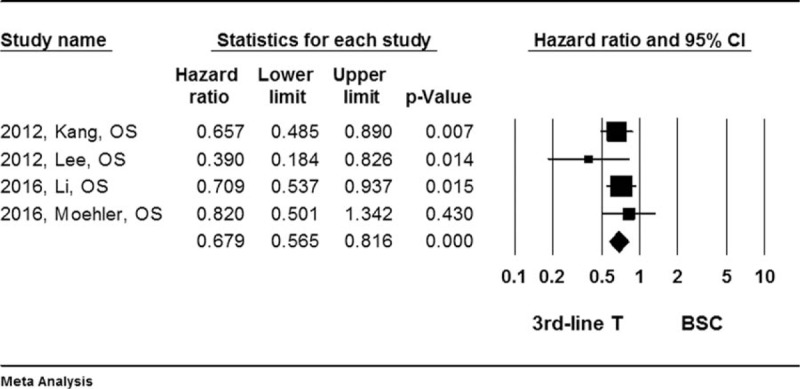
Forest plot for hazard ratio (HR) of overall survival (OS) rate. A fixed effect model was used due to non-significant heterogeneity of publications (I2 = 0.12, P = .424). The effect size was assessed by hazard ratio (HR) and 95% CI, and the OS rate was in favors of third-line chemotherapy (HR = 0.679, 95%CI: 0.565–0.816, P < .001). 3rd-line T = third-line chemotherapy, BSC = best supportive care, CI = confidence interval, HR = hazard ratio, OS = overall survival.
Figure 5
Figure 5
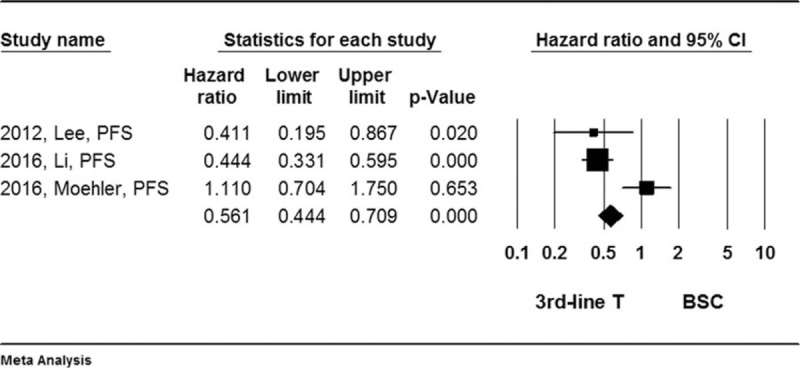
Forest plot for hazard ratio (HR) of progress free survival (PFS) rate. A random effect model was used due to non-significant heterogeneity of publications (I2 = 82.9%, P = .04). The effect size was assessed by hazard ratio (HR) and 95% CI, and the OS rate was in favor of third-line chemotherapy (HR = 0.561, 95%CI: 0.444–0.709, P < .001). 3rd-line T = third-line chemotherapy, BSC = best supportive care, CI = confidence interval, HR = hazard ratio, OS = overall survival, PFS = progress free survival.

References

    1. Siegel R, Ma J, Zou Z, et al. Cancer statistics, 2014. CA Cancer J Clin 2014;64:9–29. doi:10.3322/caac.21208. - PubMed
    1. Hess LM, Michael D, Mytelka DS, et al. Chemotherapy treatment patterns, costs, and outcomes of patients with gastric cancer in the United States: a retrospective analysis of electronic medical record (EMR) and administrative claims data. Gastric Cancer 2016;19:607–15. - PMC - PubMed
    1. Zhao G, Ford ES, Ahluwalia IB, et al. Prevalence and trends of receipt of cancer screenings among US women with diagnosed diabetes. J Gen Intern Med 2009;24:270–5. - PMC - PubMed
    1. Liu J, Sun L, Gong Y. Risk factors of precancerous gastric lesions in a population at high risk of gastric cancer. Chin J Cancer Res 2010;22:267–73.
    1. Yang L. Incidence and mortality of gastric cancer in China. World J Gastroenterol 2006;12:17–20. - PMC - PubMed

MeSH terms

Substances