. 2017 Jun 27;11(6):6416-6421.
doi: 10.1021/acsnano.7b02884. Epub 2017 Jun 15.

General Strategy for Direct Cytosolic Protein Delivery via Protein-Nanoparticle Co-engineering

Affiliations

General Strategy for Direct Cytosolic Protein Delivery via Protein-Nanoparticle Co-engineering

Rubul Mout et al. ACS Nano. .

Abstract

Endosomal entrapment is a key hurdle for most intracellular protein-based therapeutic strategies. We report a general strategy for efficient delivery of proteins to the cytosol through co-engineering of proteins and nanoparticle vehicles. The proteins feature an oligo(glutamate) sequence (E-tag) that binds arginine-functionalized gold nanoparticles, generating hierarchical spherical nanoassemblies. These assemblies fuse with cell membranes, releasing the E-tagged protein directly into the cytosol. Five different proteins with diverse charges, sizes, and functions were effectively delivered into cells, demonstrating the generality of our method. Significantly, the engineered proteins retained activity after cytosolic delivery, as demonstrated through the delivery of active Cre recombinase, and granzyme A to kill cancer cells.

Keywords: cytosolic protein delivery; hierarchical nanoassembly; membrane fusion; nanoparticles; protein engineering.


Conflict of interest statement

Notes

The authors declare the following competing financial interest(s): V.M.R and R.M. submitted a non-provisional patent to USPTO (Application number PCT/US2016/015711) on the invention.

Figures
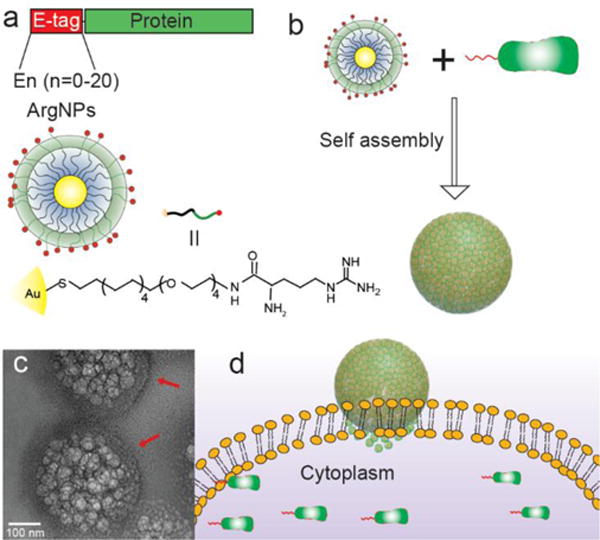
Figure 1
Figure 1
Co-engineering of E-tagged proteins and nanoparticles for direct cytoplasmic protein delivery. a) Strategy for protein engineering, and the chemical structure of arginine functionalized gold nanoparticles (ArgNPs). b) Simple mixing of E-tagged proteins and ArgNPs provides hierarchical nanoassemblies. c) Representative transmission electron micrograph (TEM) of GFP-E10:ArgNPs assemblies. Red arrow indicates nanoparticle coating on the nanoassembly surface. d) Proposed fusion-like mechanism for direct cytosolic protein delivery.
Figure 2
Figure 2
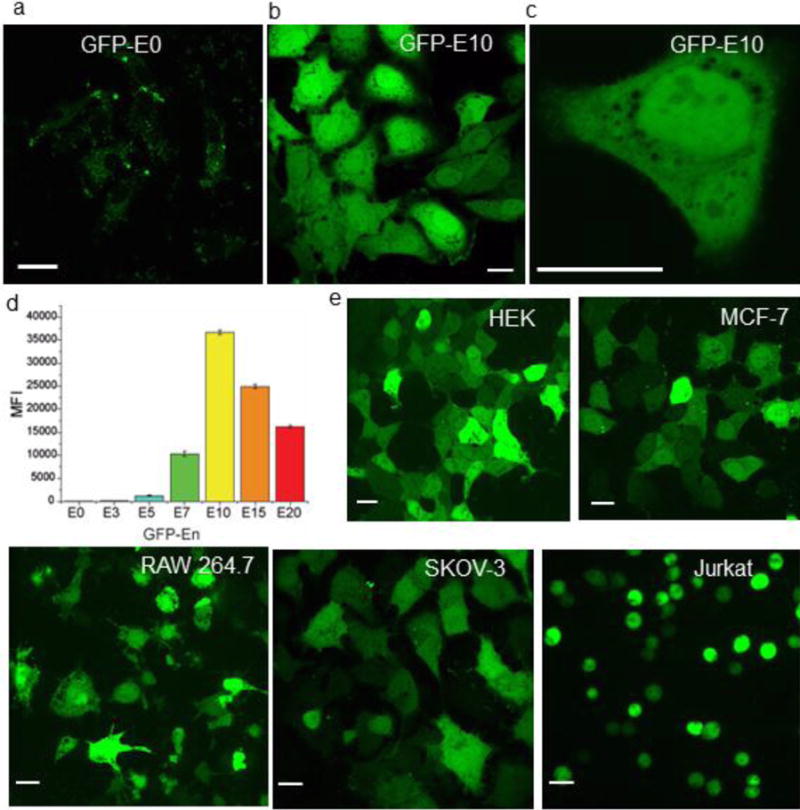
Confocal microscopy images showing nanoparticle-mediated cytoplasmic delivery of E-tagged GFP in Hela cells a) Unmodified GFP (GFP-E0) is not delivered into cell. b) GFP-E10 is delivered efficiently into the cytosol. c) Enlarged image of a cell after delivery of GFP-E10, indicating thorough distribution of delivered protein in the cytoplasm and nucleus. d) Flow cytometry data (mean fluorescence intensity, MFI) showing GFP-En delivery efficiency increases as the E-tag length increases, reaching maximum at GFP-E10. e) GFP-E10 delivery in different cell lines. Scale bar= 20 μm.
Figure 3
Figure 3
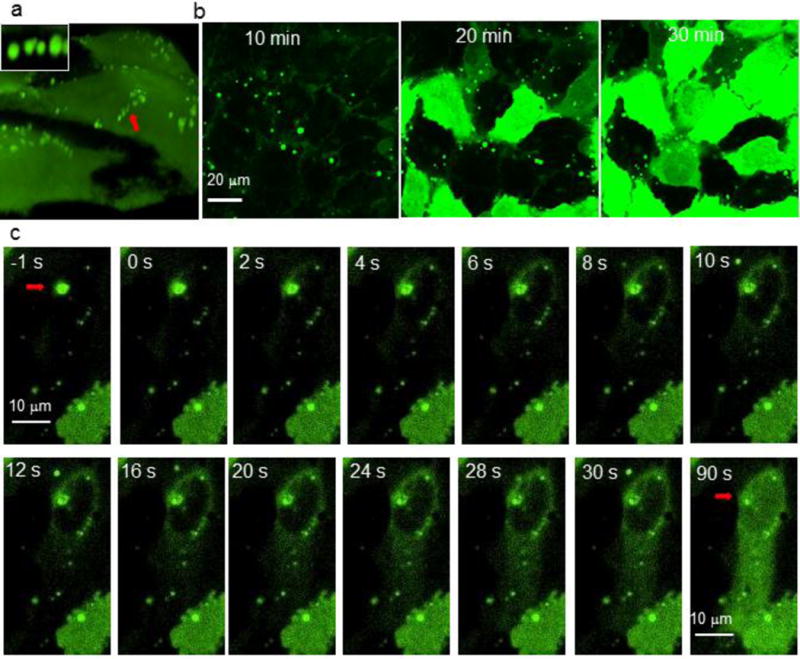
Micrographic evidence for a a fusion-like mechanism for nanoassembly-mediated direct cytosolic protein delivery. a) Confocal microscopy images showing nanoassemblies bound to the cell membrane (indicated by red arrow) in SKOV-3 cells (also see supplementary movie 3). Inset—enlarged image of nanoassemblies. 3D image was reconstructed from z-stacking images. Also, see supplementary movie 3. b) Time-lapse confocal microscopy imaging revealing the direct cytosolic delivery of GFP-E10 in HeLa cells (see supplementary movie 1). Representative still-images showing at 10, 20, and 30 min after nanoassemblies were added to the cell culture dish. c) A single nanoassembly (red arrow) was fused to the cell membrane (at -1s), which then rapidly released encapsulated GFP-E10 into the cytosol. Delivered GFP-E10 was distributed thorough the cytosol (after 30s), and the nucleus (90s) (also see supplementary movie 2).
Figure 4
Figure 4
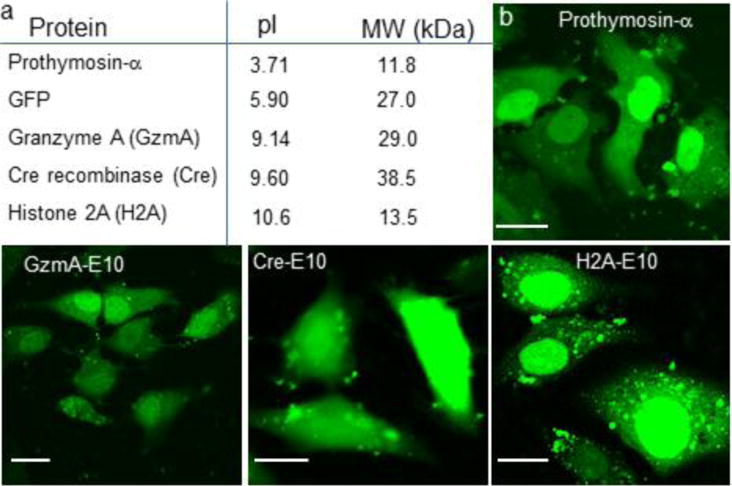
Direct cytoplasmic delivery of multiple E-tagged proteins with widely varying size and charge. a) List of proteins delivered here with their respective charge (pI) and size (MW). b) Nanoassembly-mediated delivery of these E-tagged proteins (FITC-labelled) indicated the even distribution in the cytoplasm and nucleus as shown through confocal microscopy images. Note that, except Cre recombinase, these proteins have an inherent nuclear signal, which is also reflected by their preferential accumulation in the nucleus. Scale bar= 20 μm.
Figure 5
Figure 5
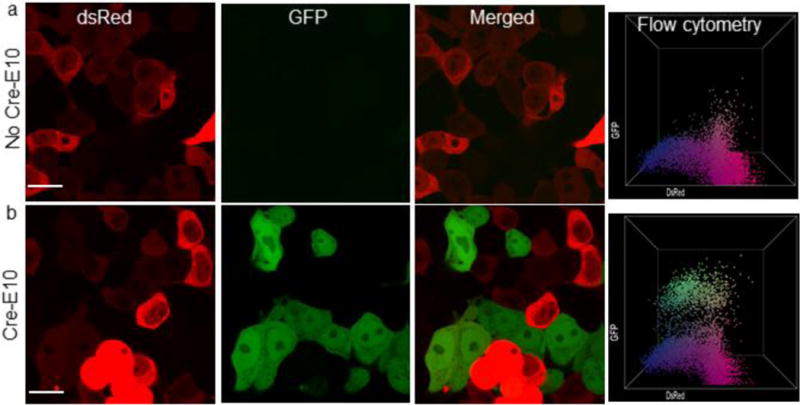
Nanoassembly mediated Cre-E10 delivery provided efficient gene recombination. Confocal micrograph and flow cytometry data before (a), and after (b) Cre-E10 delivery in HEK cells. Delivery of Cre-E10 efficiently floxed dsRed gene, thus turning on GFP expression (b). Scale bar= 20 μm.
Figure 6
Figure 6
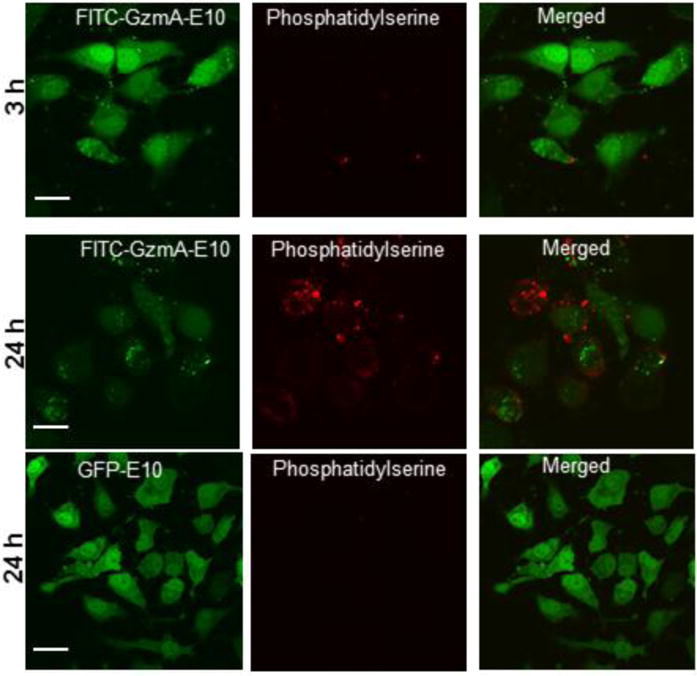
Nanoassembly-mediated delivery of functional Granzyme A-E10 (GzmA-E10) effectively killed HeLa cells. Confocal microscopy images showing FITC-GzmA-E10 or GFP-E10 delivered cells along with phosphatidylserine staining. a) 3, and 24 h after GzmA-E10 delivery. b) 24 h after GFP-E10 delivery. Note that 24 h after GzmA-E10 delivery cells died, which also showed phosphatidylserine staining, confirming the GzmA-E10 mediated cell death. Scale bar= 20 μm.

References

    1. Mitragotri S, Burke PA, Langer R. Overcoming the Challenges in Administering Biopharmaceuticals: Formulation and Delivery Strategies. Nat Rev Drug Discov. 2014;13:655–672. - PMC - PubMed
    1. Gu Z, Biswas A, Zhao M, Tang Y. Tailoring Nanocarriers for Intracellular Protein Delivery. Chem Soc Rev. 2011;40:3638–3655. - PubMed
    1. Komor AC, Badran AH, Liu DR. CRISPR-Based Technologies for the Manipulation of Eukaryotic Genomes. Cell. 2017;168:20–36. - PMC - PubMed
    1. Mout R, Ray M, Lee YW, Scaletti F, Rotello VM. In Vivo Delivery of CRISPR/Cas9 for Therapeutic Gene Editing: Progress and Challenges. Bioconjug Chem. 2017;28:880–884. - PMC - PubMed
    1. Khalil AS, Collins JJ. Synthetic Biology: Applications Come of Age. Nat Rev Genet. 2010;11:367–379. - PMC - PubMed

Publication types