. 2017 Jun 13;19(11):2177-2184.
doi: 10.1016/j.celrep.2017.05.042.

A UV-Independent Topical Small-Molecule Approach for Melanin Production in Human Skin

Affiliations

A UV-Independent Topical Small-Molecule Approach for Melanin Production in Human Skin

Nisma Mujahid et al. Cell Rep. .

Abstract

The presence of dark melanin (eumelanin) within human epidermis represents one of the strongest predictors of low skin cancer risk. Topical rescue of eumelanin synthesis, previously achieved in "redhaired" Mc1r-deficient mice, demonstrated significant protection against UV damage. However, application of a topical strategy for human skin pigmentation has not been achieved, largely due to the greater barrier function of human epidermis. Salt-inducible kinase (SIK) has been demonstrated to regulate MITF, the master regulator of pigment gene expression, through its effects on CRTC and CREB activity. Here, we describe the development of small-molecule SIK inhibitors that were optimized for human skin penetration, resulting in MITF upregulation and induction of melanogenesis. When topically applied, pigment production was induced in Mc1r-deficient mice and normal human skin. These findings demonstrate a realistic pathway toward UV-independent topical modulation of human skin pigmentation, potentially impacting UV protection and skin cancer risk.

Keywords: eumelanin; microphthalmia-associated transcription factor (MITF); pigmentation; salt-inducible kinase (SIK); topical drug.


Figures

Figure 1
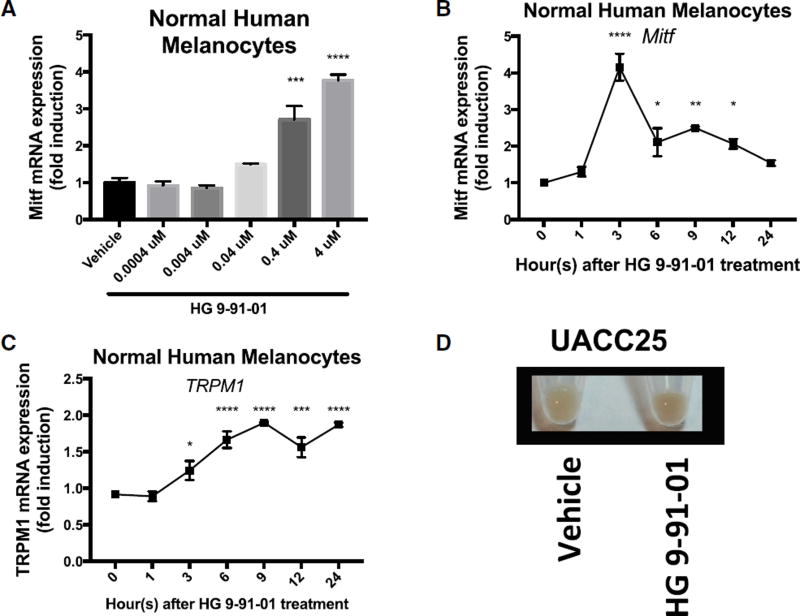
Figure 1. Inhibition of SIK by HG 9-91-01 Promotes MITF Transcription and Pigmentation In Vitro
(A) mRNA expression of MITF relative to RPL11 mRNA and vehicle control in normal human melanocytes 3 hr after HG 9-91-01 or vehicle control (70% ethanol, 30% propylene glycol) treatment, quantified by qRT-PCR (n = 3, mean ± SEM). (B and C) mRNA expression of MITF (B) and MITF-dependent gene TRPM1 (C) relative to RPL11 mRNA and vehicle control at each time point, in normal human melanocytes over 24 hr after 4 µM HG 9-91-01 or vehicle control treatment, quantified by qRT-PCR (n = 3, mean ± SEM). (D) Cell pellets of UACC257 melanoma cells after 3 days of treatment with vehicle control or 4 µM SIK inhibitor HG 9-91-01 (image is representative of n = 3 experiments). For the graph in (A), statistical significance is reported as follows: ***p < 0.001; ****p < 0.0001, one-way ANOVA with Dunnett’s multiple comparisons test comparing treatment dose to vehicle control. For the graphs in (B) and (C), statistical significance is reported as follows: *p < 0.05; **p < 0.01; ***p < 0.001; ****p < 0.0001, repeated-measures one-way ANOVA with Dunnett’s multiple comparisons test comparing each time point to time point 0.
Figure 2
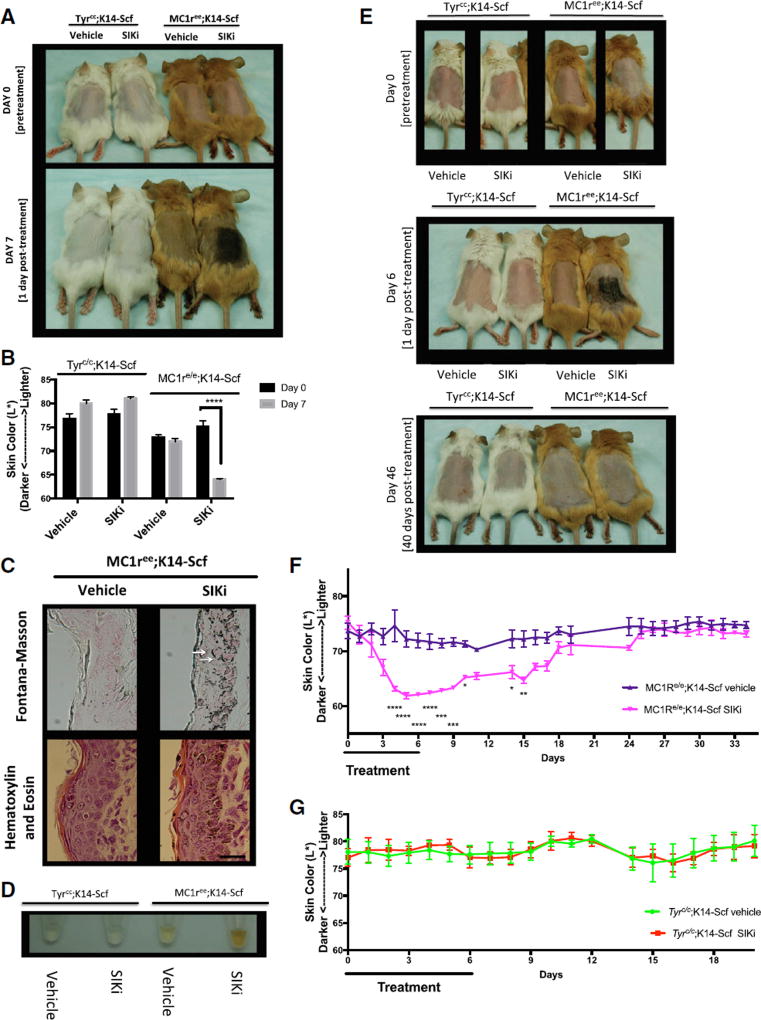
Figure 2. Topical Treatment with HG9-91-01 Causes Robust Darkening that Is Progressive and Reversible in Mc1re/e;K14-SCF Mice
(A–D) Shown here: (A) Mc1re/e;K14-SCF mice and Tyrc/c;K14-SCF mice before treatment (day 0) and after 7 days of treatment (day 7) with 30 µL vehicle control (70% ethanol, 30% propylene glycol) or 37.5 mM HG 9-91-01 (image is representative of n = 4 experiments). (B) Reflective colorimetry measurements (L* white-black color axis; n = 4, mean ± SEM) and (D) melanin extraction (image is representative of n = 4 experiments) of the Mc1re/e;K14-SCF mice and Tyrc/c;K14-SCF mice described in (A). (C) Skin sections of Mc1re/e;K14-SCF mice described in (A) stained with Fontana-Masson (eumelanin) (top two panels) or H&E (bottom two panels); (magnification, 400×). White arrows represent nuclear capping; scale bar represents 25 µm. (E) Mc1re/e;K14-SCF mice and Tyrc/c;K14-SCF mice before treatment (day 0) and after 6 days of treatment with 30 µL vehicle control (70% ethanol, 30% propylene glycol) or 37.5 mM HG 9-91-01 (day 6), and 40 days post-treatment (day 46) (vehicle mouse in day-46 photo is different from that in the day-0 and day-6 photos). (F and G) Reflective colorimetry measurements (CIE L* white-black color axis) of (F) Mc1re/e;K14-SCF mice and (G) Tyrc/c;K14-SCF mice treated as described in (E). Vehicle-treated Mc1re/e;K14-SCF mice: n = 5 (days 0–19), and n = 4 (days 24–34); HG 9-91-01-treated Mc1re/e;K14-SCF mice: n = 3; vehicle-treated Tyrc/c;K14-SCF mice: n = 3 (days 0–10), and n = 2 (days 11–20); HG 9-91-01-treated Tyrc/c;K14-SCF mice: n = 3 (mean ± SEM). For the graph in (B), statistical significance is reported as follows: ****p < 0.0001, multiple t test analysis with the two-stage linear step-up procedure of Benjamini, Krieger, and Yekutieli. For the graphs in (F) and (G), statistical significance is reported as follows: *p < 0.05; **p < 0.01; ***p < 0.001; ****p < 0.0001, two-way ANOVA with Sidak’s multiple comparisons test comparing treatment to vehicle control at each time point.
Figure 3
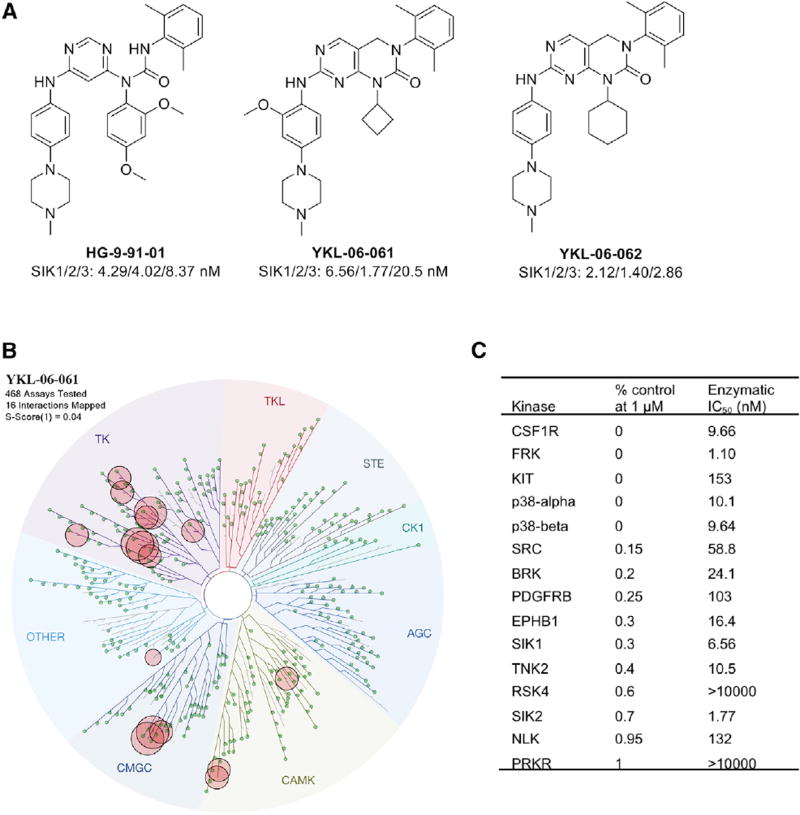
Figure 3. Characterization of SIK Inhibitors
(A) Structures of HG-9-91-01, YKL-06-061, and YKL-06-062 and their biochemical IC50s against SIKs. (B) KinomeScan kinase selectivity profile for YKL-06-061. YKL-06-061 was profiled at a concentration of 1 µM against a diverse panel of 468 kinases by DiscoverX. Kinases that exhibited a score of 1 or below are marked in red circles. (Score is percent relative to DMSO control. Smaller numbers indicate stronger binding.) See Table S1 for full kinome profile. (C) Biochemical kinase IC50s of YKL-06-061 top hits as shown in (B). TK, tyrosine kinase; TKL, tyrosine kinase-like; STE, homologs of yeast sterile 7, sterile 11, sterile 20 kinases; CK1, casein kinase 1; AGC, containing PKA, PKG, and PKC families; CAMK, calcium/ calmodulin-dependent protein kinase; CMGC, containing CDK, MAPK, GSK3, and CLK families. See also Table S1.
Figure 4
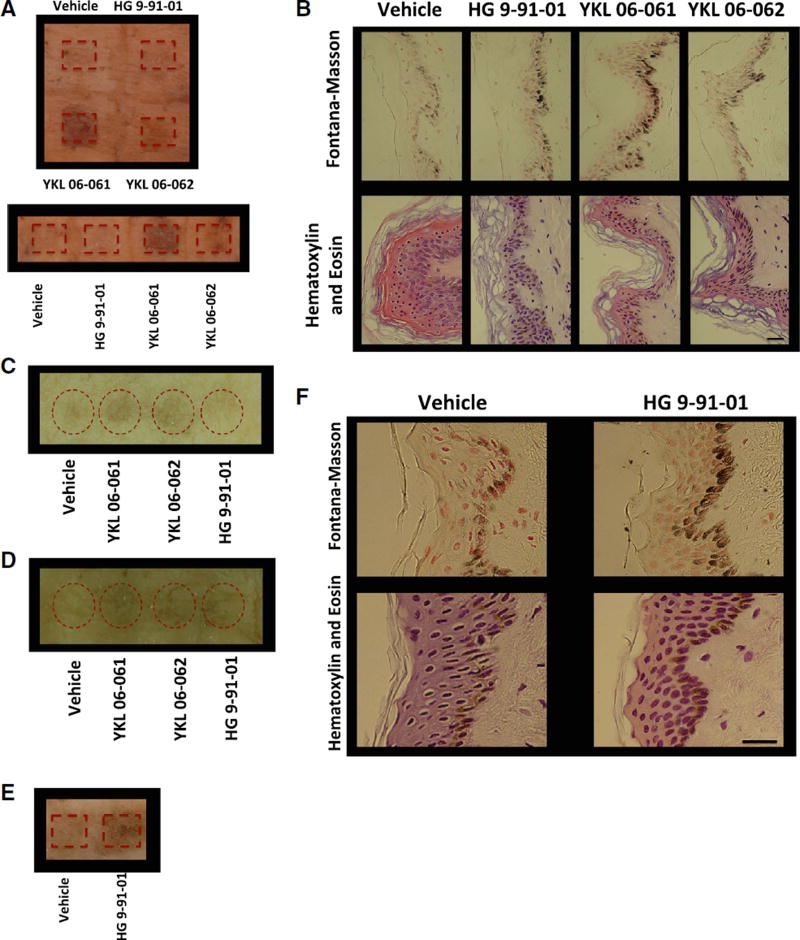
Figure 4
Treatment of Human Skin Explants with 37.5 mM of SIK Inhibitor Induces Pigmentation (A) Human breast skin explants treated with passive application of vehicle control (70% ethanol, 30% propylene glycol) or 37.5 mM SIK inhibitor YKL 06-061, YKL 06-062, or HG 9-91-01 for 8 days (10 µL; 1×/day). Image was taken 2 days after the end of treatment (image is representative of two of n = 3 experiments). (B) Fontana-Masson (top panel) and H&E (bottom panel) staining (magnification, 400×) of breast skin described in (A). Scale bar represents 25 µm. (C) Human breast skin explants treated with passive application of vehicle control or 37.5 mM SIK inhibitor YKL 06-061, YKL 06-062, or HG 9-91-01 for 5 days (10 µL; 2×/day). Image was taken 1 day after the end of treatment (image is representative of n = 1 experiment). (D) Human breast skin explants treated with passive application of vehicle control or 37.5 mM SIK inhibitor YKL 06-061, YKL 06-062, or HG 9-91-01 for 6 days (10 µL; 2×/day). Image was taken 1 day after the end of treatment (image is representative of n = 1 experiment). (E) Human breast skin explants treated with mechanical application of vehicle control or 50 mM (50 µL for 1 day; 1×/day) or 25 mM (50 µL for 3 days; 3×/day) HG 9-91-01. Image was taken 4 days after the start of treatment (image is representative of n = 1 experiment). (F) Fontana-Masson (top panels) and H&E (bottom panels) staining (magnification, 400×) of human skin explants described in (E). Scale bar represents 25 µm.

Comment in

  • Getting a tan without getting SIK.
    D'Orazio JA. D'Orazio JA. Pigment Cell Melanoma Res. 2017 Sep;30(5):451-453. doi: 10.1111/pcmr.12613. Pigment Cell Melanoma Res. 2017. PMID: 28677151 No abstract available.
  • Self-tanning cells, the new SPF.
    Venere M. Venere M. Sci Transl Med. 2017 Jul 5;9(397):eaan8202. doi: 10.1126/scitranslmed.aan8202. Sci Transl Med. 2017. PMID: 28679660
  • A Topical Solution to the Sunless Tanning Problem.
    Michael HT, Merlino G. Michael HT, et al. Trends Mol Med. 2017 Sep;23(9):771-773. doi: 10.1016/j.molmed.2017.07.010. Epub 2017 Aug 5. Trends Mol Med. 2017. PMID: 28789829 Free PMC article.

References

    1. Armstrong BK, Kricker A. The epidemiology of UV induced skin cancer. J. Photochem. Photobiol. 2001;B 63:8–18. - PubMed
    1. Bertolotto C, Abbe P, Hemesath TJ, Bille K, Fisher DE, Ortonne JP, Ballotti R. Microphthalmia gene product as a signal transducer in cAMP-induced differentiation of melanocytes. J. Cell Biol. 1998;142:827–835. - PMC - PubMed
    1. Bertolotto C, Lesueur F, Giuliano S, Strub T, de Lichy M, Bille K, Dessen P, d’Hayer B, Mohamdi H, Remenieras A, et al. French Familial Melanoma Study Group. A SUMOylation-defective MITF germline mutation predisposes to melanoma and renal carcinoma. Nature. 2011;480:94–98. - PubMed
    1. Bos JD, Meinardi MM. The 500 dalton rule for the skin penetration of chemical compounds and drugs. Exp. Dermatol. 2000;9:165–169. - PubMed
    1. Choy YB, Prausnitz MR. The rule of five for non-oral routes of drug delivery: ophthalmic, inhalation and transdermal. Pharm. Res. 2011;28:943–948. - PMC - PubMed

Publication types