. 2017 Jun 14;16(1):104.
doi: 10.1186/s12943-017-0674-z.

Oct4 transcriptionally regulates the expression of long non-coding RNAs NEAT1 and MALAT1 to promote lung cancer progression

Affiliations

Oct4 transcriptionally regulates the expression of long non-coding RNAs NEAT1 and MALAT1 to promote lung cancer progression

Jayu Jen et al. Mol Cancer. .

Abstract

Background: Oct4, a key stemness transcription factor, is overexpressed in lung cancer. Here, we reveal a novel transcription regulation of long non-coding RNAs (lncRNAs) by Oct4. LncRNAs have emerged as important players in cancer progression.

Methods: Oct4 chromatin-immunoprecipitation (ChIP)-sequencing and several lncRNA databases with literature annotation were integrated to identify Oct4-regulated lncRNAs. Luciferase activity, qRT-PCR and ChIP-PCR assays were conducted to examine transcription regulation of lncRNAs by Oct4. Reconstitution experiments of Oct4 and downstream lncRNAs in cell proliferation, migration and invasion assays were performed to confirm the Oct4-lncRNAs signaling axes in promoting lung cancer cell growth and motility. The expression correlations between Oct4 and lncRNAs were investigated in 124 lung cancer patients using qRT-PCR analysis. The clinical significance of Oct4/lncRNAs signaling axes were further evaluated using multivariate Cox regression and Kaplan-Meier analyses.

Results: We confirmed that seven lncRNAs were upregulated by direct binding of Oct4. Among them, nuclear paraspeckle assembly transcript 1 (NEAT1), metastasis-associated lung adenocarcinoma transcript 1 (MALAT1) and urothelial carcinoma-associated 1 (UCA1) were validated as Oct4 transcriptional targets through promoter or enhancer activation. We showed that lung cancer cells overexpressing NEAT1 or MALAT1 and the Oct4-silenced cells reconstituted with NEAT1 or MALAT1 promoted cell proliferation, migration and invasion. In addition, knockdown of NEAT1 or MALAT1 abolished Oct4-mediated lung cancer cell growth and motility. These cell-based results suggested that Oct4/NEAT1 or Oct4/MALAT1 axis promoted oncogenesis. Clinically, Oct4/NEAT1/MALAT1 co-overexpression was an independent factor for prediction of poor outcome in 124 lung cancer patients.

Conclusions: Our study reveals a novel mechanism by which Oct4 transcriptionally activates NEAT1 via promoter and MALAT1 via enhancer binding to promote cell proliferation and motility, and led to lung tumorigenesis and poor prognosis.

Keywords: Lung cancer; MALAT1; NEAT1; Oct4; Transcription regulation; lncRNA.


Figures
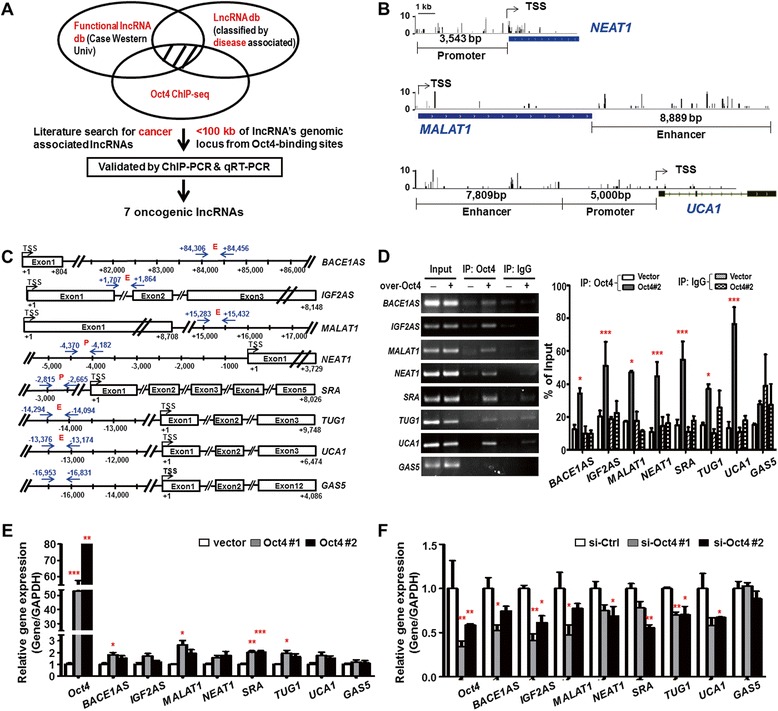
Fig. 1
Fig. 1
Oncogenic lncRNAs were revealed as Oct4 transcriptional downstream targets in lung cancer using ChIP-seq, ChIP-PCR and qRT-PCR assays. a Flowchart of strategies used to identify Oct4 targeted downstream lncRNAs. b The Oct4 binding peaks at promoter and enhancer regions of three representative lncRNAs NEAT1, MALAT1 and UCA1. c Schematic diagram depicting the ChIP-PCR primers for amplification of the regions including Oct4 binding sites around the eight lncRNAs genomic locus (indicated as blue arrows). TSS: transcription start site as indicated by (+1). Oct4 binding regions were classified as enhancer (E) or promoter (P). d ChIP-PCR analysis of Oct4 occupancy at the binding sites of the eight lncRNAs genomic loci. GAS5 serves as a negative control lncRNA. Results are normalized to input by semi-quantitative analysis. IgG serves as an experimental negative control. Data represent mean ± SEM. P-values were determined by two-way ANOVA. e, f qRT-PCR analysis of eight lncRNAs expressions in A549 cells stably overexpressing Oct4 (Oct4#1, Oct4#2) (e) or Oct4-silenced A549 cells (si-Oct4#1, si-Oct4#2) (f). GAS5 serves as a negative control lncRNA. Target lncRNA expression levels were normalized to GAPDH expression levels. Data represent mean ± SEM. P-values were determined by two-tailed Student t-test. *P < 0.05; **P < 0.01; ***P < 0.001
Fig. 2
Fig. 2
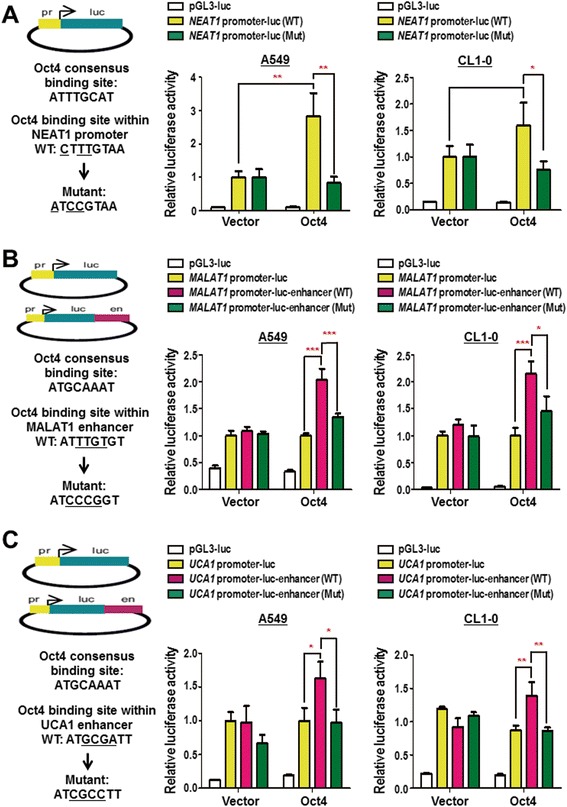
Oct4 promoted oncogenic lncRNAs transcription through activating promoter of NEAT1 and enhancer of MALAT1 and UCA1. a Schematic diagram depicting the construction of promoter activity assay of NEAT1 (upper left). The wild-type (WT) and mutation (Mut) sites at the Oct4 consensus region are shown (lower left). Dual luciferase assay performed in A549 (middle) and CL1–0 (right) cells. b, c Schematic diagram depicting the construction of enhancer activity assay (upper left). The minimal promoters reported were inserted upstream of the luciferase reporter, while the Oct4 binding ChIP-seq regions were inserted downstream as the enhancer plasmids. The WT and Mut sites at the Oct4 consensus region are shown (lower left). Cells were transfected with vector or Oct4 plasmids and luciferase plasmids of NEAT1 (a) MALAT1 (b) or UCA1 (c). Data are mean ± SEM. P-values were determined by two-way ANOVA. *P < 0.05; **P < 0.01; ***P < 0.001
Fig. 3
Fig. 3
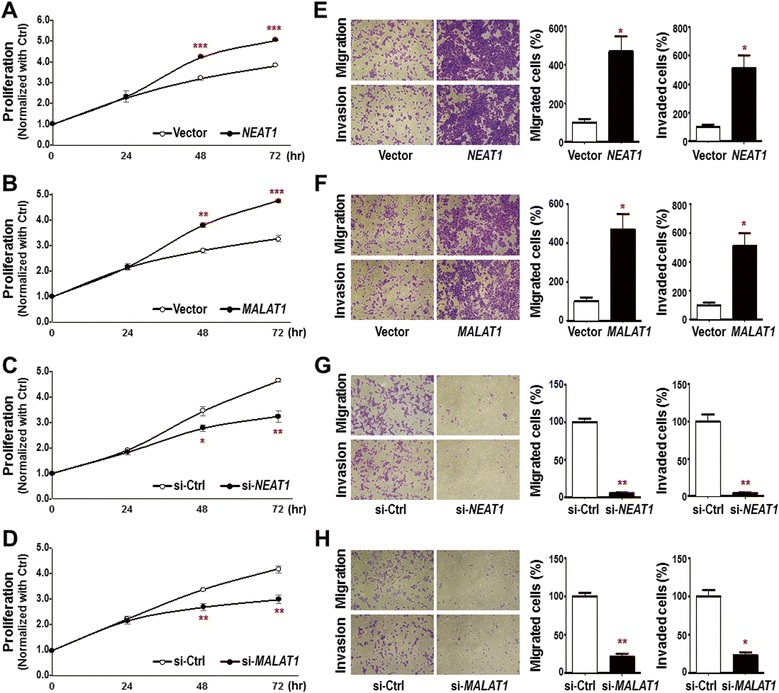
NEAT1 and MALAT1 promoted cell proliferation, migration and invasion in lung cancer cells. a-d Cell proliferation was analyzed by RealTime-Glo viability assay for A549 cells treated with NEAT1 expression vectors (a), MALAT1 expression vectors (b), si-NEAT1 oligo (c) or si-MALAT1 oligo (d) at indicated time points. e-h Cell motility was analyzed by transwell migration and invasion assays for A549 cells treated with NEAT1 expression vectors (e), MALAT1 expression vectors (f), si-NEAT1 oligo (g) or si-MALAT1 oligo (h). Data represent mean ± SEM. P-values were determined by two-tailed Student’s t-test. *P < 0.05; **P < 0.01; ***P < 0.001
Fig. 4
Fig. 4
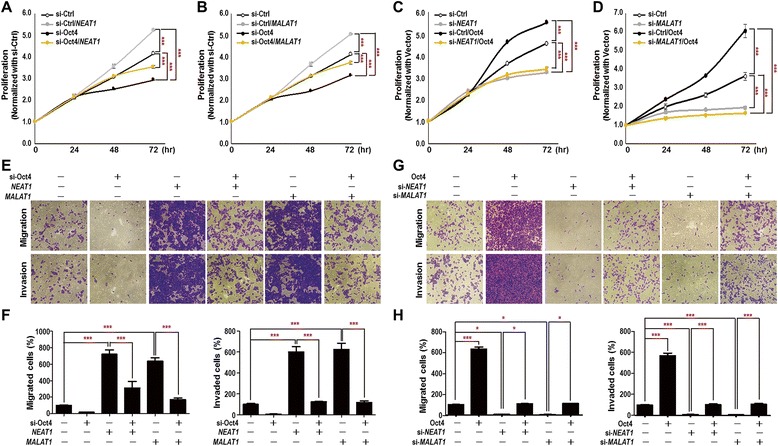
Oct4/NEAT1 or Oct4/MALAT1 signaling axis promoted lung cancer cell proliferation and motility. a-d Cell proliferation assay. Cells were reconstituted with expression vector of NEAT1 (a) or MALAT1 (b) in Oct4-silenced A549 cells, or si-NEAT1 oligo (c) or si-MALAT1 oligo (d) in Oct4-overexpressed A549 cells. Treated cells were then re-seeded and analyzed by RealTime-Glo viability assay at indicated time points. e-h Transwell migration and invasion assays. (e, f). Cells were reconstituted with expression vector of NEAT1 or MALAT1 in Oct4-silenced A549 cells, or (g, h) si-NEAT1 oligo or si-MALAT1 oligo in Oct4-overexpressed A549 cells. Treated cells were re-seeded and analyzed by transwell migration and invasion assays. Results were photographed and quantified. Data represent mean ± SEM. P-values were determined by two-way ANOVA. *P < 0.05; **P < 0.01; ***P < 0.001
Fig. 5
Fig. 5
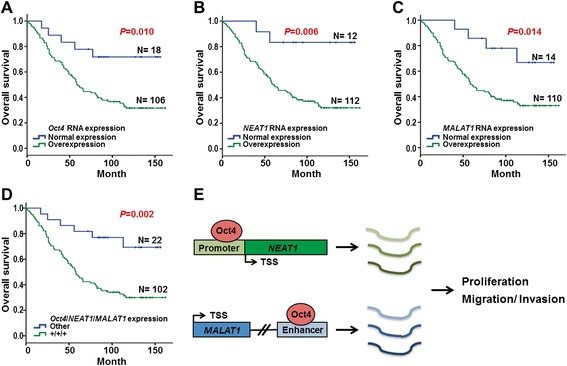
Clinical significances of Oct4/NEAT1/MALAT1 signaling axis in 124 lung cancer patients. qRT-PCR analyses of Oct4, NEAT1 and MALAT1 RNA expression were performed in 124 lung cancer specimens. a-d Overall survival analyzed by Kaplan-Meier method indicated that patients with high RNA expression of Oct4 (a), NEAT1 (b), MALAT1 (c) or coinciding high expression of Oct4, NEAT1 and MALAT1 (d) had poor survival. P-values were determined using log-rank test. e Schematic diagram depicting Oct4 activates NEAT1 transcription via promoter binding and MALAT1 transcription via enhancer binding. NEAT1 and MALAT1 lncRNAs act as downstream effectors of Oct4 to promote lung cancer proliferation, migration and invasion, and thereby lead to lung cancer progression

References

    1. Wang Z, Oron E, Nelson B, Razis S, Ivanova N. Distinct lineage specification roles for NANOG, OCT4, and SOX2 in human embryonic stem cells. Cell Stem Cell. 2012;10:440–454. doi: 10.1016/j.stem.2012.02.016. - DOI - PubMed
    1. Chang CC, Shieh GS, Wu P, Lin CC, Shiau AL, Wu CL. Oct-3/4 expression reflects tumor progression and regulates motility of bladder cancer cells. Cancer Res. 2008;68:6281–6291. doi: 10.1158/0008-5472.CAN-08-0094. - DOI - PubMed
    1. Ben-Porath I, Thomson MW, Carey VJ, Ge R, Bell GW, Regev A, Weinberg RA. An embryonic stem cell-like gene expression signature in poorly differentiated aggressive human tumors. Nat Genet. 2008;40:499–507. doi: 10.1038/ng.127. - DOI - PMC - PubMed
    1. Kim BW, Cho H, Choi CH, Ylaya K, Chung JY, Kim JH, Hewitt SM. Clinical significance of OCT4 and SOX2 protein expression in cervical cancer. BMC Cancer. 2015;15:1015. doi: 10.1186/s12885-015-2015-1. - DOI - PMC - PubMed
    1. Chiou SH, Yu CC, Huang CY, Lin SC, Liu CJ, Tsai TH, Chou SH, Chien CS, Ku HH, Lo JF. Positive correlations of Oct-4 and Nanog in oral cancer stem-like cells and high-grade oral squamous cell carcinoma. Clin Cancer Res. 2008;14:4085–4095. doi: 10.1158/1078-0432.CCR-07-4404. - DOI - PubMed

Publication types

MeSH terms

Substances