Review
. 2017 Aug 4;292(31):12744-12753.
doi: 10.1074/jbc.R117.789537. Epub 2017 Jun 14.

Biogenesis and functions of mammalian iron-sulfur proteins in the regulation of iron homeostasis and pivotal metabolic pathways

Affiliations
Review

Biogenesis and functions of mammalian iron-sulfur proteins in the regulation of iron homeostasis and pivotal metabolic pathways

Tracey A Rouault et al. J Biol Chem. .

Abstract

Fe-S cofactors are composed of iron and inorganic sulfur in various stoichiometries. A complex assembly pathway conducts their initial synthesis and subsequent binding to recipient proteins. In this minireview, we discuss how discovery of the role of the mammalian cytosolic aconitase, known as iron regulatory protein 1 (IRP1), led to the characterization of the function of its Fe-S cluster in sensing and regulating cellular iron homeostasis. Moreover, we present an overview of recent studies that have provided insights into the mechanism of Fe-S cluster transfer to recipient Fe-S proteins.

Keywords: HSC20; HSPA9; ISCU; energy metabolism; iron-response element (IRE); iron-sulfur cluster biogenesis; iron-sulfur protein; metalloenzyme; mitochondrial respiratory chain complex.


Conflict of interest statement

The authors declare that they have no conflicts of interest with the contents of this article

Figures
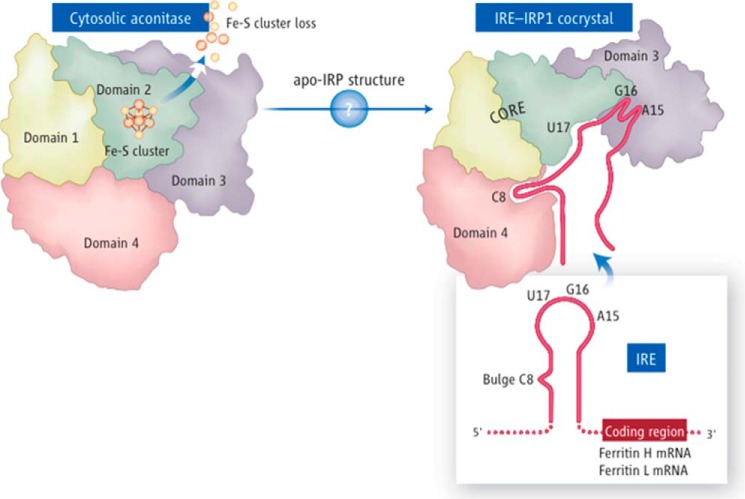
Figure 1.
Figure 1.
IRP1 alternates between function as a cytosolic aconitase, which contains a [Fe4-S4] cluster in the active-site cleft, to an apoprotein form that lacks the cluster and binds to IRE stem-loop structures present in several iron transcripts. Upon binding, IRP1 represses translation of multiple transcripts that contain IREs near the 5′-end of the transcript and stabilizes mRNAs that contain IREs at the 3′-UTR from endonucleolytic degradation. Apo-IRP1 undergoes a large conformational change that creates a complex IRE-binding pocket, in which the bulge C binds to domain 4, and three residues of the loop make finger-like binding projections into newly accessible regions of domain 3. The length of the upper stem of the IRE optimizes the distance between its two main IRP contact points, resulting in high affinity binding.
Figure 2.
Figure 2.
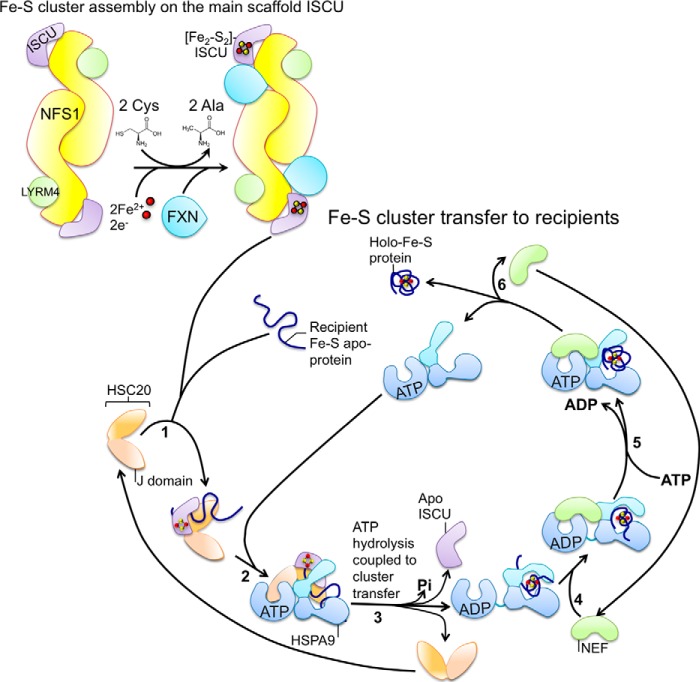
Model for how highly conserved basic Fe-S biogenesis machinery generates and transfers Fe-S clusters. Fe-S cluster assembly on the main scaffold protein ISCU: nascent Fe-S clusters are initially assembled on the main scaffold protein ISCU. A cysteine desulfurase NFS1 forms a dimer to which monomers of the primary scaffold ISCU are proposed to bind at either end, based on the solved structure of the bacterial machinery. LYRM4 is a structural component of the core complex in eukaryotes, and it is required for the activity of NFS1, which, aided by its cofactor pyridoxal phosphate, provides sulfur, removed from cysteine, for the nascent cluster. Frataxin is part of the core complex, potentially binding in a pocket-like region between NFS1 and ISCU. The cluster assembles upon ISCU when iron is provided together with the reducing equivalents needed to generate the final electronic configuration of the cluster. Fe-S cluster transfer to recipients: cluster transfer from ISCU to recipient apoproteins is assisted by a dedicated chaperone/co-chaperone (HSPA9/HSC20) system that facilitates cluster release from the primary scaffold ISCU and transfer to recipient apoproteins or to intermediate carriers, which then target specific recipients. The co-chaperone HSC20 starts the functional cycle of the cognate system by associating with the scaffold protein ISCU, which is loaded with an Fe-S cluster, and with a recipient Fe-S apoprotein (step 1). Step 2, ISCU binds to the HSP70 chaperone (HSPA9 in mammalian cells) in a two-step process, which involves the transient interaction of the J-domain of HSC20 with the NBD of the ATP-bound state of HSPA9, and the interaction of ISCU with the SBD. ATP-bound HSPA9 is in the open conformation, which exhibits the substrate-binding cavity to allow the interaction with ISCU. Step 3, simultaneous association of ISCU and the interaction of the NBD of HSPA9 with the J-domain of HSC20 lowers the activation energy for the hydrolysis of ATP. Hydrolysis of ATP and the coupled conformational change in the SBD of HSPA9 is proposed to facilitate cluster release from ISCU and transfer to the recipient protein. Step 4, a nucleotide exchange factor (NEF), which exhibits high affinity for the ADP-bound state of the HSP70 chaperone, binds to the HSP70-client complex and exchanges ADP with ATP in the NBD (step 5). The client, which has folded into the native conformation driven by the energy provided by hydrolysis of ATP and has acquired its Fe-S cluster, is finally released (step 6).
Figure 3.
Figure 3.
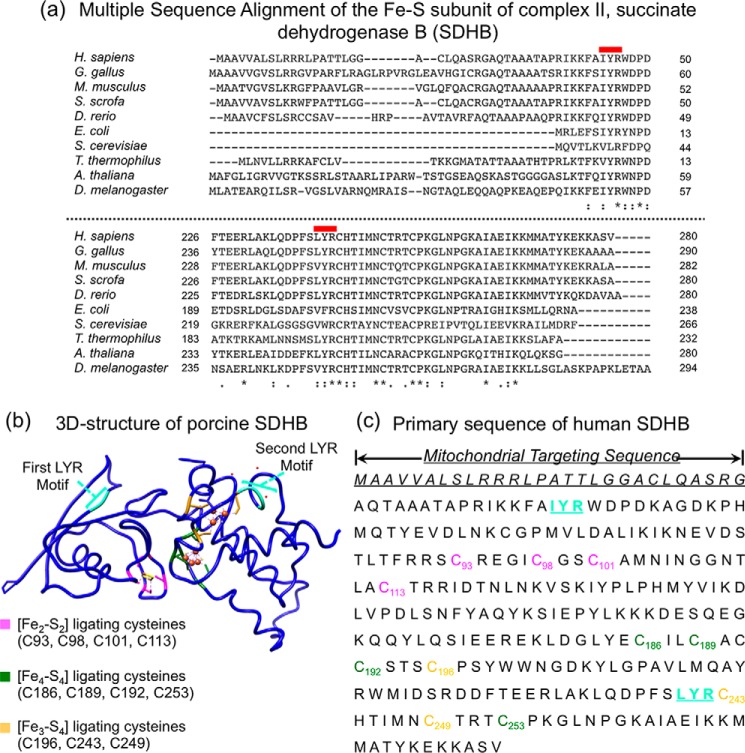
SDHB contains two highly conserved LYR motifs that are essential for Fe-S cluster incorporation. a, multiple sequence alignment of the Fe-S subunit of complex II, SDHB. The two LYR motifs that engage the Fe-S transfer complex are highly conserved in human, yeast, plants, and bacteria. b, ribbon representation of the three-dimensional structure of porcine SDHB (Protein Data Bank code 3SFD, 96% identical to human) and primary sequence of human SDHB (c). The two LYR motifs are shown in cyan. The cysteine residues that coordinate the [Fe2-S2] cluster are in magenta, and the ligands of [Fe4-S4] and of [Fe3-S4] clusters are shown in green and yellow, respectively.
Figure 4.
Figure 4.
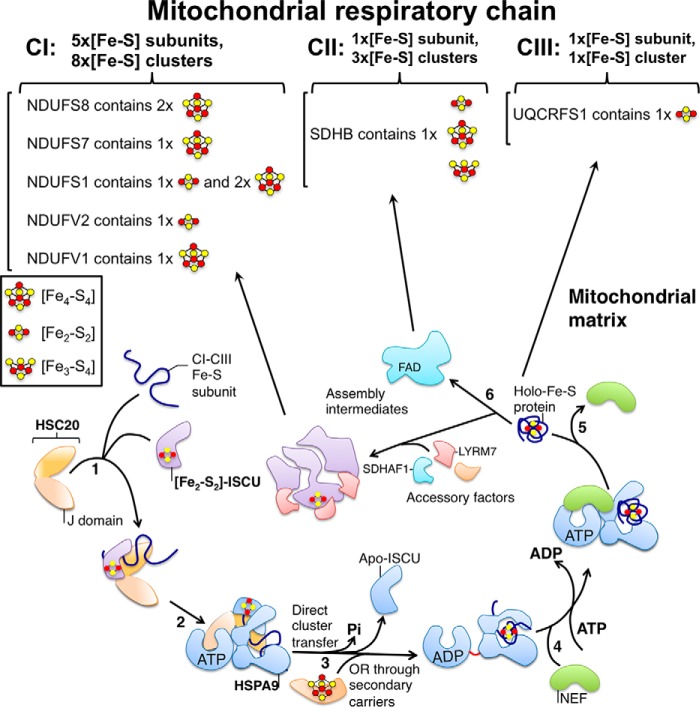
Single adaptable cochaperone scaffold complex delivers nascent Fe-S clusters to mammalian respiratory chain complexes I–III. HSC20 binds the main scaffold protein ISCU and a recipient Fe-S cluster-ligating subunit of complexes I–III of the respiratory chain (step 1). The transient interaction of the J-domain of HSC20 with the nucleotide-binding domain of HSPA9 activates the ATPase activity of the chaperone (step 2). The hydrolysis of ATP is coupled to a conformational change in HSPA9, which is proposed to facilitate cluster release from ISCU and transfer to the recipient protein (step 3). Secondary carriers such as ISCA1/2, NFU1, may also mediate or facilitate transfer of Fe-S clusters from ISCU to Fe-S clients (step 3). NEF, which has high affinity for the ADP-bound state of HSPA9, exchanges ADP with ATP (step 4). The Fe-S protein, which has folded into the native conformation driven by the energy provided by hydrolysis of ATP, and has acquired its Fe-S cluster, is released from the transfer complex (steps 5 and 6). As the biogenesis of the mitochondrial OXPHOS system is a modular and complex process, the newly synthesized Fe-S subunits of complexes I–III likely interact with accessory factors, which coordinate the assembly of a large number of proteins into assembly intermediates, prior to their integration into functional respiratory complexes.

References

    1. Zahringer J., Baliga B. S., and Munro H. N. (1979) Relative abundance of specific messenger-RNA species in the free mRNP fraction of rat liver. FEBS Lett. 108, 317–320 - PubMed
    1. Leibold E. A., Aziz N., Brown A. J., and Munro H. N. (1984) Conservation in rat liver of light and heavy subunit sequences of mammalian ferritin. Presence of unique octopeptide in the light subunit. J. Biol. Chem. 259, 4327–4334 - PubMed
    1. Hentze M. W., Caughman S. W., Rouault T. A., Barriocanal J. G., Dancis A., Harford J. B., and Klausner R. D. (1987) Identification of the iron-responsive element for the translational regulation of human ferritin mRNA. Science 238, 1570–1573 - PubMed
    1. Leibold E. A., and Munro H. N. (1988) Cytoplasmic protein binds in vitro to a highly conserved sequence in the 5′ untranslated region of ferritin heavy- and light-subunit mRNAs. Proc. Natl. Acad. Sci. U.S.A. 85, 2171–2175 - PMC - PubMed
    1. Rouault T. A., Tang C. K., Kaptain S., Burgess W. H., Haile D. J., Samaniego F., McBride O. W., Harford J. B., and Klausner R. D. (1990) Cloning of the cDNA encoding an RNA regulatory protein–the human iron-responsive element-binding protein. Proc. Natl. Acad. Sci. U.S.A. 87, 7958–7962 - PMC - PubMed

MeSH terms

Associated data