Review
. 2017 Jul 28;292(30):12375-12382.
doi: 10.1074/jbc.R116.760884. Epub 2017 Jun 14.

Long non-coding RNAs (lncRNAs) and their transcriptional control of inflammatory responses

Affiliations
Review

Long non-coding RNAs (lncRNAs) and their transcriptional control of inflammatory responses

Nicholas W Mathy et al. J Biol Chem. .

Abstract

Long non-coding RNAs (lncRNAs) have emerged as potential key regulators of the inflammatory response, particularly by modulating the transcriptional control of inflammatory genes. lncRNAs may act as an enhancer or suppressor to inflammatory transcription, function as scaffold molecules through interactions with RNA-binding proteins in chromatin remodeling complexes, and modulate dynamic and epigenetic control of inflammatory transcription in a gene-specific and time-dependent fashion. Here, we will review recent literature regarding the role of lncRNAs in transcriptional control of inflammatory responses. Better understanding of lncRNA regulation of inflammation will provide novel targets for the development of new therapeutic strategies.

Keywords: NF-κB; chromatin remodeling; epigenetics; inflammation; long noncoding RNA (long ncRNA, lncRNA); toll-like receptor (TLR); transcription regulation.


Conflict of interest statement

The authors declare that they have no conflicts of interest with the contents of this article

Figures
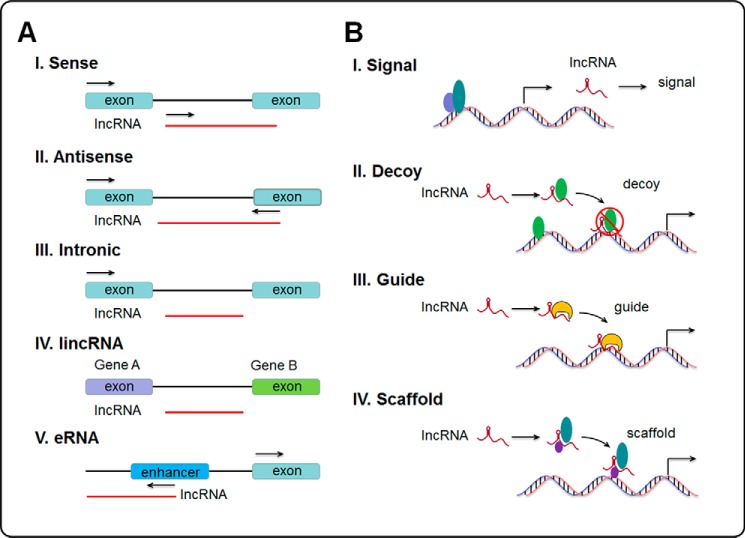
Figure 1.
Figure 1.
General classification of lncRNAs and their functional models in transcriptional control. A, classification of lncRNAs into five classes: exonic sense, intronic sense, antisense, bidirectional and intergenic, based upon their genomic locations and transcription (35). B, functional models of transcriptional control. lncRNAs may act as signals, decoys, guides or scaffolds to modulate gene expression at the transcriptional level (36).
Figure 2.
Figure 2.
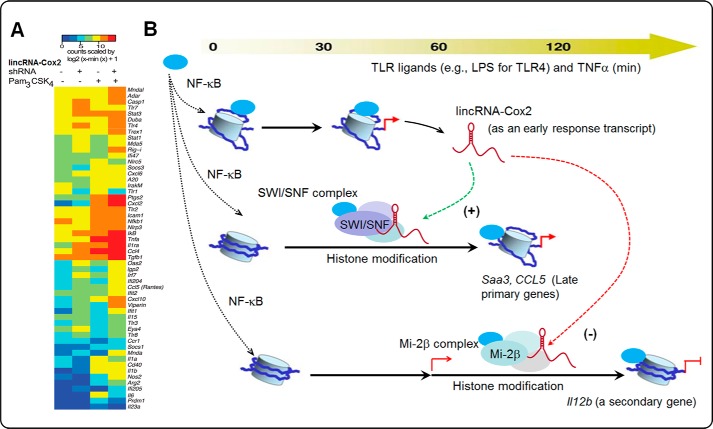
Control of inflammatory response gene expression by lincRNA-Cox2. A, heat map representation of differentially regulated genes performed on RNA extracted from control or lincRNA-Cox2 shRNA knockdown mouse bone marrow-derived macrophages stimulated with Pam3CSK4 (a TLR2 ligand) for 5 h, based on the work of Carpenter et al. (30). B, lincRNA-Cox2 is an early NF-κB response gene. Upon induction, lincRNA-Cox2 is assembled into the SWI/SNF complex in macrophages in response to LPS stimulation. This resulting lincRNA-Cox2–SWI/SNF complex can modulate SWI/SNF-associated chromatin remodeling and, consequently, transcription of late primary response genes (e.g. Saa3 and Ccl5) in cells following LPS stimulation or microbial challenge (57). In addition, lincRNA-Cox2 can be assembled into the Mi-2–NuRD complex and subsequently recruited to the Il12b gene locus (a secondary response gene), resulting in trans-suppression through histone modification-mediated epigenetic mechanisms (61).
Figure 3.
Figure 3.
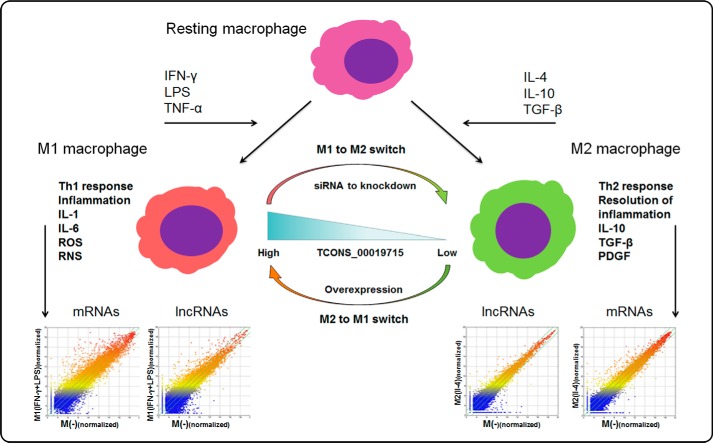
lncRNAs in M1 and M2 macrophage activation. Upon activation, resting macrophages can be activated into one of two functionally different states: the classically activated macrophage (M1, by IFN-γ, or LPS) or an alternatively activated macrophage (M2, by IL-4 or IL-10). Genome-wide analysis reveals differentiated lncRNA expression profiles of both mRNAs and lncRNAs in M1 (IFN-γ + LPS) and M2 (IL-4) macrophages (human monocyte-derived macrophages). Scatter plots show the variation in lncRNA and mRNA expression levels between the M1 (IFN-γ + LPS) and M2 (IL-4) and non-stimulated macrophages, based on the work of Huang et al. (66). TCONS_00019715 is expressed at a high level in M1 macrophages versus a lower level in M2 macrophages. Overexpression or knockdown of TCONS_00019715 causes reciprocal macrophage switch (66).

References

    1. Pawate S., Shen Q., Fan F., and Bhat N. R. (2004) Redox regulation of glial inflammatory response to lipopolysaccharide and interferon γ. J. Neurosci. Res. 77, 540–551 - PubMed
    1. Jung Y. J., Isaacs J. S., Lee S., Trepel J., and Neckers L. (2003) IL-1β-mediated up-regulation of HIF-1α via an NFκB/COX-2 pathway identifies HIF-1 as a critical link between inflammation and oncogenesis. FASEB J. 17, 2115–2117 - PubMed
    1. Adhikari A., Xu M., and Chen Z. J. (2007) Ubiquitin-mediated activation of TAK1 and IKK. Oncogene 26, 3214–3226 - PubMed
    1. Qin H., Wilson C. A., Lee S. J., Zhao X., and Benveniste E. N. (2005) LPS induces CD40 gene expression through the activation of NF-κB and STAT-1α in macrophages and microglia. Blood 106, 3114–3122 - PMC - PubMed
    1. Fitzgerald D. C., Meade K. G., McEvoy A. N., Lillis L., Murphy E. P., MacHugh D. E., and Baird A. W. (2007) Tumour necrosis factor-α (TNF-α) increases nuclear factor κB (NFκB) activity in and interleukin-8 (IL-8) release from bovine mammary epithelial cells. Vet. Immunol. Immunopathol. 116, 59–68 - PubMed

Publication types

Substances

LinkOut - more resources