


Guidelines for developing, translating, and validating a questionnaire in perioperative and pain medicine
- PMID: 28616007
- PMCID: PMC5463570
- DOI: 10.4103/sja.SJA_203_17
Guidelines for developing, translating, and validating a questionnaire in perioperative and pain medicine
Abstract
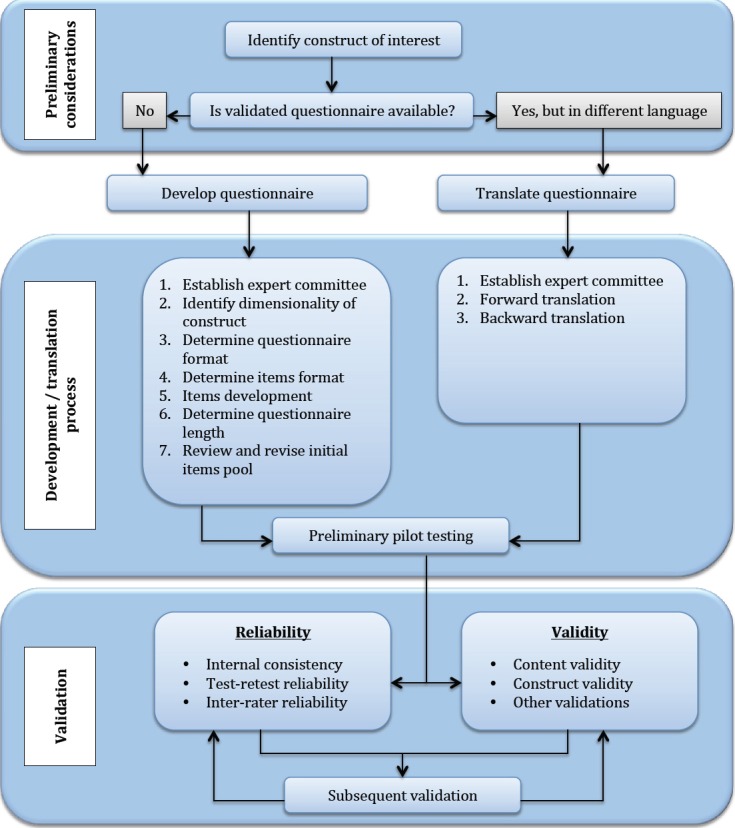
The task of developing a new questionnaire or translating an existing questionnaire into a different language might be overwhelming. The greatest challenge perhaps is to come up with a questionnaire that is psychometrically sound, and is efficient and effective for use in research and clinical settings. This article provides guidelines for the development and translation of questionnaires for application in medical fields, with a special emphasis on perioperative and pain medicine. We provide a framework to guide researchers through the various stages of questionnaire development and translation. To ensure that the questionnaires are psychometrically sound, we present a number of statistical methods to assess the reliability and validity of the questionnaires.
Keywords: Anesthesia; development; questionnaires; translation; validation.
Conflict of interest statement
There are no conflicts of interest.
Figures
References
-
- Crocker L, Algina J. Introduction to Classical and Modern Test Theory. Mason, Ohio: Cengage Learning; 2008.
-
- Davis TC, Mayeaux EJ, Fredrickson D, Bocchini JA, Jr, Jackson RH, Murphy PW. Reading ability of parents compared with reading level of pediatric patient education materials. Pediatrics. 1994;93:460–8. - PubMed
-
- Bell A. Designing and testing questionnaires for children. J Res Nurs. 2007;12:461–9.
-
- Wong DL, Baker CM. Pain in children: Comparison of assessment scales. Okla Nurse. 1988;33:8. - PubMed
Publication types
Grants and funding
LinkOut - more resources
Full Text Sources
Other Literature Sources
Medical