


Effect of Pretreatment with Omega-3 Supplement on Cardiac Necrosis Markers in Chronic Kidney Disease Patients Undergoing Elective Percutaneous Coronary Intervention
- PMID: 28616432
- PMCID: PMC5463556
- DOI: 10.4103/jrpp.JRPP_17_24
Effect of Pretreatment with Omega-3 Supplement on Cardiac Necrosis Markers in Chronic Kidney Disease Patients Undergoing Elective Percutaneous Coronary Intervention
Abstract
Objective: Studies have demonstrated the direct relation between elevation in cardiac necrosis markers and increased risk of cardiovascular complications after percutaneous coronary intervention (PCI) in chronic kidney disease (CKD) patients. In this study, we sought to evaluate the effect of omega-3 on creatine kinase-MB (CK-MB) and troponin-I in CKD patients undergoing elective PCI.
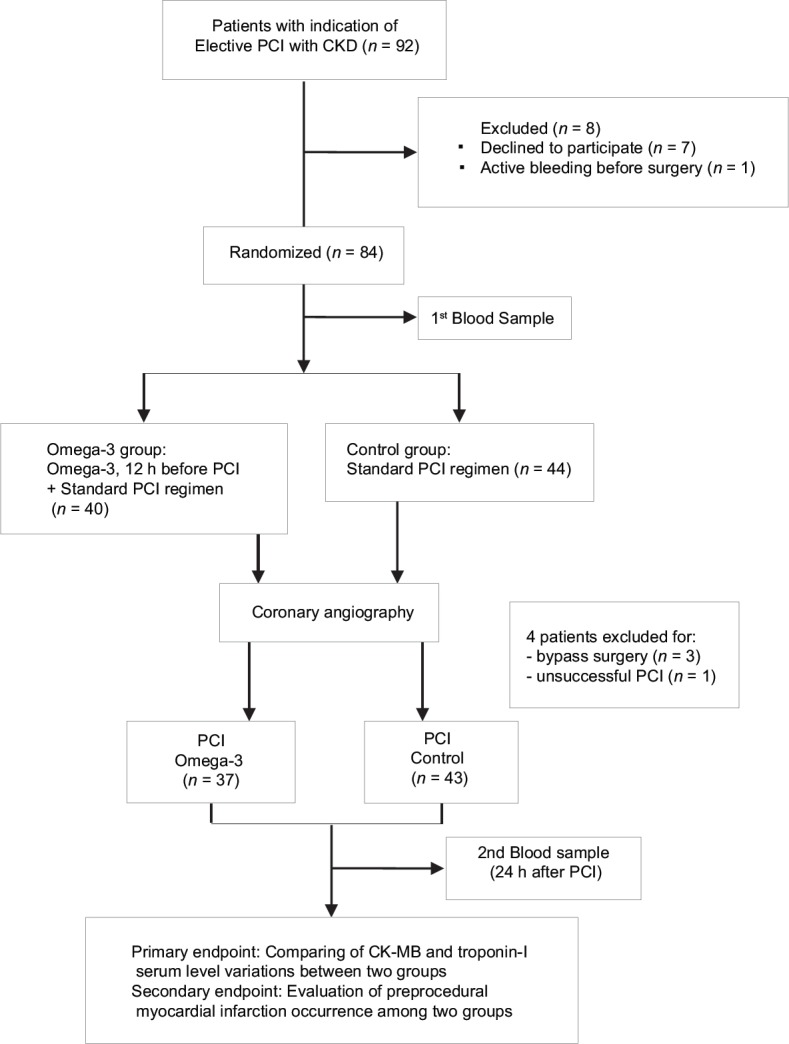
Methods: Eighty CKD patients, candidate for elective PCI, were randomly assigned into two groups: Group A - receiving omega-3 (2.5 g, 12 h before PCI) plus standard treatment (n = 37) and Group B - control group, receiving only standard therapy (aspirin 325 mg and clopidogrel 600 mg loading dose and weight-adjusted intravenous heparin) (n = 43). Blood samples were collected before and 24 h after PCI for measuring CK-MB and troponin-I. The primary endpoint was considered to be postprocedural variations of CK-MB and troponin-I levels in both groups. The secondary endpoint was the percentage of pre-procedural myocardial infarction (PMI) occurrence, defined as the elevation of post-PCI troponin-I, between study groups.
Findings: Both the baseline and 24-h CK-MB were significantly higher in omega-3 group. Although 24-h troponin-I increased less in omega-3-treated arm compared to the control group, no statistically significant variation was observed between the two groups. With regard to PMI occurrence, no significant difference was detected among study groups.
Conclusion: Despite the beneficial but nonsignificant effects of omega-3 on decreasing post-PCI elevation of troponin-I and PMI occurrence, further investigations with bigger study population, higher doses of omega-3 and longer duration of treatment, and long-term follow-up of patients are required to better test the potential effects of omega-3 in improving clinical outcomes in CKD patients undergoing PCI.
Keywords: Chronic kidney disease; creatine kinase-MB; omega-3 fatty acids; percutaneous coronary intervention; preprocedural myocardial infarction; troponin-I.
Conflict of interest statement
There are no conflicts of interest.
Figures
References
-
- Coats WC, Dellsperger KC. Advances in percutaneous coronary intervention in patients with chronic kidney disease. Adv Perit Dial. 2010;26:42–6. - PubMed
-
- Edwards NC, Steeds RP, Ferro CJ, Townend JN. The treatment of coronary artery disease in patients with chronic kidney disease. QJM. 2006;99:723–36. - PubMed
-
- Gruberg L, Mehran R, Waksman R, Dangas G, Fuchs S, Wu H, et al. Creatine kinase-MB fraction elevation after percutaneous coronary intervention in patients with chronic renal failure. Am J Cardiol. 2001;87:1356–60. - PubMed
-
- Jeong YH, Hong MK, Lee CW, Park DW, Kim YH, Kim JJ, et al. Impact of significant chronic kidney disease on long-term clinical outcomes after drug-eluting stent versus bare metal stent implantation. Int J Cardiol. 2008;125:36–40. - PubMed
-
- Selvanayagam JB, Porto I, Channon K, Petersen SE, Francis JM, Neubauer S, et al. Troponin elevation after percutaneous coronary intervention directly represents the extent of irreversible myocardial injury: Insights from cardiovascular magnetic resonance imaging. Circulation. 2005;111:1027–32. - PubMed
LinkOut - more resources
Full Text Sources
Other Literature Sources
Research Materials
Miscellaneous