Review
. 2015 Sep 13:1:49-59.
doi: 10.1016/j.onehlt.2015.09.002. eCollection 2015 Dec.

Cross-species transmission of canine distemper virus-an update

Affiliations
Review

Cross-species transmission of canine distemper virus-an update

Andreas Beineke et al. One Health. .

Abstract

Canine distemper virus (CDV) is a pantropic morbillivirus with a worldwide distribution, which causes fatal disease in dogs. Affected animals develop dyspnea, diarrhea, neurological signs and profound immunosuppression. Systemic CDV infection, resembling distemper in domestic dogs, can be found also in wild canids (e.g. wolves, foxes), procyonids (e.g. raccoons, kinkajous), ailurids (e.g. red pandas), ursids (e.g. black bears, giant pandas), mustelids (e.g. ferrets, minks), viverrids (e.g. civets, genets), hyaenids (e.g. spotted hyenas), and large felids (e.g. lions, tigers). Furthermore, besides infection with the closely related phocine distemper virus, seals can become infected by CDV. In some CDV outbreaks including the mass mortalities among Baikal and Caspian seals and large felids in the Serengeti Park, terrestrial carnivores including dogs and wolves have been suspected as vectors for the infectious agent. In addition, lethal infections have been described in non-carnivore species such as peccaries and non-human primates demonstrating the remarkable ability of the pathogen to cross species barriers. Mutations affecting the CDV H protein required for virus attachment to host-cell receptors are associated with virulence and disease emergence in novel host species. The broad and expanding host range of CDV and its maintenance within wildlife reservoir hosts considerably hampers disease eradication.

Keywords: Canine distemper virus; Carnivores; H protein; Human health risk; Spillover.


Figures
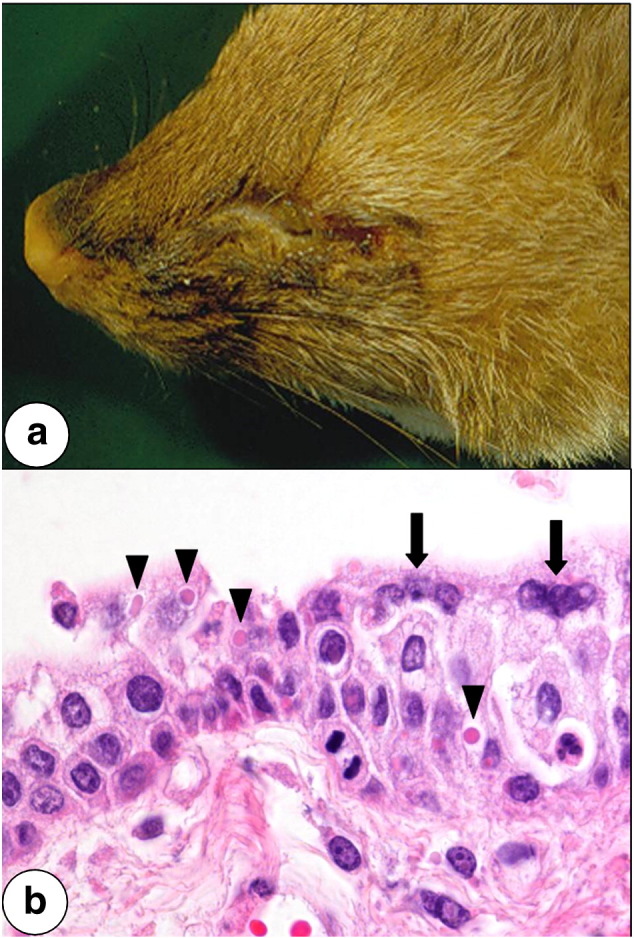
Fig. 1
Fig. 1
Canine distemper virus infection in a marten. a) Severe muco-suppurative conjunctivitis; b) Conjunctiva with epithelial syncytial cells (arrows) and cytoplasmic eosinophilic viral inclusion bodies (arrowheads); hematoxylin–eosin, magnification × 600.
Fig. 2
Fig. 2
Encephalitis in a badger following canine distemper virus (CDV) infection. a) Intranuclear (arrow) and cytoplasmic eosinophilic viral inclusion bodies in neurons of the cerebral cortex; hematoxylin–eosin, magnification × 1000; b) Immunolabeling of CDV antigen in the nucleus (arrow) and neuronal cytoplasmic process (arrowhead); avidin–biotin–peroxidase complex method; hematoxylin counterstain; magnification × 600.
Fig. 3
Fig. 3
Lymphoid depletion in wildlife species following canine distemper virus (CDV) infection. a) Severe hypocellularity (asterisk) of the splenic white pulp in a CDV-infected marten; A = central artery; hematoxylin–eosin, magnification × 200; b) Detection of CDV antigen in a splenic follicle of a raccoon by immunohistochemistry; A = central artery; avidin–biotin–peroxidase complex method; hematoxylin counterstain; magnification × 400.
Fig. 4
Fig. 4
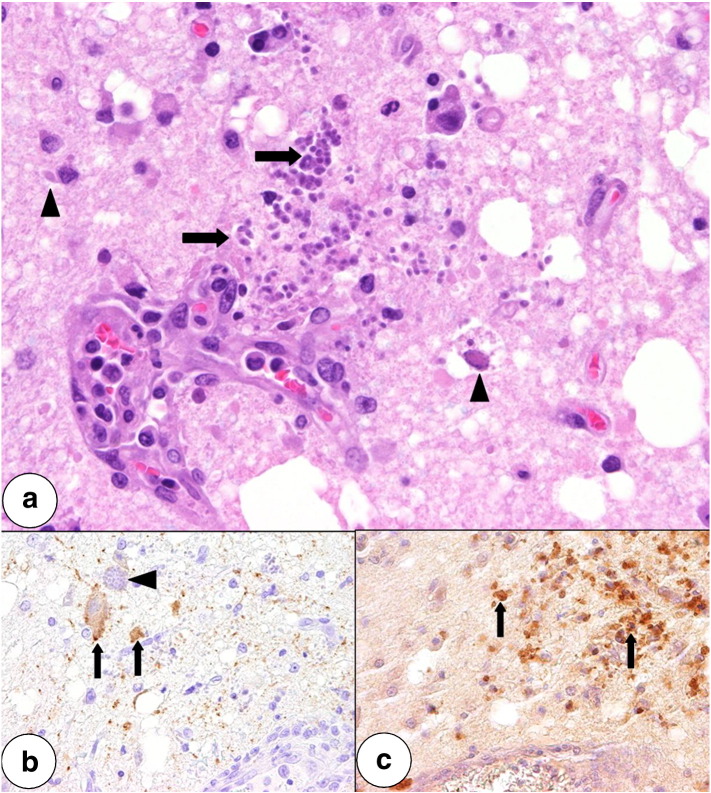
Concurrent toxoplasmosis in a marten infected with canine distemper virus (CDV). a) lympho-histiocytic encephalitis with numerous protozoal tachyzoites (arrows) and intranuclear eosinophilic viral inclusion bodies (arrowheads); hematoxylin–eosin, magnification × 400; b) Immunolabeling of CDV antigen in neurons and glial cells (arrows); note accumulation of protozoal tachyzoites (arrowhead); avidin–biotin–peroxidase complex method; hematoxylin counterstain; magnification × 400; c) Immunolabeling of Toxoplasma gondii antigen (arrows); avidin–biotin–peroxidase complex method; hematoxylin counterstain; magnification × 400.
Fig. 5
Fig. 5
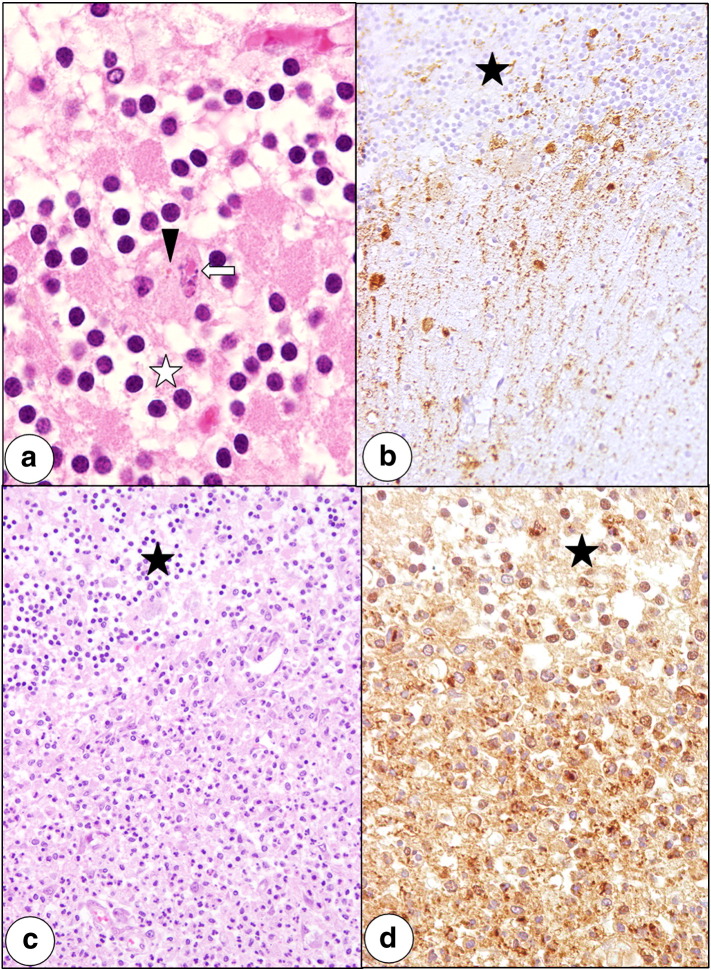
Bacterial co-infection in a canine distemper virus (CDV) infected badger. a) Intranuclear (arrow) and cytoplasmic (arrowhead) inclusion bodies in the granular layer (asterisk) of the cerebellum; hematoxylin–eosin, magnification × 600; b) Immunohistochemical labeling of CDV antigen in the cerebellum; asterisk = granular layer; avidin–biotin–peroxidase complex method; hematoxylin counterstain; magnification × 200 c) Severe suppurative encephalitis in the cerebellar white matter; asterisk = granular layer; hematoxylin–eosin, magnification × 200; d) Demonstration of intralesional Listeria monocytogenes antigen by immunohistochemistry; asterisk = granular layer; avidin–biotin–peroxidase complex method; hematoxylin counterstain; magnification × 400.
Fig. 6
Fig. 6
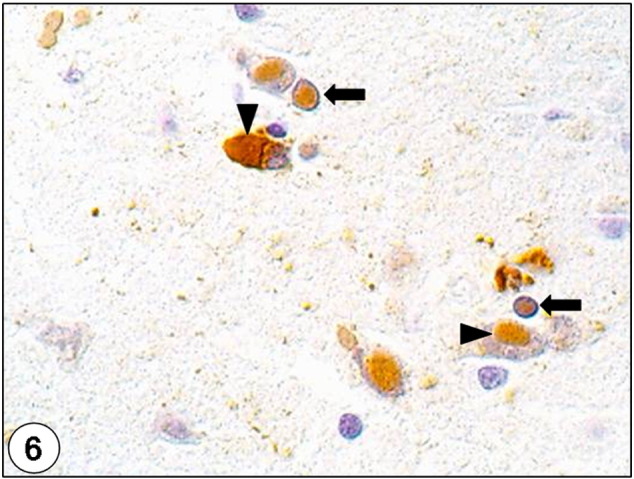
Canine distemper virus infection in a spotted hyena from the Serengeti National Park; demonstration of viral antigen in nuclei (arrows) and cytoplasm (arrowheads) of neuronal and glial cells of the brain by immunohistochemistry. Peroxidase-antiperoxidase technique; hematoxylin counterstain; magnification × 600.

References

    1. Barrett T. Morbillivirus infections, with special emphasis on morbilliviruses of carnivores. Vet. Microbiol. 1999;69:3–13. - PubMed
    1. Osterhaus A.D., Groen J., Spijkers H.E., Broeders H.W., UytdeHaag F.G., de Vries P., Teppema J.S., Visser I.K., van de Bildt M.W., Vedder E.J. Mass mortality in seals caused by a newly discovered morbillivirus. Vet. Microbiol. 1990;23:343–350. - PubMed
    1. Beineke A., Puff C., Seehusen F., Baumgärtner W. Pathogenesis and immunopathology of systemic and nervous canine distemper. Vet. Immunol. Immunopathol. 2009;127:1–18. - PubMed
    1. Orvell C. Structural polypeptides of canine distemper virus. Arch. Virol. 1980;66:193–206. - PubMed
    1. Lempp C., Spitzbarth I., Puff C., Cana A., Kegler K., Techangamsuwan S., Baumgärtner W., Seehusen F. New aspects of the pathogenesis of canine distemper leukoencephalitis. Viruses. 2014;6:2571–2601. - PMC - PubMed

LinkOut - more resources