. 2015 Oct 24:1:66-75.
doi: 10.1016/j.onehlt.2015.10.001. eCollection 2015 Dec.

Primate malarias: Diversity, distribution and insights for zoonotic Plasmodium

Affiliations

Primate malarias: Diversity, distribution and insights for zoonotic Plasmodium

Christina Faust et al. One Health. .

Abstract

Protozoans within the genus Plasmodium are well-known as the causative agents of malaria in humans. Numerous Plasmodium species parasites also infect a wide range of non-human primate hosts in tropical and sub-tropical regions worldwide. Studying this diversity can provide critical insight into our understanding of human malarias, as several human malaria species are a result of host switches from non-human primates. Current spillover of a monkey malaria, Plasmodium knowlesi, in Southeast Asia highlights the permeability of species barriers in Plasmodium. Also recently, surveys of apes in Africa uncovered a previously undescribed diversity of Plasmodium in chimpanzees and gorillas. Therefore, we carried out a meta-analysis to quantify the global distribution, host range, and diversity of known non-human primate malaria species. We used published records of Plasmodium parasites found in non-human primates to estimate the total diversity of non-human primate malarias globally. We estimate that at least three undescribed primate malaria species exist in sampled primates, and many more likely exist in unstudied species. The diversity of malaria parasites is especially uncertain in regions of low sampling such as Madagascar, and taxonomic groups such as African Old World Monkeys and gibbons. Presence-absence data of malaria across primates enables us to highlight the close association of forested regions and non-human primate malarias. This distribution potentially reflects a long coevolution of primates, forest-adapted mosquitoes, and malaria parasites. The diversity and distribution of primate malaria are an essential prerequisite to understanding the mechanisms and circumstances that allow Plasmodium to jump species barriers, both in the evolution of malaria parasites and current cases of spillover into humans.

Keywords: Malaria richness; Plasmodium knowlesi; Primates; Species richness estimates; Spillover; Zoonosis.


Figures
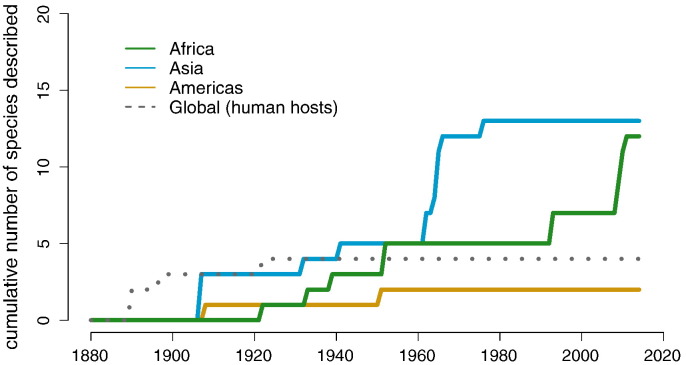
Fig. 1
Fig. 1
Discovery of primate Plasmodium species. Colored lines are used to indicate geographic regions where the parasites are endemic. Aside from human malarias (‘Global’), all primate malarias are restricted to the region in which they were described. We included parasites in Table A.1 that have been morphologically described by at least two groups or belong to the Laverania clade (see Methods for distinction of species). The last reviews of primate malarias were conducted in 1933 , 1941 , 1966 , and 1971 . Fooden also reviewed Macaca literature in 1994. The dataset gathered here nearly doubles the number of individuals examined in previous reviews and presents the most updated taxonomic distinctions. (For interpretation of the references to color in this figure legend, the reader is referred to the web version of this article.).
Fig. 2
Fig. 2
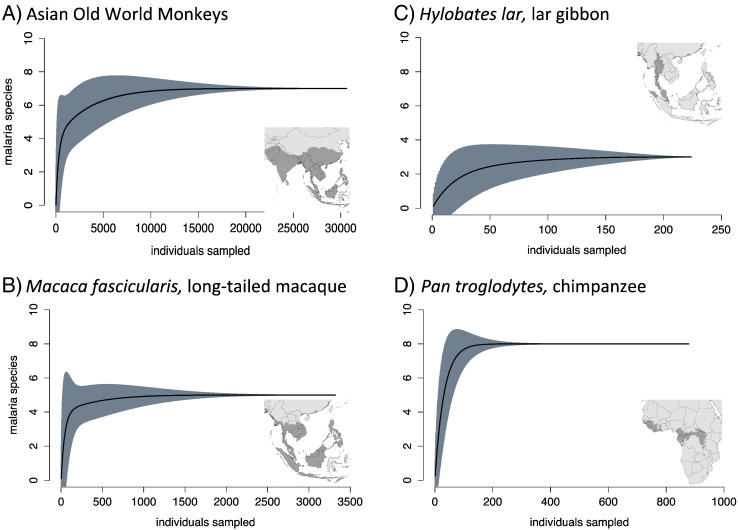
Species accumulation curves for parasites of well-sampled primate hosts and groups. Although Asian Old World Monkeys may yet have undiscovered species in unsampled primate species, the sampled hosts are well covered (A), this includes several individual species theat have been well-sampled, such as Macaca fascicularis (B). Several ape parasite accumulation curves saturate, i.e. Hylobates lar (C), but potentially overlapping species identities among Pan troglodytes underscores that more sampling needs to be done to marry molecular and morphological surveys (D).
Fig. 3
Fig. 3
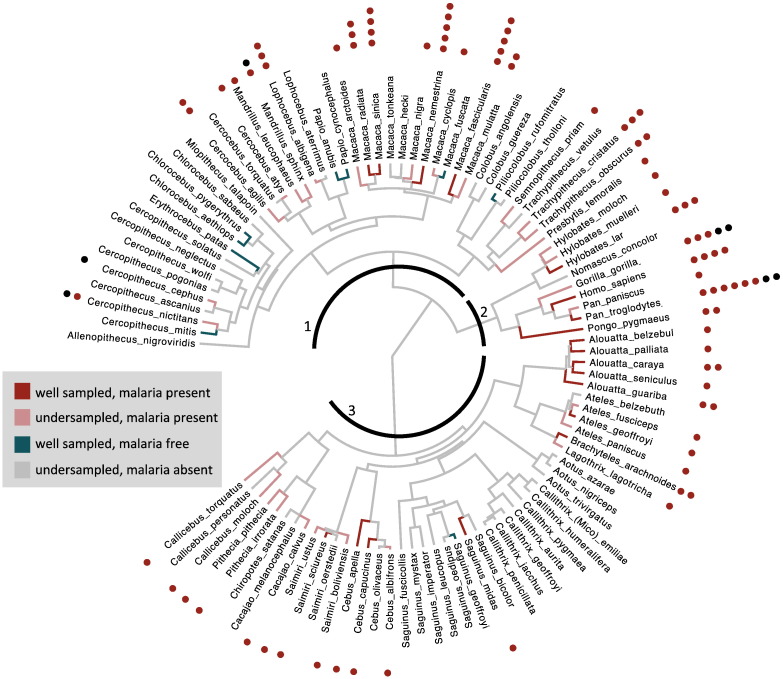
Simian phylogeny with malaria parasite sampling effort. Phylogeny truncated from 10K Trees and includes Old World Monkeys (1), apes (2), and New World Monkeys (3). (Fig. A1 includes prosimians too). Dark red edges are well-sampled primates with malaria, light red edges are undersampled species that have been found with malaria parasites, and gray edges are species that have been sampled but have not been found with malaria parasites. Species that are not infected with Plasmodium in the wild are highlighted in blue (see also Fig. A.2). The number of morphologically described Plasmodium species in each primate are given by the red circles next to the species name, whereas molecularly described are represented by black circles. (For interpretation of the references to color in this figure legend, the reader is referred to the web version of this article.).
Fig. 4
Fig. 4
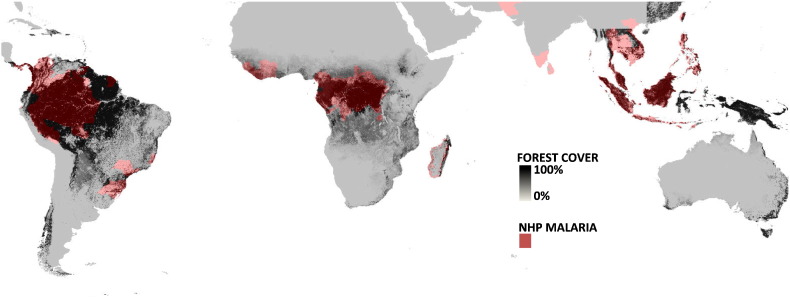
Global distribution and prevalence of NHP malarias. Global distribution of the ranges of susceptible primate species to Plasmodium and the countries and states in which they have been found infected. The map is overlaid with the percentage forest cover, data on coverage is from Hansen et al. .
Fig. 5
Fig. 5
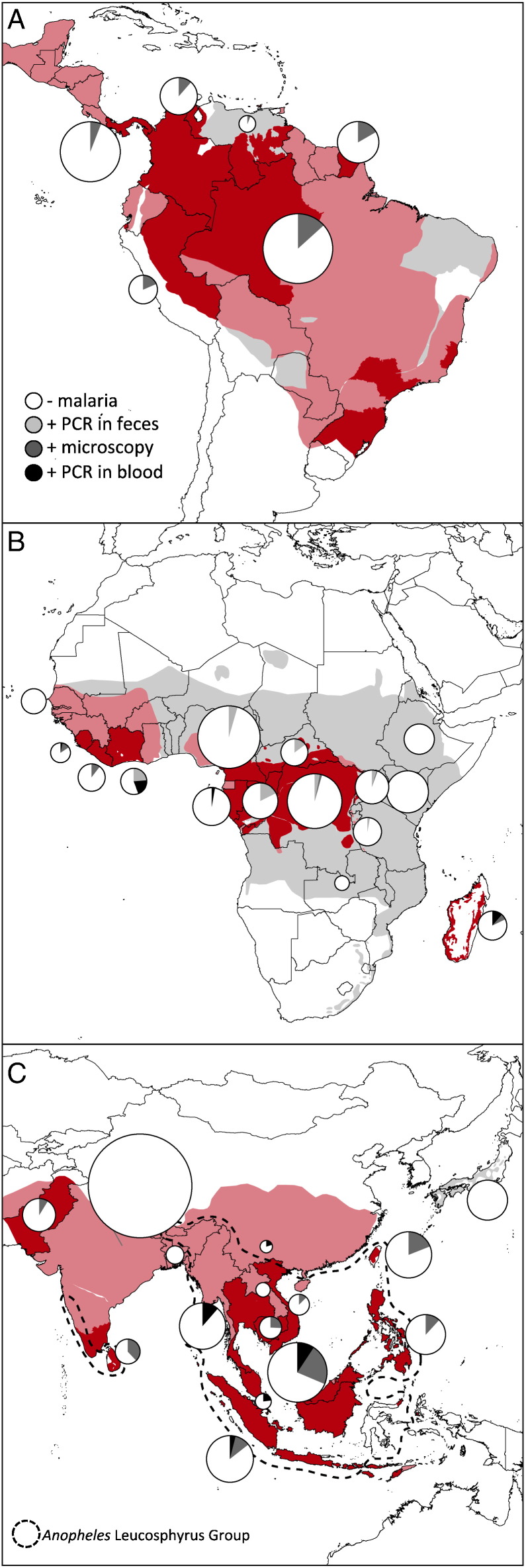
Prevalence of primate malarias by region. Dark red shading indicates the intersection of countries where simian malaria has been recorded and the range of natural primate hosts, whereas light red areas include primates ranges that can be infected with malaria in other parts of their range but have not been found infected (or sampled) in the location (species ranges, [47]). Gray shading indicates ranges of primates that have been sampled for malaria but have never been found infected in any part of their range. All known surveys of simian malaria were pooled into countries for the Americas (A), Africa (B), and Asia (C). Non-white portions of pie charts represent proportion infected and reflect sampling method — microscopy (dark gray) or PCR-based methods in blood (black) or fecal (light gray) samples. Size of pie charts is scaled by the square root of the total sample size from the county. The range of Anopheles Leucosphyrus group of vectors is shown in Asia (C).

References

    1. World Health O . World Health Organization; Geneva: 2014. World Malaria Report 2014 — Full Report; pp. 1–242.
    1. Weatherall D.J., Clegg J.B. Inherited haemoglobin disorders: an increasing global health problem. Bull. World Health Organ. 2001;79:704–712. - PMC - PubMed
    1. Patrinos G.P. Improvements in the HbVar database of human hemoglobin variants and thalassemia mutations for population and sequence variation studies. Nucleic Acids Res. 2004;32:537D–541D. - PMC - PubMed
    1. Garnham P.C.C. Blackwell Scientific; Oxford, UK: 1966. Malaria Parasites and Other Haemosporidia.
    1. Telford S.R. CRC Press; 2009. Hemoparasites of the Reptilia.

LinkOut - more resources