. 2016 Mar 4:2:33-41.
doi: 10.1016/j.onehlt.2016.02.002. eCollection 2016 Dec.

Proteobacteria from the human skin microbiota: Species-level diversity and hypotheses

Affiliations

Proteobacteria from the human skin microbiota: Species-level diversity and hypotheses

C Cosseau et al. One Health. .

Abstract

The human skin microbiota is quantitatively dominated by Gram-positive bacteria, detected by both culture and metagenomics. However, metagenomics revealed a huge variety of Gram-negative taxa generally considered from environmental origin. For species affiliation of bacteria in skin microbiota, clones of 16S rRNA gene and colonies growing on diverse culture media were analyzed. Species-level identification was achieved for 81% of both clones and colonies. Fifty species distributed in 26 genera were identified by culture, mostly belonging to Actinobacteria and Firmicutes, while 45 species-level operational taxonomic units distributed in 30 genera were detected by sequencing, with a high diversity of Proteobacteria. This mixed approach allowed the detection of 100% of the genera forming the known core skin Gram-negative microbiota and 43% of the known diversity of Gram-negative genera in human skin. The orphan genera represented 50% of the current skin pan-microbiota. Improved culture conditions allowed the isolation of Roseomonas mucosa, Aurantimonas altamirensis and Agrobacterium tumefaciens strains from healthy skin. For proteobacterial species previously described in the environment, we proposed the existence of skin-specific ecotypes, which might play a role in the fine-tuning of skin homeostasis and opportunistic infections but also act as a shuttle between environmental and human microbial communities. Therefore, skin-associated proteobacteria deserve to be considered in the One-Health concept connecting human health to the health of animals and the environment.

Keywords: 16S rRNA gene; Culture; Proteobacteria; Skin microbiota; Species-level identification.


Figures
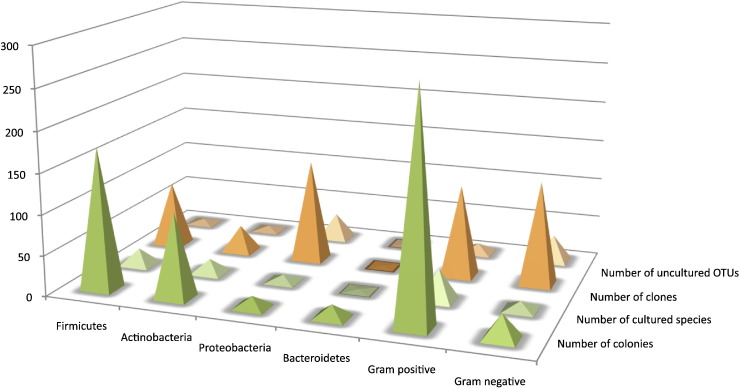
Fig. 1
Fig. 1
Bacterial diversity of the skin microbiota according to phylum and type of cell wall structure. Number of colonies and clones assessed the quantitative representation of each phylum. Number of cultured species and number of uncultured OTUs assessed the species diversity in each phylum.
Fig. 2
Fig. 2
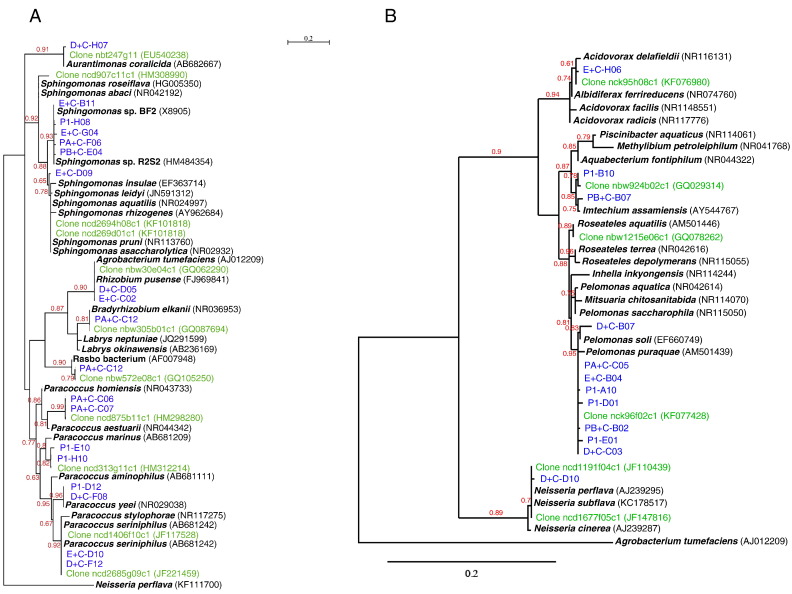
Phylogenetic tree showing the relationship of the 16S rRNA gene sequences. ML phylogenetic tree showing the 16S rRNA gene sequence relationships of the clones obtained in this study (in blue) with cultured and uncultured members of Alphaproteobacteria (A), Betaproteobacteria (B) and Gammaproteobacteria (C). The sequences used to reconstruct this tree were obtained from the GenBank database (accession numbers are indicated in brackets). Sequences from uncultured bacteria obtained from skin human samples were in green. Sequences of strains of validate species and some not validate but published species were in black bold type. Neisseria perflava was used as outgroup for Alphaproteobacteria, Agrobacterium tumefaciens C58 for Betaproteobacteria and Pelomonas aquatica for Gammaproteobacteria. The scale bar indicates substitutions per nucleotide position. Numbers given at the nodes represent bootstrap percentages.
Fig. 2
Fig. 2
Phylogenetic tree showing the relationship of the 16S rRNA gene sequences. ML phylogenetic tree showing the 16S rRNA gene sequence relationships of the clones obtained in this study (in blue) with cultured and uncultured members of Alphaproteobacteria (A), Betaproteobacteria (B) and Gammaproteobacteria (C). The sequences used to reconstruct this tree were obtained from the GenBank database (accession numbers are indicated in brackets). Sequences from uncultured bacteria obtained from skin human samples were in green. Sequences of strains of validate species and some not validate but published species were in black bold type. Neisseria perflava was used as outgroup for Alphaproteobacteria, Agrobacterium tumefaciens C58 for Betaproteobacteria and Pelomonas aquatica for Gammaproteobacteria. The scale bar indicates substitutions per nucleotide position. Numbers given at the nodes represent bootstrap percentages.

References

    1. NIH HMP Working Group, Peterson J., Garges S., Giovanni M., McInnes P., Wang L. The NIH Human Microbiome Project. Genome Res. 2009;19:2317–2323. - PMC - PubMed
    1. Human Microbium Project Consortium Structure, function and diversity of the healthy human microbiome. Nature. 2012;486:207-4. - PMC - PubMed
    1. McBride M.E., Duncan W.C., Knox J.M. The environment and the microbial ecology of human skin. Appl. Environ. Microbiol. 1977;33:603–608. - PMC - PubMed
    1. Fierer N., Hamady M., Lauber C.L., Knight R. The influence of sex, handedness, and washing on the diversity of hand surface bacteria. Proc. Natl. Acad. Sci. 2008;105:17994–17999. - PMC - PubMed
    1. Costello E.K., Lauber C.L., Hamady M., Fierer N., Gordon J.I., Knight R. Bacterial community variation in human body habitats across space and time. Science. 2009;326:1694–1697. - PMC - PubMed