Whole genome sequencing distinguishes between relapse and reinfection in recurrent leprosy cases
- PMID: 28617800
- PMCID: PMC5498066
- DOI: 10.1371/journal.pntd.0005598
Whole genome sequencing distinguishes between relapse and reinfection in recurrent leprosy cases
Abstract
Background: Since leprosy is both treated and controlled by multidrug therapy (MDT) it is important to monitor recurrent cases for drug resistance and to distinguish between relapse and reinfection as a means of assessing therapeutic efficacy. All three objectives can be reached with single nucleotide resolution using next generation sequencing and bioinformatics analysis of Mycobacterium leprae DNA present in human skin.
Methodology: DNA was isolated by means of optimized extraction and enrichment methods from samples from three recurrent cases in leprosy patients participating in an open-label, randomized, controlled clinical trial of uniform MDT in Brazil (U-MDT/CT-BR). Genome-wide sequencing of M. leprae was performed and the resultant sequence assemblies analyzed in silico.
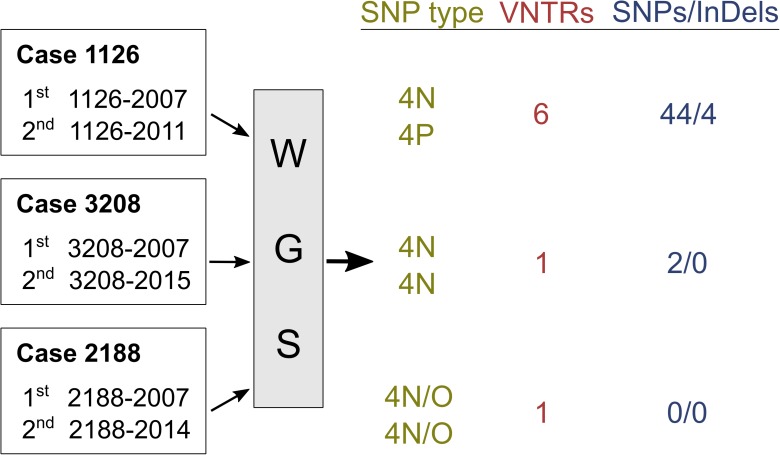
Principal findings: In all three cases, no mutations responsible for resistance to rifampicin, dapsone and ofloxacin were found, thus eliminating drug resistance as a possible cause of disease recurrence. However, sequence differences were detected between the strains from the first and second disease episodes in all three patients. In one case, clear evidence was obtained for reinfection with an unrelated strain whereas in the other two cases, relapse appeared more probable.
Conclusions/significance: This is the first report of using M. leprae whole genome sequencing to reveal that treated and cured leprosy patients who remain in endemic areas can be reinfected by another strain. Next generation sequencing can be applied reliably to M. leprae DNA extracted from biopsies to discriminate between cases of relapse and reinfection, thereby providing a powerful tool for evaluating different outcomes of therapeutic regimens and for following disease transmission.
Conflict of interest statement
The authors have declared that no competing interests exist.
Figures
References
-
- Britton WJ, Lockwood DN. Leprosy. Lancet. 2004;363(9416):1209–19. doi: 10.1016/S0140-6736(04)15952-7 - DOI - PubMed
-
- Han XY, Seo YH, Sizer KC, Schoberle T, May GS, Spencer JS, et al. A new Mycobacterium species causing diffuse lepromatous leprosy. Am J Clin Pathol. 2008;130(6):856–64. doi: 10.1309/AJCPP72FJZZRRVMM - DOI - PubMed
-
- WHO. Global leprosy update, 2014: need for early case detection. 2015. - PubMed
-
- WHO. Model Prescribing Information: Drugs Used in Leprosy. Geneva1998.
-
- Penna ML, Buhrer-Sekula S, Pontes MA, Cruz R, Goncalves Hde S, Penna GO. Primary results of clinical trial for uniform multidrug therapy for leprosy patients in Brazil (U-MDT/CT-BR): reactions frequency in multibacillary patients. Lepr Rev. 2012;83(3):308–19. . - PubMed
Publication types
MeSH terms
Substances
LinkOut - more resources
Full Text Sources
Other Literature Sources
Medical