


Increasing prevalence of infectious diseases in asylum seekers at a tertiary care hospital in Switzerland
- PMID: 28617860
- PMCID: PMC5472310
- DOI: 10.1371/journal.pone.0179537
Increasing prevalence of infectious diseases in asylum seekers at a tertiary care hospital in Switzerland
Abstract
Objective: The increasing number of refugees seeking asylum in Europe in recent years poses new challenges for the healthcare systems in the destination countries. The goal of the study was to describe the evolution of medical problems of asylum seekers at a tertiary care centre in Switzerland.
Methods: At the University Hospital Basel, we compared all asylum seekers during two 1-year time periods in 2004/05 and 2014/15 concerning demographic characteristics and reasons for referrals and hospitalizations.
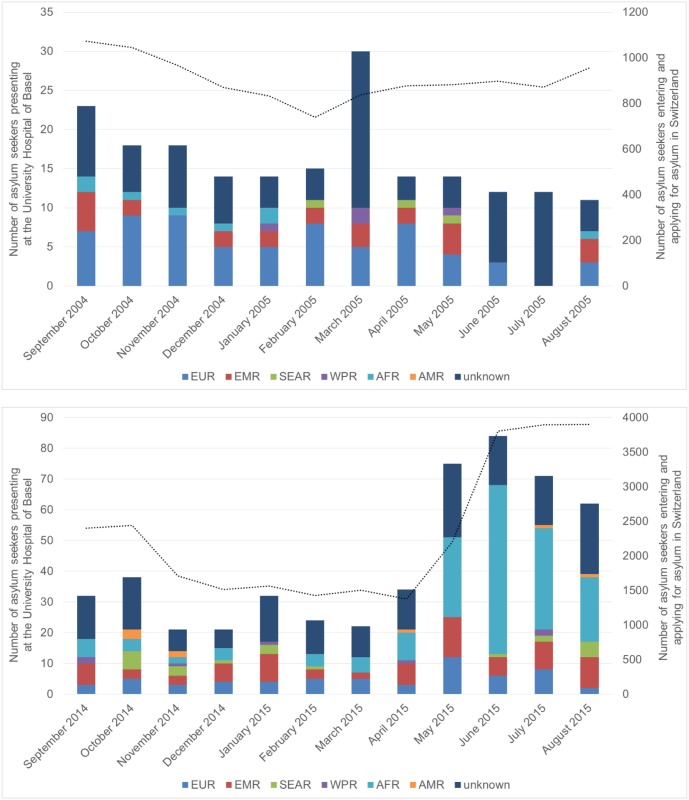
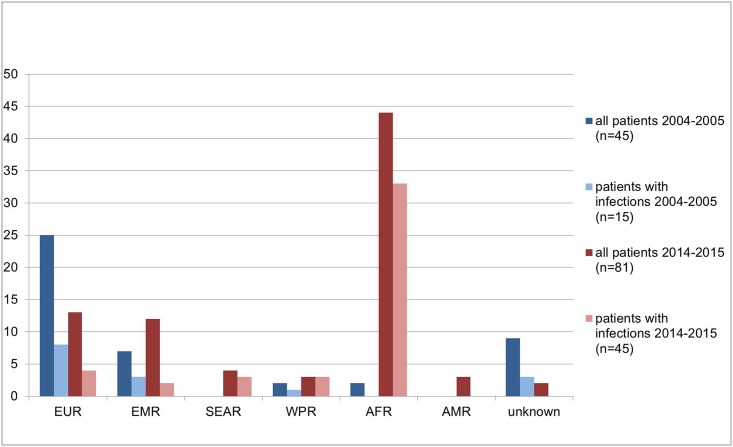
Results: Hundred ninety five of 2'544 and 516 of 6'243 asylum seekers registered at the national asylum reception and procedure centre Basel were referred to the University Hospital Basel in 2004/05 and 2014/15, and originated mainly from Europe (62.3%, mainly Turkey) and Africa (49.1%, mainly Eritrea), respectively. Median age was similar in both study periods (26.9 and 26.2 years). Infectious diseases in asylum seekers increased from 22.6% to 36.6% (p<0.001) and were the main reasons for hospitalizations (33.3% of 45 and 55.6% of 81 hospitalized patients, p = 0.017) in 2004/05 compared to 2014/15. The leading infectious diseases in hospitalized patients were tuberculosis (n = 4) and bacterial skin infections (n = 2) in 2004/05; Malaria (n = 9), pneumonia (n = 6), Chickenpox (n = 5), other viral infections (n = 5) and bacterial skin infections (n = 5) in 2014/15. Infectious diseases like malaria, cutaneous diphtheria, louseborne-relapsing fever or scabies were only found in the second study period. Almost one third of the admitted asylum seekers required isolation precautions with median duration of 6-9.5 days in both study periods.
Conclusions: The changing demography of asylum seekers arriving in Switzerland in the current refugee crisis has led to a shift in disease patterns with an increase of infectious diseases and the re-emergence of migration-associated neglected infections. Physicians should be aware of these new challenges.
Conflict of interest statement
Figures
References
-
- UNHCR (2015) Global Trends Forced Displacement in 2014. Geneva, Switzerland: United Nations High Commissioner for Refugees (UNHCR).
-
- SEM (2015) Faktenblatt: Aktuelle Lage, Resettlement und Relocation. Bern: Staatssekretariat für Migration SEM der Schweizerischen Eidgenossenschaft.
-
- BFS (2010) Personen im Asylprozess nach detailierter Staatsangehörigkeit 1995–2010. Bern: Bundesamt für Statistik BFS.
-
- SEM (2015) Asylstatistik 3. Quartal 2015. Bern: Staatssekretariat für Migration SEM.
-
- Clark RC, Mytton J (2007) Estimating infectious disease in UK asylum seekers and refugees: a systematic review of prevalence studies. Journal of Public Health 29: 420–428. doi: 10.1093/pubmed/fdm063 - DOI - PubMed
Publication types
MeSH terms
LinkOut - more resources
Full Text Sources
Other Literature Sources
Medical
