


Executive Functions, Memory, and Social Cognitive Deficits and Recovery in Chronic Alcoholism: A Critical Review to Inform Future Research
- PMID: 28618018
- PMCID: PMC5531758
- DOI: 10.1111/acer.13431
Executive Functions, Memory, and Social Cognitive Deficits and Recovery in Chronic Alcoholism: A Critical Review to Inform Future Research
Abstract
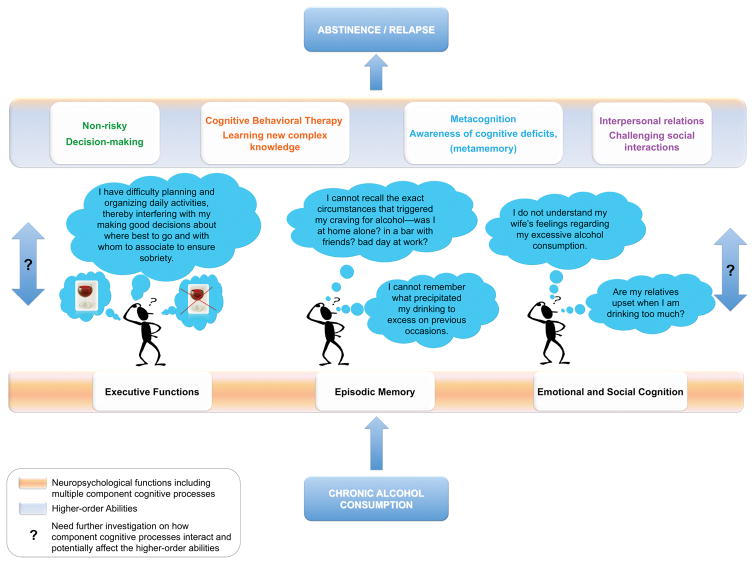
Alcoholism is a complex and dynamic disease, punctuated by periods of abstinence and relapse, and influenced by a multitude of vulnerability factors. Chronic excessive alcohol consumption is associated with cognitive deficits, ranging from mild to severe, in executive functions, memory, and metacognitive abilities, with associated impairment in emotional processes and social cognition. These deficits can compromise efforts in initiating and sustaining abstinence by hampering efficacy of clinical treatment and can obstruct efforts in enabling good decision making success in interpersonal/social interactions, and awareness of cognitive and behavioral dysfunctions. Despite evidence for differences in recovery levels of selective cognitive processes, certain deficits can persist even with prolonged sobriety. Herein is presented a review of alcohol-related cognitive impairments affecting component processes of executive functioning, memory, and the recently investigated cognitive domains of metamemory, social cognition, and emotional processing; also considered are trajectories of cognitive recovery with abstinence. Finally, in the spirit of critical review, limitations of current knowledge are noted and avenues for new research efforts are proposed that focus on (i) the interaction among emotion-cognition processes and identification of vulnerability factors contributing to the development of emotional and social processing deficits and (ii) the time line of cognitive recovery by tracking alcoholism's dynamic course of sobriety and relapse. Knowledge about the heterochronicity of cognitive recovery in alcoholism has the potential of indicating at which points during recovery intervention may be most beneficial.
Keywords: Abstinence; Alcoholism; Clinical Implications; Cognitive Impairment; Recovery.
Copyright © 2017 by the Research Society on Alcoholism.
Conflict of interest statement
None of the authors - Anne-Pascale Le Berre, Rosemary Fama, and Edith V. Sullivan - have conflicts of interest with the reported data or their interpretation.
Figures
References
-
- Alvarez JA, Emory E. Executive function and the frontal lobes: a meta-analytic review. Neuropsychol Rev. 2006;16:17–42. - PubMed
-
- Amenta S, Noel X, Verbanck P, Campanella S. Decoding of emotional components in complex communicative situations (irony) and its relation to empathic abilities in male chronic alcoholics: an issue for treatment. Alcohol Clin Exp Res. 2013;37:339–347. - PubMed
-
- Ando B, Must A, Kurgyis E, Szkaliczki A, Drotos G, Rozsa S, Szikszay P, Horvath S, Janka Z, Almos PZ. Personality traits and coping compensate for disadvantageous decision-making in long-term alcohol abstinence. Alcohol Alcohol. 2012;47:18–24. - PubMed
-
- Assanangkornchai S, Srisurapanont M. The treatment of alcohol dependence. Curr Opin Psychiatry. 2007;20:222–227. - PubMed
-
- Bates ME, Bowden SC, Barry D. Neurocognitive impairment associated with alcohol use disorders: implications for treatment. Exp Clin Psychopharmacol. 2002;10:193–212. - PubMed
Publication types
MeSH terms
Grants and funding
LinkOut - more resources
Full Text Sources
Other Literature Sources
Medical
