


Insomnia severity as a mediator of the association between mental health symptoms and alcohol use in young adult veterans
- PMID: 28618286
- PMCID: PMC5536856
- DOI: 10.1016/j.drugalcdep.2017.03.031
Insomnia severity as a mediator of the association between mental health symptoms and alcohol use in young adult veterans
Abstract
Purpose: Prior research has documented associations between mental health and alcohol use, mental health and insomnia, and insomnia and alcohol use. This study examined insomnia severity as a mediator of the association between mental health and alcohol-related outcomes in young adult veterans.
Procedures: Veterans aged 18-34 years (N=622, 83% male) who reported drinking in the past year completed assessments at baseline and one-month follow-up as part of a larger intervention trial. Participants reported symptoms of depression and posttraumatic stress disorder (PTSD) at baseline, insomnia severity at one month, and alcohol use and related consequences at baseline and one month. Mediation analyses using bootstrapped confidence intervals were used to examine the indirect effects of baseline mental health symptoms on alcohol-related outcomes at one month via insomnia severity.
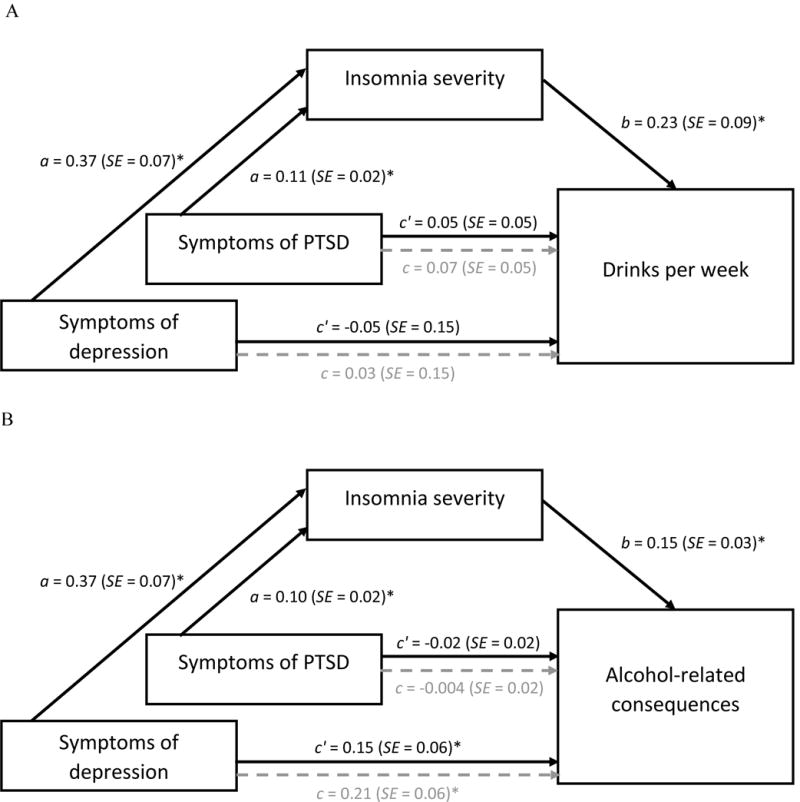
Main findings: Insomnia severity was associated with both drinking quantity and alcohol-related consequences. Greater depressive (but not PTSD) symptoms were associated directly with more alcohol-related consequences. Neither depressive nor PTSD symptoms had direct effects on drinking quantity when controlling for the other mental health symptoms (e.g., depressive symptoms did not predict drinking quantity when controlling for symptoms of PTSD). However, symptoms of depression and PTSD predicted drinks per week and alcohol-related consequences indirectly through insomnia severity.
Conclusions: Symptoms of depression and PTSD increase risk for alcohol use and related consequences in part by increasing symptoms of insomnia. Findings suggest that insomnia may be an appropriate target for prevention and intervention efforts among heavy-drinking Veterans reporting symptoms of depression or PTSD.
Keywords: Alcohol consequences; Depression; Posttraumatic stress; Sleep.
Copyright © 2017 Elsevier B.V. All rights reserved.
Conflict of interest statement
The authors have no conflicts of interest to report.
Figures
References
-
- Barlas FM, Higgins WB, Pflieger JC, Diecker K. 2011 Health Related Behaviors Survey of Active Duty Military Personnel. ICF International, Fairfax; 2013.
-
- Benitez A, Gunstad J. Poor sleep quality diminishes cognitive functioning independent of depression and anxiety in healthy young adults. Clin Neuropsychol. 2012;26:214–223. - PubMed
-
- Bovin MJ, Marx BP, Weathers FW, Gallagher MW, Rodriguez P, Schnurr PP, Keane TM. Psychometric properties of the PTSD Checklist for Diagnostic and Statistical Manual of Mental Disorders-Fifth Edition (PCL-5) in Veterans. Psychol Assess. 2016;28:1379–1391. - PubMed
-
- Bray RM. Substance use in the US active duty military. In: Moore BA, Barnett JE, Moore BA, Barnett JE, editors. Military psychologists’ desk reference. Oxford University Press; New York: 2013. pp. 221–226.
Publication types
MeSH terms
Grants and funding
LinkOut - more resources
Full Text Sources
Other Literature Sources
Medical
Miscellaneous
